32A vs 40A vs 48A EV Charger
Short answer
A 32 amp charger needs a 40 amp breaker and delivers 7.7 kW. A 40 amp charger needs a 50 amp breaker and delivers 9.6 kW. A 48 amp charger needs a 60 amp breaker and delivers 11.5 kW. Each step buys under two kilowatts, roughly six more miles of range per hour on an average crossover.
These three outputs cover almost every home installation done in North America. Thirty-two amps needs a 40 amp breaker and delivers 7.7 kW. Forty amps needs a 50 amp breaker and delivers 9.6 kW. Forty-eight amps needs a 60 amp breaker and delivers 11.5 kW. That is the whole ladder, and the total distance from the bottom rung to the top is 3.8 kW, which on an average crossover is about thirteen miles of range per hour. Each individual step buys under two kilowatts and roughly six miles per hour.
The recommendation for most households with capacity in the panel is to wire for 48 amps and buy the Emporia 48A at $449.00, because the conductor in the wall is the part you cannot revisit cheaply. The recommendation for a household whose car cannot use 11.5 kW, or whose panel is tight, is the Grizzl-E Classic 40A at $299.99, and it will not feel slower in daily use.
Wire for 48 A, settle for 40 A
Wire for this if you can
EMPORIA
Emporia Level 2 EV Charger, 48A J1772
$449.00
Forty-eight amps on a 60 amp circuit delivers 11.5 kW, which saturates the onboard AC charger in nearly every electric car sold. It is the right buy when the panel has the capacity and the car can use the output, because the incremental cost of the bigger circuit while an electrician is already in the garage is small compared with doing the job twice.
- Output
- 11.5 kW
- Continuous
- 48 A
- Circuit
- 60 A
- Copper
- 6 AWG
- Cable
- 25 ft
- Install
- Hardwired
Paid link. Price shown when researched.
What does each step actually buy you?
The code treats EV charging as a continuous load, so the circuit is sized at 125 percent of the charger's continuous output. Read the other direction, a breaker supports a charger drawing 80 percent of its rating. That single rule generates the entire table below, and it is why a 50 amp circuit gives you 40 amps of charging rather than 50.
| Charger output | Breaker | Power at 240 V | Typical copper | Where it fits |
|---|---|---|---|---|
| 32 A | 40 A | 7.7 kW | 8 AWG | Plenty for a car with a 6.6 or 7.2 kW onboard charger. |
| 40 A | 50 A | 9.6 kW | 6 AWG | The most common home install. Fits a NEMA 14-50 outlet. |
| 48 A | 60 A | 11.5 kW | 6 AWG | Hardwired only. Saturates almost every onboard charger sold. |
Two things in that table matter more than the kilowatt column. The first is that 40 amps and 48 amps often share the same 6 AWG copper, which means the conductor cost of stepping up is frequently zero and the argument for 48 amps gets much stronger. The second is the last row: 48 amps is hardwired only, because a NEMA 14-50 receptacle is rated 50 amps and therefore permits 40 amps continuous and no more. That is the real dividing line on this page, and it is covered in detail in hardwired versus plug-in.
Run your own numbers through the breaker size calculator before you talk to anybody, because the 125 percent rule is the single fact that most quotes get argued over and it takes ten seconds to settle.
How many miles per hour does each output add to your car?
Kilowatts are the honest unit and miles per hour is the one people plan around, so here is the ladder applied to real vehicles at their real onboard AC charger limits. The onboard charger is the limit, not the wall unit: the charger offers current and the car decides how much of it to take, and the lower number always wins.
| Vehicle | Onboard AC limit | 32 A, 7.7 kW | 40 A, 9.6 kW | 48 A, 11.5 kW | What the top of the ladder buys |
|---|---|---|---|---|---|
| Tesla Model Y | 11.5 kW | 30 mi/h | 37 mi/h | 45 mi/h | 15 miles per hour more at 48 A |
| Tesla Model 3 | 11.5 kW | 32 mi/h | 40 mi/h | 48 mi/h | 16 miles per hour more at 48 A |
| Tesla Cybertruck | 11.5 kW | 18 mi/h | 23 mi/h | 28 mi/h | 10 miles per hour more at 48 A |
| Ford F-150 Lightning | 19.2 kW | 15 mi/h | 19 mi/h | 23 mi/h | 8 miles per hour more at 48 A |
| Ford Mustang Mach-E | 10.5 kW | 25 mi/h | 32 mi/h | 35 mi/h | 10 miles per hour more at 48 A |
| Chevrolet Equinox EV | 11.5 kW | 26 mi/h | 33 mi/h | 39 mi/h | 13 miles per hour more at 48 A |
| Chevrolet Bolt EUV | 11.5 kW | 28 mi/h | 35 mi/h | 41 mi/h | 13 miles per hour more at 48 A |
| Hyundai Ioniq 5 | 10.9 kW | 27 mi/h | 34 mi/h | 38 mi/h | 11 miles per hour more at 48 A |
| Kia EV6 | 10.9 kW | 27 mi/h | 34 mi/h | 38 mi/h | 11 miles per hour more at 48 A |
| Rivian R1T | 11.5 kW | 17 mi/h | 21 mi/h | 25 mi/h | 8 miles per hour more at 48 A |
| Nissan Leaf | 6.6 kW | 23 mi/h | 23 mi/h | 23 mi/h | None. Wire for 40 amps and stop. |
| Volkswagen ID.4 | 11 kW | 25 mi/h | 31 mi/h | 35 mi/h | 10 miles per hour more at 48 A |
| Honda Prologue | 11.5 kW | 25 mi/h | 31 mi/h | 37 mi/h | 12 miles per hour more at 48 A |
| Toyota bZ4X | 6.6 kW | 23 mi/h | 23 mi/h | 23 mi/h | None. Wire for 40 amps and stop. |
The Nissan Leaf row is the one to read twice. Its onboard charger accepts 6.6 kW, so all three columns are identical and 48 amps buys it precisely nothing. Early Toyota bZ4X model years behave the same way, and the bZ4X is the trap in that pair because later model years raised the limit, so the answer depends on the build year rather than the badge. If your car is on that list, wire for 40 amps at most, spend the difference on cable length, and be glad the panel calculation got easier.
At the other end, the Ford F-150 Lightning accepts 19.2 kW, which is the only mainstream vehicle that can use more than 11.5 kW at home. Even there, getting the full 19.2 kW means an 80 amp charger on a 100 amp branch circuit, which is half of a typical 200 amp residential service consumed by one appliance. Most Lightning owners install 48 amps and are right to.
The middle of the table is where the honest argument lives. A Mustang Mach-E at 10.5 kW and a Volkswagen ID.4 at 11 kW gain roughly one to two miles per hour from 48 amps over 40. An Ioniq 5 or EV6 at 10.9 kW is the same. Only the vehicles with a full 11.5 kW onboard charger, which is most current Teslas, the Equinox EV, the Bolt EUV, the Prologue, the Cybertruck and the Rivian R1T, use the top rung completely. Check whether it is full by morning rather than how fast it charges, using the charge time calculator.
32 amps: 7.7 kW on a 40 amp circuit
The right output for a 6.6 or 7.2 kW car, and the lightest load a panel has to carry. Cheaper conductor, cheaper breaker, and frequently the difference between needing a panel upgrade and not.

AIMILER
AIMILER 32A, 25 ft Cable
$199.99
Thirty-two amps on a 40 amp circuit, 7.7 kW, with a 25 foot cable. The correct output for a car with a 6.6 or 7.2 kW onboard charger, and the lightest genuine Level 2 load a panel has to carry.
- Output
- 7.7 kW
- Circuit
- 40 A
- Copper
- 8 AWG
- Cable
- 25 ft
Trade-off Wrong buy if a large-pack vehicle is coming, because the circuit is the part you cannot resize cheaply.
Check price
Tesla
Tesla Mobile Connector, 32A
$300.00
A 32 amp NACS unit on a 20 foot cable, which is the ceiling for a mobile connector. Worth knowing about because it turns an existing 14-50 receptacle into 7.7 kW of charging with no wall unit at all.
- Output
- 7.7 kW
- Circuit
- 40 to 50 A
- Connector
- NACS
- Cable
- 20 ft
Trade-off A portable unit hanging from a receptacle is not a permanent installation and should not be treated as one.
Check pricePaid links. Prices shown when researched and change without notice.
What does the extra amperage cost to install?
The charger price differences are small and visible. The install differences are larger and mostly invisible until a quote arrives, so here they are line by line. Conductor prices below assume a 50 foot run of stranded copper THHN in conduit, which is the common case.
| Line item | 32 A | 40 A | 48 A |
|---|---|---|---|
| Charger output | 7.7 kW | 9.6 kW | 11.5 kW |
| Breaker required | 40 A two-pole | 50 A two-pole | 60 A two-pole |
| Standard breaker cost | $15 to $25 | $16.95 | $19.39 to $32.75 |
| GFCI breaker if plug-in | $80 to $100 | $83.00 to $132.30 | Not applicable, hardwired |
| Typical copper conductor | 8 AWG | 6 AWG | 6 AWG |
| Conductor cost per 50 ft run | About $135 | About $210 | About $210 |
| Connection method | Plug-in or hardwired | Plug-in or hardwired | Hardwired only |
| Continuous load added to the calculation | 9,600 VA | 12,000 VA | 14,400 VA |
| Share of a 200 A service | 20 percent | 25 percent | 30 percent |
Three rows carry the argument. Conductor cost jumps between 32 and 40 amps, because that is where 8 AWG becomes 6 AWG, and then does not jump again at 48 amps. Breaker cost is trivial at every step. And the GFCI row disappears at 48 amps, because a hardwired install has no receptacle outlet and therefore usually no GFCI breaker requirement, which claws back 80 to 130 dollars of the difference. Net, stepping from 40 to 48 amps on the same job typically costs 150 to 400 dollars, most of it labour for the hardwired termination.
Size the conductor yourself before you accept a number, especially on a long run, using the wire gauge calculator. Run length is the variable that quietly breaks the tidy table above: past roughly 100 feet, voltage drop can push a 48 amp circuit to 4 AWG, and at that point the conductor cost of the upgrade stops being zero.
40 amps: 9.6 kW on a 50 amp circuit
The most common home install in North America, and the largest output that can still plug into a NEMA 14-50 receptacle rather than being wired in permanently.
Grizzl-E
Grizzl-E Classic 40A
$299.99
The standard answer at 40 amps. Nine point six kilowatts on a 50 amp circuit, UL certified in a sealed metal case, no app and no account, and it plugs into a NEMA 14-50 so the unit is owner-replaceable.
- Output
- 9.6 kW
- Circuit
- 50 A
- Copper
- 6 AWG
- Plug
- 14-50
Trade-off No scheduling and no energy reporting, so a time-of-use plan has to be run from the car.
Check price
Autel
Autel MaxiCharger 40A
$375.99
The same 9.6 kW with a flexible 25 foot cable and an indoor or outdoor rating, on a NEMA 14-50 cord cap. The better pick if the charger has to live on an exposed wall.
- Output
- 9.6 kW
- Circuit
- 50 A
- Plug
- 14-50
- Cable
- 25 ft
Trade-off Around 76 dollars more than the unit beside it for the same 9.6 kW of charging.
Check pricePaid links. Prices shown when researched and change without notice.
What does each step do to your panel?
This is the question that decides the outcome for a large minority of houses, and it is the one asked last. A load calculation adds the charger as a continuous load at 125 percent, so the number the calculation carries is 9,600 VA at 32 amps, 12,000 VA at 40 amps and 14,400 VA at 48 amps. Against a 200 amp service, which is 48,000 VA, that is 20, 25 and 30 percent of the whole service allocated to one appliance.
On a 200 amp service with gas heat and a gas range, all three fit comfortably. On a 200 amp service with electric heat, an electric range, a heat pump water heater and a hot tub, 48 amps may not fit while 32 amps does, and stepping down one rung is very often cheaper than any other solution. On a 100 amp service the arithmetic is tighter still and 32 amps is frequently the only output that fits without further work. Find out which case you are in with the panel load calculator before you shop, not after.
If the answer comes back tight, do not treat a service upgrade as the automatic next step. A dynamic load management device throttles or pauses charging when the rest of the house draws heavily, which in practice is invisible because charging happens overnight, and it frequently replaces a several thousand dollar upgrade for several hundred. That comparison is worked through in load management versus a panel upgrade.
There is one more panel detail that catches people out and has nothing to do with capacity. A two-pole breaker needs two adjacent free spaces, and tandem breakers cannot serve a 240 volt load, so a panel that looks half empty may have no usable position for a 60 amp breaker at all. That is a physical constraint, it is discovered during the site visit rather than on paper, and it can turn the 48 amp option into a subpanel conversation.
48 amps: 11.5 kW on a 60 amp circuit
The top of the practical range and the output that saturates nearly every onboard charger sold. Hardwired only, because no common household receptacle carries 48 amps continuous.
EMPORIA
Emporia Level 2 EV Charger, 48A J1772
$449.00
Forty-eight amps hardwired for 11.5 kW on a 60 amp circuit, with a 25 foot cable, a factory whip and Wi-Fi for scheduling. The cheapest way to reach the top of the practical range.
- Output
- 11.5 kW
- Circuit
- 60 A
- Copper
- 6 AWG
- Install
- Hardwired
Trade-off Hardwired by necessity, so it does not move house with you without paying an electrician again.
Check price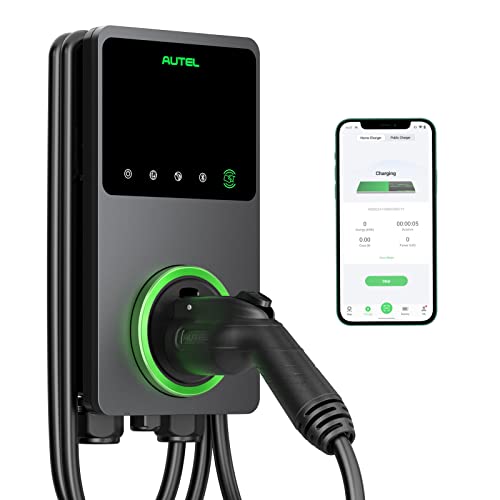
Autel
Autel MaxiCharger 50A Hardwired, 25 ft
$529.00
Fifty amps hardwired rather than 48, so a fractionally higher ceiling on the same 60 amp circuit, with a 25 foot cable and Bluetooth as well as Wi-Fi for commissioning.
- Output
- 11.5 kW plus
- Circuit
- 60 A
- Install
- Hardwired
- Cable
- 25 ft
Trade-off Eighty dollars more for output almost no vehicle on sale can actually accept.
Check pricePaid links. Prices shown when researched and change without notice.
So which one should you actually buy?
Buy 48 amps if the car accepts 11 kW or more, the panel calculation comes back comfortable, and you intend to stay in the house. The conductor is in the wall for the life of the building and the marginal cost while an electrician is already on site is small. The 48 amp charger roundup has the full shortlist.
Buy 40 amps if you want a plug-in unit you can take with you, if the receptacle already exists, or if the car tops out near 10 kW and the difference is a mile of range per hour. Nine point six kilowatts refills a 40 mile commute in about 75 minutes. Nobody at 40 amps is charging slowly, and the 40 amp roundup is where most readers should be shopping.
Buy 32 amps if the car has a 6.6 or 7.2 kW onboard charger, or if the panel is genuinely tight and the choice is between 32 amps today and a service upgrade you cannot fund. The AIMILER 32A at $199.99 has a 25 foot cable, which is longer than several 40 amp units, and cable length is the specification owners regret far more often than amperage.
One last piece of advice that cuts across the whole ladder. If your budget forces a choice between a higher output and a longer cable, take the cable. A 25 foot cable lets one mounting position serve either side of a two-car garage and reaches a car parked nose in or backed in. Two extra kilowatts changes a finishing time you are asleep for.
Where to go next
Settle the connection method next in hardwired versus plug-in, since 48 amps forces that answer, then check the panel with the panel load calculator and confirm the breaker with the breaker size calculator. If you already know the output you want, the hardwired 48 amp buildout prices the entire job line by line.
We review them on their own too, in full detail: the 48 amp Emporia, the 40 amp Grizzl-E Classic and the 32 amp Tesla Mobile Connector.
Common questions
Is a 48 amp charger worth the extra cost over 40 amps?
It is worth it if the car can accept 11.5 kW and the panel has the capacity, because the extra cost at install time is one breaker size and a hardwired termination rather than a receptacle. It buys 1.9 kW, roughly six more miles of range per hour on an average crossover. It is not worth it on a Nissan Leaf or an early Toyota bZ4X, which cap at 6.6 kW and charge identically on either circuit.
What breaker does each charger output need?
The code treats EV charging as a continuous load and sizes the circuit at 125 percent of the charger output. That gives a 40 amp breaker for a 32 amp charger, a 50 amp breaker for 40 amps, and a 60 amp breaker for 48 amps. Read it the other way and a breaker supports a charger drawing 80 percent of its rating, which is why a 50 amp circuit gives you 40 amps of charging and not 50.
Will a 48 amp charger charge my Nissan Leaf faster?
No. The Leaf has a 6.6 kW onboard AC charger, and the onboard charger is the limit, not the wall unit. A 32 amp charger offers 7.7 kW, the Leaf takes 6.6 kW of it, and a 48 amp charger offering 11.5 kW results in exactly the same 6.6 kW. Early Toyota bZ4X model years are the same. Spend the difference on cable length or on a cheaper circuit instead.
Can I install a 48 amp charger on a 50 amp circuit turned down?
You can set most 48 amp units to a lower output during commissioning, and running one at 40 amps on a 50 amp circuit is a legitimate way to buy the hardware now and raise the output after a future panel upgrade. What you cannot do is plug a 48 amp unit into a NEMA 14-50 at full output, because the receptacle permits only 40 amps continuous regardless of what the charger is capable of.
How much more does the 48 amp install actually cost?
Usually 150 to 400 dollars more than the 40 amp version of the same job. The breaker is a few dollars more, the conductor is often the same 6 AWG, and the real difference is the hardwired termination and the extra load on the panel calculation. If the load calculation forces a service upgrade to fit 48 amps, the difference stops being hundreds and becomes thousands.
Is there any reason to go above 48 amps?
Only the Ford F-150 Lightning, which accepts 19.2 kW and needs an 80 amp charger on a 100 amp branch circuit to use it. That single circuit is half a typical 200 amp residential service, so most Lightning owners are still better served by 48 amps. For every other vehicle sold, a 64 or 80 amp circuit delivers the same charging speed as 48 amps at several times the installation cost.
Getting your own panel and load numbers ready for an electrician? The EV Home Charging Install Planner is the paid version of these pages: 8 printable worksheets you fill in with your own numbers, plus the full PDF, $29.
How this page was researched
Specifications come from manufacturer documentation, listed safety certifications and verified owner reviews. We do not perform hands-on product testing and never claim to. Figures are researched planning information, not professional electrical advice. Last reviewed 2026-08-17.