Best Level 2 Home EV Chargers
Short answer
The best Level 2 home charger for most houses is the Emporia 48A hardwired station at around $449, which delivers 11.5 kW on a 60 amp circuit and saturates the onboard charger in nearly every electric car sold. If your circuit is 50 amps, buy a 40 amp unit instead and get 9.6 kW.
The best Level 2 home charger for most houses is the Emporia 48A hardwired station at around $449. It delivers 11.5 kW on a 60 amp circuit, ships with a 25 foot cable, reports energy per session, and costs roughly half what the premium brands ask for identical output. If your panel or your budget caps you at a 50 amp circuit, the Grizzl-E Classic 40A at around $299.99 is the right answer instead, and it gives up under two kilowatts doing it.
That is the whole recommendation, and the rest of this page exists to explain why the number that matters is not the one on the charger. Your car's onboard AC charger sets the real ceiling. The wall unit can only offer power; the car decides how much of it to take. Buying 48 amps for a vehicle that accepts 6.6 kW is the single most expensive mistake in this category, because it costs you a larger breaker, heavier conductor and a hardwired termination to deliver exactly the speed a cheaper unit would have delivered.
Top pick, Level 2 home charger
Best for most homes
EMPORIA
Emporia Level 2 EV Charger, 48A J1772
$449.00
A hardwired 48 amp station with a 25 foot cable, Wi-Fi scheduling and genuine energy reporting, at roughly half what the premium brands charge for the same output. It delivers 11.5 kW, which is the exact ceiling of the onboard charger in most electric cars sold, so nothing you pay for goes unused.
- Output
- 11.5 kW
- Continuous
- 48 A
- Circuit
- 60 A
- Cable
- 25 ft
- Connector
- J1772
- Install
- Hardwired
Paid link. Price shown when researched.
What does your car actually let you use?
Every Level 2 charger is a switch and a safety negotiator. It offers a current level over the pilot signal, the car answers with the current it is willing to draw, and the lower of the two wins. That means the charger's amperage is a ceiling, not a delivery promise, and the car's onboard AC charger is the floor that ceiling lands on.
Most current electric cars top out at 11.5 kW, which is exactly what a 48 amp unit provides at 240 volts. A few sit slightly below: the Mustang Mach-E is near 10.5 kW, the Ioniq 5 and EV6 near 10.9 kW, the ID.4 at 11 kW. In every one of those cases a 48 amp charger is fully used and a 40 amp charger costs you roughly a mile of range per hour. The exceptions run in both directions. The Nissan Leaf and early Toyota bZ4X accept 6.6 kW, so a 32 amp charger on a 40 amp circuit is genuinely all they can use. At the other end the Ford F-150 Lightning accepts 19.2 kW, and it is close to the only vehicle sold that can.
Work your own case through the charge time calculator before you shop, because the honest question is not how fast the charger is but whether the car is full by morning. A vehicle that finishes at 3am on a 40 amp circuit gains nothing measurable from finishing at 1am on a 60 amp one.
Which output should you wire for?
The circuit is the expensive decision, not the charger. Chargers get replaced; conductors in a wall stay for the life of the house. That argues for wiring one step above what you need today if the incremental cost is small, and against wiring for a number no vehicle in your driveway will ever draw.
| Charger output | Breaker | Power at 240 V | Typical copper | Where it fits |
|---|---|---|---|---|
| 24 A | 30 A | 5.8 kW | 10 AWG | The dryer-circuit case. Common with splitters on an existing 14-30. |
| 32 A | 40 A | 7.7 kW | 8 AWG | Plenty for a car with a 6.6 or 7.2 kW onboard charger. |
| 40 A | 50 A | 9.6 kW | 6 AWG | The most common home install. Fits a NEMA 14-50 outlet. |
| 48 A | 60 A | 11.5 kW | 6 AWG | Hardwired only. Saturates almost every onboard charger sold. |
| 64 A | 80 A | 15.4 kW | 4 AWG | Rare. Very few vehicles can use it. |
Read the middle two rows carefully, because that is where nearly every home install lands. The step from 40 to 48 amps costs a 60 amp breaker instead of a 50, a hardwired termination instead of a receptacle, and often a heavier conductor once run length is accounted for. It buys 1.9 kW. On a car with an 11.5 kW onboard charger that is worth having and the incremental cost during a job you are already paying for is small. On a 6.6 kW car it buys nothing at all.
The 64 and 80 amp rows exist for completeness and almost nobody should wire for them. An 80 amp charger needs a 100 amp branch circuit, which is half of a typical 200 amp residential service consumed by one appliance. Full detail on that trade sits in 32A vs 40A vs 48A, and the sizing arithmetic is in the breaker size calculator.
Starter: the cheapest way to get real Level 2 charging
The starter tier is not the compromise tier. A 40 amp charger on a 50 amp circuit delivers 9.6 kW, which recovers roughly 30 to 35 miles of range per hour on an average crossover. That refills a 40 mile commute in about 75 minutes. Nobody in this tier is charging slowly; they are charging on the cheapest wiring job that qualifies as Level 2, and for a household with one car and predictable mileage that is the correct place to stop spending.
Starter tier: 32 and 40 amp units, $200 to $300
Real Level 2 output on a 40 or 50 amp circuit, with no cloud account required unless you want one.
Grizzl-E
Grizzl-E Classic 40A
$299.99
A sealed metal case and no app, no account and no cloud dependency. It is a 40 amp unit, so it wants a 50 amp circuit and delivers 9.6 kW, which is more than a Leaf or an early bZ4X can accept anyway.
- Output
- 9.6 kW
- Continuous
- 40 A
- Circuit
- 50 A
- Case
- Metal
Trade-off No scheduling and no energy reporting, so time-of-use charging has to be scheduled in the car instead.
Check price
Lectron
Lectron 40A NEMA 14-50 Plug-In
$269.99
The lowest-friction path to Level 2 if a NEMA 14-50 receptacle already exists in the garage. It plugs in, it is ETL certified, and it comes off the wall in seconds when you move house.
- Output
- 9.6 kW
- Continuous
- 40 A
- Plug
- 14-50
- Cable
- 16 ft
Trade-off A 16 foot cable is short. Measure from the receptacle to the charge port before you commit.
Check price
AIMILER
AIMILER 32A, 25 ft Cable
$199.99
A 32 amp plug-in unit with a 25 foot cable and an app, sized for a 40 amp circuit. This is the right output if your car has a 6.6 or 7.2 kW onboard charger, because the extra amps would be wasted.
- Output
- 7.7 kW
- Continuous
- 32 A
- Circuit
- 40 A
- Cable
- 25 ft
Trade-off Caps at 7.7 kW, so it is the wrong buy if you later replace the car with a large-pack truck.
Check pricePaid links. Prices shown when researched and change without notice.
The Grizzl-E Classic is the pick here because it is deliberately dumb. There is no app, no firmware update path and no cloud service that can be discontinued in four years, and the case is sealed metal rather than moulded plastic. If your car already schedules its own charging, which nearly all of them do, the app on the wall unit is redundant and the money is better spent on cable length.
The Lectron 40A plug-in is the answer to a specific and common situation: there is already a NEMA 14-50 in the garage, put there for an RV or a welder, and it is on a properly sized 50 amp circuit. In that case the electrical work is already paid for and the charger is genuinely a plug-in appliance. Have the receptacle inspected first, because a builder-grade 14-50 that has spent ten years unused is not the same thing as an EV-rated one.
The AIMILER 32A exists on this list for the 6.6 kW cars. A 32 amp unit runs on a 40 amp circuit, which is cheaper to wire, lighter on the panel and frequently the difference between needing a panel upgrade and not needing one. Its 25 foot cable is also longer than either 40 amp unit above it, and cable length is the specification people regret more often than amperage.
Buy once: the tier most people should actually be shopping in
The middle tier is 48 amps hardwired, and it is where the site's default recommendation lives. The argument is not that 11.5 kW is necessary. It is that the marginal cost of 48 amps over 40 amps, at the moment an electrician is already in your garage with the panel open, is small relative to the cost of doing the job twice. If the panel has the capacity, the conductor run is not long, and the car can use the output, this is the tier to buy in.
Buy-once tier: 48 to 50 amp hardwired, $449 to $529
All three deliver 11.5 kW or slightly more on a 60 amp circuit. The differences are app quality, radio and warranty rather than charging speed.
EMPORIA
Emporia Level 2 EV Charger, 48A J1772
$449.00
The pick for most houses. Hardwired 48 amps, a 25 foot cable, a factory whip and per-session energy data in the app, which is what makes a time-of-use rate plan checkable rather than hopeful.
- Output
- 11.5 kW
- Circuit
- 60 A
- Cable
- 25 ft
- Smart
- Wi-Fi
Trade-off Hardwired by design, so moving it later means paying an electrician a second time.
Check price
ChargePoint
ChargePoint HomeFlex, Hardwired 50A
$494.00
The most mature app in the category by a distance, with reliable scheduling, utility program integration and a support organisation that answers the phone. Hardwired and adjustable up to 50 amps.
- Output
- Up to 12 kW
- Continuous
- Up to 50 A
- Circuit
- 60 A
- Smart
- Wi-Fi
Trade-off Costs more than the Emporia for hardware that charges at the same speed on the same circuit.
Check price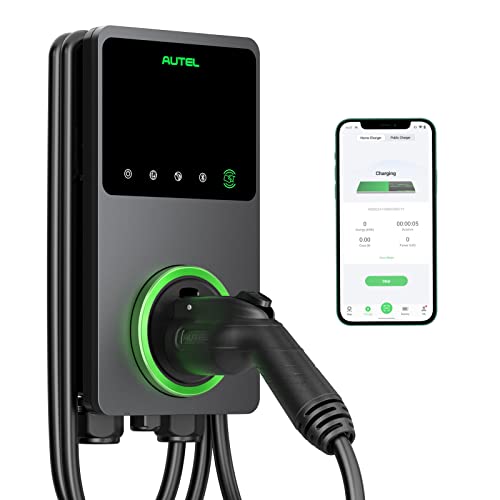
Autel
Autel MaxiCharger 50A Hardwired, 25 ft
$529.00
A 50 amp capable hardwired unit with both Wi-Fi and Bluetooth, which matters more than it sounds when the charger lives in a detached garage at the edge of the house network.
- Continuous
- Up to 50 A
- Circuit
- 60 A
- Cable
- 25 ft
- Radio
- Wi-Fi and BT
Trade-off The 50 amp setting needs a 60 amp circuit and delivers only marginally more than 48 amps.
Check pricePaid links. Prices shown when researched and change without notice.
Emporia wins on price per delivered kilowatt and on energy reporting, which is the feature that turns a time-of-use rate plan from a theory into something you can audit against a bill. It ships hardwired with a whip, and the 25 foot cable reaches across a two-car garage from a single mounting point.
ChargePoint HomeFlex is the pick if you value the software layer. Its scheduling is the most reliable in the category by owner consensus, it integrates with more utility rebate and demand-response programs than anything else on this page, and the company has a support organisation rather than an email address. You are paying a premium for an app on hardware that charges at the same speed.
The Autel MaxiCharger 50A hardwired earns its place on connectivity. Garage-mounted chargers sit in the worst Wi-Fi location in most houses, behind a steel door and often on an exterior wall, and a unit with Bluetooth as well as Wi-Fi remains configurable when the network drops. If you have ever tried to commission a device that will not see your router, that redundancy is worth real money.
Ceiling: load management, 80 amps and two cars
The top tier is not about charging faster. Two of the three products here solve problems that money cannot otherwise fix: a panel with no spare capacity, and a driveway with two electric cars and one available circuit. The third, the 80 amp unit, is the only genuinely faster option and almost nobody should buy it.
Ceiling tier: $599 to $899
Buy in this tier to solve a constraint, not to charge faster. Two of the three deliver the same 9.6 to 11.5 kW as the tier below.

EMPORIA
Emporia Pro 48A with PowerSmart Load Management
$599.00
The same 48 amp hardware with PowerSmart load management built in, so the charger throttles itself when the house draws heavily instead of tripping the main. On a full panel this device is frequently cheaper than the service upgrade it replaces.
- Output
- 11.5 kW
- Circuit
- 60 A
- Load mgmt
- Built in
- Install
- Hardwired
Trade-off The load management hardware only earns its price if your panel is genuinely tight.
Check price
Grizzl-E
Grizzl-E Ultimate 80A
$899.00
An 80 amp unit delivering 19.2 kW on a 100 amp branch circuit. Essentially the Ford F-150 Lightning case and nothing else, because almost no other vehicle has an onboard charger that can accept it.
- Output
- 19.2 kW
- Continuous
- 80 A
- Circuit
- 100 A
- Case
- Metal
Trade-off A 100 amp branch circuit is half a 200 amp service, so this usually forces a service upgrade.
Check priceGrizzl-E
Grizzl-E Duo Connect, Dual 40A
$899.99
Two 40 amp outputs that share one circuit intelligently, which is the honest answer for a two-EV household with one spare breaker space. Both cars plug in overnight and the unit divides the supply.
- Outputs
- Two
- Per output
- 9.6 kW
- Shared
- Yes
- Case
- Metal
Trade-off When both cars charge at once each gets roughly half, so plan around the slower night.
Check pricePaid links. Prices shown when researched and change without notice.
Who should not buy the top tier
Do not buy the Grizzl-E Ultimate 80A unless you own an F-150 Lightning with the hardware to accept 19.2 kW and a service that can carry a 100 amp branch circuit. For every other vehicle it delivers exactly what a 48 amp unit delivers, on a circuit that costs several times as much to install and that will likely trigger a service upgrade. The same applies to the Autel 80A and the Enphase CS 100.
Do not buy the Emporia Pro if your load calculation comes back comfortable. Its extra cost is the load management hardware, and load management on a panel with plenty of headroom is a feature you pay for and never see operate. Run the panel load calculator first, and if the answer is tight read load management versus a panel upgrade, because that comparison is frequently the difference between a 600 dollar device and a 5,000 dollar job.
How we chose these chargers
We did not test any of these units in person and we do not claim to. There is no lab here, no instrumented garage and no sample units. Saying otherwise would be the easiest thing on the page to write and the least defensible.
What the picks are built from is published specification sheets, listed safety certifications and verified owner reviews read in volume. Certification is the first filter and it is not negotiable: a home charger should carry a UL 2594 listing or an ETL listing to that standard, and an Energy Star listing is a useful secondary signal because it implies a measured standby draw. A 240 volt appliance that runs at near-full load for eight hours a night with no listing mark is not a bargain, it is an uninsured risk.
The second filter is output honesty. Several listings advertise an amperage the unit only reaches under conditions the buyer will not have, or quote peak rather than continuous output. Everything above is rated at its continuous figure, matched to the breaker the 125 percent rule requires. The third filter is cable length, because a 16 foot cable and a 25 foot cable are a much bigger practical difference than 40 amps against 48. The fourth is failure pattern in owner reviews, specifically reports of connector overheating, enclosure water ingress and cloud services going dark, all of which are visible in review volume even though individual reviews are unreliable.
Prices were accurate when researched and change without notice. Where a product has no verified Amazon listing it appears as a search link rather than a direct one, which is deliberate: a fabricated product link is worse than no link.
Buying tips: where the money actually goes
Buy cable length before you buy amperage
A 25 foot cable lets one wall position serve either side of a two-car garage and reaches a car parked nose in or backed in. A 16 foot cable frequently does not reach the far side of the same garage. Owners regret short cables constantly and rarely regret 9.6 kW instead of 11.5 kW. If the choice is a longer cable or a higher amperage at the same price, take the cable.
Check the panel before you check the catalogue
A 60 amp circuit needs two adjacent free spaces for a two-pole breaker, and tandem breakers cannot serve a 240 volt load, so a panel that looks half empty may have no usable position. The bus rating matters too. This is the calculation that turns an 800 dollar job into a 5,000 dollar one, so do it first through the panel load calculator.
If it plugs in, buy an EV-rated receptacle
A builder-grade NEMA 14-50 costs under ten dollars and was designed for an RV that plugs in a few weekends a year. Yours will carry 40 amps for eight hours nightly, and the plug face is the most likely component in the entire installation to fail. The EV-rated versions on the receptacle roundup cost four to five times as much and that difference is not optional.
Decide who does the scheduling
Charger scheduling and car scheduling fight each other. If both are set, the car will sometimes wake, find the charger offering nothing, and go back to sleep until morning. Pick one, and if you are on a time-of-use plan pick the one that also reports energy so you can check the bill.
Budget for the install, not the box
On most projects the charger is the smallest line on the invoice. A short run on the same wall as the panel is often 450 to 900 dollars. A 30 to 50 foot run through finished walls is more like 900 to 1,600. A detached garage with trenching starts around 2,500 and can pass 6,000. Price the whole job through the installation cost calculator before you decide which charger you can afford.
Where to go next
If you have settled on 48 amps, the hardwired 48 amp buildout lists every part with prices and a running total. If you are still choosing between plug-in and hardwired, read hardwired versus plug-in. And if you drive a Tesla or a recent Hyundai or Kia, the connector question comes first, so start with the best chargers for Tesla instead.
We review them on their own too, in full detail: the Emporia 48 amp, the Grizzl-E Classic and the Tesla Wall Connector.
Common questions
What size breaker does a Level 2 home charger need?
It depends on the charger output, because EV charging is a continuous load and the circuit is sized at 125 percent. A 32 amp charger needs a 40 amp breaker, a 40 amp charger needs a 50 amp breaker, and a 48 amp charger needs a 60 amp breaker. Read the rule backwards and a 50 amp breaker supports a charger drawing 40 amps continuously, which is why a NEMA 14-50 outlet is always paired with a 40 amp unit.
Is a 48 amp charger actually faster than a 40 amp one?
Only if the car can accept the difference. A 48 amp charger delivers 11.5 kW and a 40 amp charger delivers 9.6 kW, a gap of under two kilowatts or roughly six miles of range per hour on an average crossover. If your car has an 11.5 kW onboard charger you get the full difference. If it has a 6.6 kW onboard charger, as a Nissan Leaf does, both units charge at exactly the same speed.
Should I buy a plug-in charger or a hardwired one?
Plug-in wins if you rent, if you might move, or if you want to swap a failed unit yourself in ten minutes. Hardwired wins if you want 48 amps, because above 40 amps continuous the plug-in option effectively disappears, and it wins outdoors where a receptacle and in-use cover are one more thing to fail. A hardwired unit also removes the plug face, which is the most common failure point in the whole installation.
Do I need a smart charger, or is a dumb one fine?
A dumb charger is fine if your car schedules charging well and your utility does not run a rate plan you need to prove compliance with. A smart charger earns its price in two situations: when you want per-session energy data to verify a time-of-use bill, and when you need dynamic load management to avoid a panel upgrade. Both cars and chargers can schedule, so pick one and turn the other off.
How long does a Level 2 charger take to install?
A short run from a panel on the same garage wall is often half a day of labour and lands somewhere between 450 and 900 dollars including parts. A 30 to 50 foot run through finished walls typically runs 900 to 1,600 dollars, because fishing conductors is what costs the money rather than the conductor itself. A permit and inspection are normally required and are usually included in a proper quote.
Can I install a Level 2 charger myself?
No. A home charging circuit is a 240 volt continuous load that runs near its rating for hours every night, and undersized conductors, a loose lug or missing ground-fault protection are fire risks rather than code technicalities. A licensed electrician must size and install the circuit, and most jurisdictions require a permit and an inspection before it is energised. Local amendments to the National Electrical Code vary, which is another reason the sizing is not yours to guess at.
Getting your own panel and load numbers ready for an electrician? The EV Home Charging Install Planner is the paid version of these pages: 8 printable worksheets you fill in with your own numbers, plus the full PDF, $29.
How this page was researched
Specifications come from manufacturer documentation, listed safety certifications and verified owner reviews. We do not perform hands-on product testing and never claim to. Figures are researched planning information, not professional electrical advice. Last reviewed 2026-08-17.