Best Hardwired EV Chargers
Short answer
The best hardwired EV charger for most homes is the Emporia 48A at around $449, which delivers 11.5 kW on a 60 amp circuit and ships preconfigured for a hardwired install with a whip. Above 40 amps continuous there is no plug-in alternative, because a NEMA 14-50 receptacle tops out at 40 amps continuous.
The best hardwired EV charger for most houses is the Emporia 48A at around $449. It arrives configured for a hardwired install with a whip already fitted, delivers 11.5 kW on a 60 amp circuit, and carries a UL listing. If you want a better app and a phone number to call, the ChargePoint HomeFlex hardwired at around $494 does the same job with better software.
The reason this category exists as a separate shopping decision is a hard limit rather than a preference. Above 40 amps of continuous draw there is effectively no plug-in option in a residential setting. A NEMA 14-50 receptacle is rated 50 amps, which under the 125 percent continuous load rule supports a charger drawing 40 amps. Receptacles rated above that exist, but they are uncommon in residential supply houses and no mainstream manufacturer builds a 48 amp home unit around one. So the moment you decide you want 11.5 kW, you have also decided the unit is hardwired.
Top pick, hardwired home charger
Best hardwired unit
EMPORIA
Emporia Level 2 EV Charger, 48A J1772
$449.00
The hardwired unit to buy unless you have a specific reason not to. It ships preconfigured for a hardwired install with a whip, delivers 11.5 kW on a 60 amp circuit, carries a UL listing and an Energy Star listing, and costs roughly half what the premium brands ask for the same output.
- Output
- 11.5 kW
- Continuous
- 48 A
- Circuit
- 60 A
- Cable
- 25 ft
- Whip
- Included
- Connector
- J1772
Paid link. Price shown when researched.
Where does the plug-in option actually run out?
The boundary is 40 amps continuous, and it comes from the same rule that governs everything else on this site. EV charging is a continuous load, so the branch circuit is rated at 125 percent of the charger output. Run that backwards and a receptacle rated for 50 amps supports a charger drawing 40. That is why every plug-in home charger you will find tops out at 40 amps, and why the 48 amp class is hardwired without exception.
| Charger output | Breaker | Power | Typical copper | Connection method |
|---|---|---|---|---|
| 24 A | 30 A | 5.8 kW | 10 AWG | Plug-in on a 14-30, or hardwired |
| 32 A | 40 A | 7.7 kW | 8 AWG | Plug-in or hardwired |
| 40 A | 50 A | 9.6 kW | 6 AWG | Plug-in on a 14-50, or hardwired |
| 48 A | 60 A | 11.5 kW | 6 AWG | Hardwired only |
| 64 A | 80 A | 15.4 kW | 4 AWG | Hardwired only |
| 80 A | 100 A | 19.2 kW | 3 AWG | Hardwired only |
Notice that 40 and 48 amps share a conductor size on a short run. That is the argument for hardwiring even when you buy a 40 amp unit: the copper is often the same, the breaker is a size larger, and the circuit is then ready for a 48 amp charger when the current one dies. Work your own distance through the wire gauge calculator, because that equivalence breaks down on long runs where voltage drop rather than ampacity picks the conductor.
What does a hardwired install involve that a plug-in one does not?
Three things, and only one of them is expensive. The first is the termination itself. Instead of a receptacle and a cord cap, the branch circuit lands in the charger's own enclosure or in a junction immediately behind it. That is straightforward work for an electrician and slightly faster than fitting a receptacle in a proper box with an in-use cover.
The second is the whip. Most hardwired units are meant to be removable for service, and the way that is achieved is a short piece of flexible conduit with conductors inside it running from a fixed junction to the charger. Some units, including the Emporia, ship with the whip attached from the factory. Others expect the electrician to supply liquid-tight flexible conduit and terminate into the enclosure. It changes the parts list by twenty or thirty dollars and it changes the labour by very little, but it is worth knowing before the quote arrives.
The third is the ground-fault question, and it is the one that genuinely varies. Many hardwired chargers contain listed ground-fault protection internally, which is treated differently from a receptacle-fed installation in a garage or outdoors. Which code cycle your jurisdiction has adopted decides how that plays out. The detail belongs to your electrician and your inspector, and the background is in GFCI requirements for EV chargers.
Starter: hardwired without paying for software
The entry tier here is not about slow charging. Two of the three units below deliver the full 11.5 kW. What you give up is the app, and for a large number of households that is not a loss at all, because the car already schedules its own charging and the charger's schedule is a second system that can conflict with the first.
Starter tier: $299 to $749, hardwired and simple
Listed hardware, no cloud dependency, and in two cases the full 48 amp output. The compromise is software, not speed.
Grizzl-E
Grizzl-E Classic 40A
$299.99
A 40 amp unit that can be hardwired or plugged in depending on which cord set it ships with, in a sealed metal case with no app and no cloud service. On a 50 amp circuit it delivers 9.6 kW.
- Output
- 9.6 kW
- Circuit
- 50 A
- Case
- Metal
- Smart
- None
Trade-off No scheduling and no energy reporting, so time-of-use charging is handled from the car.
Check price
Lectron
Lectron Nexus 48A J1772
$429.99
Hardwired only by design, 48 amps, UL 2594 certified with an ETL listing, and a 23 foot cable with a holster in the box. The cheapest way into the 11.5 kW class from a listed unit.
- Output
- 11.5 kW
- Circuit
- 60 A
- Cable
- 23 ft
- Cert
- UL 2594
Trade-off No app at all, so there is no energy reporting to check a time-of-use bill against.
Check price
Leviton
Leviton Level 2 EV Charger, 48A
$749.99
A 48 amp indoor or outdoor hardwired station from a manufacturer most electricians already stock and already trust. Rated 208 or 240 volts, which matters in converted multi-family buildings.
- Output
- 11.6 kW
- Circuit
- 60 A
- Cable
- 18 ft
- Volts
- 208 or 240
Trade-off An 18 foot cable is short for the price, and cable length is the spec people regret.
Check pricePaid links. Prices shown when researched and change without notice.
The Lectron Nexus 48A is the value proposition on this page. It is hardwired only, UL 2594 certified with an ETL listing, and delivers the same 11.5 kW as units costing considerably more. There is no app, which means no energy reporting, so if you are on a time-of-use plan and want to verify the bill you will need a separate circuit-level energy monitor or you should buy up a tier.
The Leviton 48A earns a place for a reason that has nothing to do with specifications. Electricians stock Leviton, they have wired hundreds of them, and a unit the installer already knows tends to go in cleanly. It is also rated for 208 volts as well as 240, which matters in converted commercial buildings and some multi-family services where the supply is 208 and every charging estimate needs to come down by roughly 13 percent.
Buy once: the 48 amp hardwired tier most people should be in
This is the tier the whole site defaults to. The logic is not that 11.5 kW is necessary, it is that the marginal cost of getting there, at the moment an electrician is already in your garage with the panel open, is small relative to the cost of doing the job twice. If your panel has the capacity and your car can accept the output, buy here.
Buy-once tier: $449 to $529, all on a 60 amp circuit
All three deliver 11.5 kW or a whisker more on the same circuit. What separates them is the app, the radio and the warranty.
EMPORIA
Emporia Level 2 EV Charger, 48A J1772
$449.00
The default. Hardwired 48 amps with a factory whip, a 25 foot cable and per-session energy reporting, which is what turns a time-of-use rate plan into something you can audit rather than hope about.
- Output
- 11.5 kW
- Circuit
- 60 A
- Cable
- 25 ft
- Smart
- Wi-Fi
Trade-off Hardwired means an electrician removes it, so it does not follow you to a rental easily.
Check price
ChargePoint
ChargePoint HomeFlex, Hardwired 50A
$494.00
Adjustable up to 50 amps on a 60 amp circuit, with the most mature app in the category and the broadest integration with utility rebate and demand-response programs.
- Continuous
- Up to 50 A
- Circuit
- 60 A
- Smart
- Wi-Fi
- Connector
- J1772
Trade-off You pay a premium for software on hardware that charges at the same speed as the Emporia.
Check price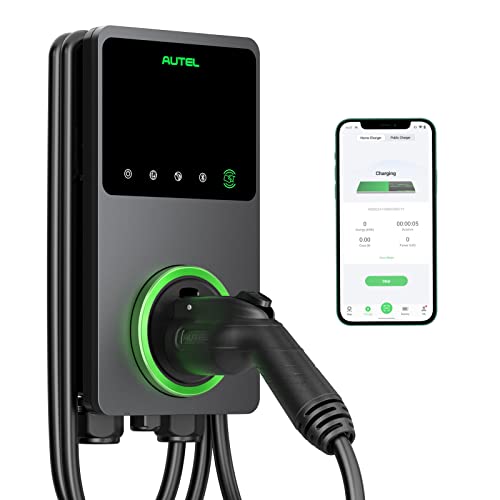
Autel
Autel MaxiCharger 50A Hardwired, 25 ft
$529.00
A 50 amp hardwired unit with a 25 foot cable and both Wi-Fi and Bluetooth. The second radio is worth more than it sounds when the charger lives in a detached garage at the edge of the house network.
- Continuous
- Up to 50 A
- Circuit
- 60 A
- Cable
- 25 ft
- Radio
- Wi-Fi and BT
Trade-off The 50 amp setting needs the same 60 amp circuit and delivers barely more than 48 amps.
Check pricePaid links. Prices shown when researched and change without notice.
A point worth being blunt about: on the same 60 amp circuit these three charge at identical speed. There is no meaningful difference in kilowatts between them, because the circuit and the car set the ceiling and both are the same in all three cases. Anyone telling you one of these charges faster than another on the same circuit is selling something.
The differences that are real are software maturity, radio redundancy and how the company behaves when something fails in year four. ChargePoint has the deepest utility program integration, which matters if your utility offers a rebate contingent on a participating charger. Autel carries Bluetooth alongside Wi-Fi, which is the difference between commissioning a unit in a detached garage and swearing at it. Emporia is the cheapest per delivered kilowatt and reports energy per session, which is the feature that pays for itself on a time-of-use plan.
Ceiling: load management, 80 amps, and who should not buy either
The top tier splits into two very different products. One solves a panel constraint. The other charges faster than anything else available at a house and is almost universally the wrong purchase.
Ceiling tier: $599 to $3,038
One of these replaces a service upgrade. The other two need a 100 amp branch circuit that will probably force one.

EMPORIA
Emporia Pro 48A with PowerSmart Load Management
$599.00
The same 48 amp hardware with PowerSmart load management built in, so the station throttles itself when the house draws heavily rather than tripping the main breaker. On a full panel it frequently replaces a service upgrade costing several thousand dollars.
- Output
- 11.5 kW
- Circuit
- 60 A
- Load mgmt
- Built in
- Install
- Hardwired
Trade-off Pointless on a panel with real headroom. You pay for a feature that never operates.
Check price
Grizzl-E
Grizzl-E Ultimate 80A
$899.00
An 80 amp hardwired unit delivering 19.2 kW on a 100 amp branch circuit, in a metal case rated for indoor or outdoor mounting. Genuinely the fastest AC charging available at a house.
- Output
- 19.2 kW
- Continuous
- 80 A
- Circuit
- 100 A
- Case
- Metal
Trade-off A 100 amp branch circuit consumes half a typical 200 amp service on its own.
Check price
Enphase Energy
Enphase CS 100 Hardwired 80A
$3,038.00
An 80 amp station aimed at houses that already run an Enphase solar and battery system, where the charger becomes one more managed load rather than an isolated appliance.
- Output
- 19.2 kW
- Circuit
- 100 A
- Cable
- 25 ft
- Ecosystem
- Enphase
Trade-off The price only makes sense as part of a larger energy system you already own.
Check pricePaid links. Prices shown when researched and change without notice.
Who should not buy the ceiling tier
Do not buy an 80 amp charger unless you own a Ford F-150 Lightning with the equipment to accept 19.2 kW. That is very close to the entire list of vehicles that can use the output. Every other car on the road will draw 11.5 kW or less from the Grizzl-E Ultimate or the Enphase CS 100, which is exactly what a 449 dollar unit on a 60 amp circuit delivers. Meanwhile the 100 amp branch circuit consumes half a typical 200 amp service and will usually force a service upgrade running three to seven thousand dollars.
Do not buy the Emporia Pro if your load calculation comes back comfortable. Its premium buys load management hardware, and load management on a panel with headroom is a feature you pay for and never see work. Run the panel load calculator first. If the answer is tight, read load management versus a panel upgrade, because in that situation the Pro is frequently the cheapest thing on the whole project.
How we chose these chargers
We did not test any of these units in person and we do not claim to. There is no lab, no instrumented garage and no sample hardware behind this page.
The picks come from published manufacturer specifications, listed safety certifications and verified owner reviews read in volume. Certification is the first filter and it is not negotiable for a hardwired unit in particular, because a hardwired charger is a permanent part of your electrical system rather than an appliance you can unplug. A UL 2594 listing or an ETL listing to that standard is the baseline, and an Energy Star listing is a useful secondary signal because it implies a measured standby draw.
The second filter is continuous rating honesty, since some listings quote a peak figure rather than the continuous output the breaker must be sized against. The third is what the unit does with a hardwired installation specifically: whether a whip is included, whether the enclosure has enough room to land 6 AWG conductor comfortably, and whether the unit is rated for outdoor mounting. The fourth is failure pattern in owner reviews, especially connector overheating, water ingress and cloud services being discontinued on units with a fifteen year service life. Prices were accurate when researched and change without notice.
Buying tips for a hardwired install
Ask whether the whip is included before the quote
It is a small line item that turns into an extra trip to the supply house if nobody checked. If the unit does not ship with one, liquid-tight flexible conduit and fittings are the usual answer and the conduit guide covers what goes where.
Wire the circuit for the charger you will own in ten years
Conductors outlive wall units by a wide margin. If the run is short and the panel has room, wiring 60 amps instead of 50 is often a small increment during work you are already paying for. It is not an argument for wiring 100 amps speculatively, because that step changes the service, not just the branch.
Mount it where the cable arcs, not where the wall is convenient
A hardwired unit is not moving again, so spend ten minutes with the car parked as it will actually park. Charge ports sit front left, front right or rear left depending on the model, and mounting height decides whether a 25 foot cable hangs in a clean arc or drags on concrete. The detail is in charger placement in a garage.
Get the load calculation done before you choose the amperage
A 60 amp circuit is 30 percent of a 200 amp service on nameplate, and the load calculation is not a simple sum. It is also the single number that decides whether this is an 800 dollar project or a 5,000 dollar one. The panel load calculator takes two minutes and can save the whole budget.
Keep the permit
A permit and inspection are normally required, they are usually a small fraction of the invoice, and the signed inspection is what an insurer and a future buyer will ask about. An electrician who suggests skipping it is telling you something about the rest of the work.
Where to go next
If 48 amps hardwired is the plan, the hardwired 48 amp buildout prices every part with a running total. If you are not yet sure hardwiring is right for your situation, the full argument is in hardwired versus plug-in. And if the amperage itself is still open, work through the breaker size calculator and the 48 amp roundup.
We review them on their own too, in full detail: the Emporia 48 amp, the Autel 50A and the Grizzl-E Ultimate 80A.
Common questions
Why are 48 amp chargers always hardwired?
Because the receptacle options run out. A NEMA 14-50 receptacle is rated 50 amps, which supports 40 amps continuous under the 125 percent rule, so it cannot legally supply a 48 amp charger. Receptacles above 50 amps exist but are uncommon in residential supply houses and are not what manufacturers design around. So every 48 amp home station ships as a hardwired unit on a 60 amp circuit.
What is the whip, and does my charger come with one?
The whip is the short length of flexible conduit and conductor between the wall box or junction and the charger itself, which lets the unit be removed without disturbing the fixed wiring. Several hardwired chargers, including the Emporia 48A, ship with a factory whip already attached. Others expect the electrician to terminate directly into the enclosure. Check before the electrician arrives, because it changes the parts list.
Is a hardwired charger safer than a plug-in one?
In one specific and important way, yes. A plug-in installation has a mechanical connection carrying 40 amps for hours every night, and contact resistance at the plug face rises as the contacts wear. That plug face is the most common failure point in a home charging installation. Hardwiring removes it entirely. It also removes the ability to swap a failed charger yourself, which is the trade.
Can a hardwired charger be moved to a new house?
Yes, but an electrician has to disconnect it and another has to install it, so you are paying labour twice and you leave a dead 60 amp circuit behind. In practice most people leave the unit and treat it as a fixture, which is not a bad outcome: a charging circuit already installed is a genuine selling point and buyers increasingly look for one.
Does a hardwired charger still need GFCI protection?
It depends on the unit and on the code cycle your jurisdiction has adopted. Many hardwired chargers include listed ground-fault protection internally and are therefore handled differently from a receptacle-fed install, which generally does require it in a garage or outdoors. This is exactly the kind of detail that varies locally, so it belongs to your electrician and your inspector rather than to a rule you read off a table.
Should I wire 60 amps even if I buy a 40 amp charger?
Often yes, if the incremental cost is small. Conductors in a wall outlive wall units, and going from 8 AWG to 6 AWG copper during a job you are already paying for is cheap compared with pulling new conductor later. The caveats are that the panel has to carry a 60 amp breaker and that the charger itself must be rated for the circuit it sits on, so the breaker is sized for the charger you actually install.
Getting your own panel and load numbers ready for an electrician? The EV Home Charging Install Planner is the paid version of these pages: 8 printable worksheets you fill in with your own numbers, plus the full PDF, $29.
How this page was researched
Specifications come from manufacturer documentation, listed safety certifications and verified owner reviews. We do not perform hands-on product testing and never claim to. Figures are researched planning information, not professional electrical advice. Last reviewed 2026-08-17.