EV Charger Troubleshooting
Short answer
Most home charging complaints are not faults. A car charging slower than its wall unit is almost always limited by its own onboard AC charger, which caps at 11.5 kW or below on nearly every model sold. The one symptom that means stop charging and call an electrician is a breaker that trips after an hour of steady current, because a delayed trip is thermal and points at a loose termination or an undersized conductor.
Home charging problems fall into two piles that look identical from the driver's seat and could not be more different in what they mean. The first pile is expectation: the car is doing exactly what its hardware allows, and the complaint is really a misunderstanding of which component sets the speed. The second pile is heat, and heat at a connection carrying 40 amps for eight hours a night is the one category on this page that deserves urgency rather than curiosity.
This guide is organised the way the problems actually arrive: as a sentence a driver would say out loud. Work down the section that matches your complaint. Everything a homeowner can safely check is a look, a listen, a setting or a plug-in tester. Everything else is inside a panel or inside the charger, and that is electrician territory without exception.
The safe first tool
Homeowner-safe diagnostics
KLEIN TOOLS
Klein 80025 Outlet and GFCI Tester Kit
$26.99
The two things a homeowner can safely check without opening anything: whether a 120 volt receptacle is wired correctly and whether its ground-fault protection still trips. The kit pairs a receptacle tester with a non-contact voltage pen, which together settle most Level 1 slow-charging complaints.
- Pieces
- 2
- Tests
- Wiring + GFCI
- Includes
- NCV pen
- Use
- 120 V outlets
- Opens nothing
- Yes
Paid link. Price shown when researched.
Why is my car charging slower than the charger is rated for?
This is the most common complaint in home charging and it is almost never a fault. Three causes cover nearly all of it, and they are easy to separate.
The car's onboard charger is the ceiling
A wall-mounted charging station does not charge the battery. It supplies alternating current to a rectifier inside the car, and that onboard AC charger has a fixed maximum. A 48 amp station is capable of 11.5 kW, but a car with a 6.6 kW onboard charger will take 6.6 kW from it, from a 40 amp unit, and from an 80 amp unit. Nothing on the wall changes that number.
| Vehicle | Onboard AC limit | On a 48 A circuit | On a 40 A circuit | Capacity unused at 48 A |
|---|---|---|---|---|
| Tesla Model Y | 11.5 kW | 11.5 kW | 9.6 kW | None |
| Tesla Model 3 | 11.5 kW | 11.5 kW | 9.6 kW | None |
| Tesla Cybertruck | 11.5 kW | 11.5 kW | 9.6 kW | None |
| Ford F-150 Lightning | 19.2 kW | 11.5 kW | 9.6 kW | None |
| Ford Mustang Mach-E | 10.5 kW | 10.5 kW | 9.6 kW | Yes, a 48 A circuit is not fully used |
| Chevrolet Equinox EV | 11.5 kW | 11.5 kW | 9.6 kW | None |
| Chevrolet Bolt EUV | 11.5 kW | 11.5 kW | 9.6 kW | None |
| Hyundai Ioniq 5 | 10.9 kW | 10.9 kW | 9.6 kW | Yes, a 48 A circuit is not fully used |
| Kia EV6 | 10.9 kW | 10.9 kW | 9.6 kW | Yes, a 48 A circuit is not fully used |
| Rivian R1T | 11.5 kW | 11.5 kW | 9.6 kW | None |
| Nissan Leaf | 6.6 kW | 6.6 kW | 6.6 kW | Yes, a 48 A circuit is not fully used |
| Volkswagen ID.4 | 11 kW | 11.0 kW | 9.6 kW | Yes, a 48 A circuit is not fully used |
| Honda Prologue | 11.5 kW | 11.5 kW | 9.6 kW | None |
| Toyota bZ4X | 6.6 kW | 6.6 kW | 6.6 kW | Yes, a 48 A circuit is not fully used |
Read the two middle columns against each other. For most of this table the difference between a 40 amp circuit and a 48 amp circuit is under two kilowatts, and for the Leaf and the early bZ4X it is exactly nothing. The full list of limits is in the EV battery capacity chart, and the charge time calculator will tell you what your own combination should be producing before you decide anything is wrong.
The charger was dialled down at commissioning
Almost every smart charger ships with a configurable maximum current, and the electrician sets it during commissioning to match the circuit that was actually installed. That is correct behaviour. What goes wrong is that the setting is sometimes left at a conservative default, or at the value chosen for a temporary circuit that was later upgraded. A unit sold as a 48 amp station can perfectly legitimately be running at 24 amps because that is what somebody selected two years ago.
Check the current limit in the charger app before you check anything else. It costs nothing and it resolves a surprising share of slow-charging complaints. If the setting is lower than the circuit supports, the fix is a configuration change by whoever commissioned it, not new hardware.
The supply is 208 volts, not 240
In many townhouse developments, converted commercial buildings and multi-family services, the two hot legs give 208 volts rather than 240. The amperage rules are identical and nothing is faulty, but power is volts multiplied by amps, so every circuit delivers roughly 13 percent less.
| Charger output | Breaker | At 240 V | At 208 V | Power lost |
|---|---|---|---|---|
| 12 A | 15 A | 2.9 kW | 2.5 kW | 14 % |
| 16 A | 20 A | 3.8 kW | 3.3 kW | 12 % |
| 24 A | 30 A | 5.8 kW | 5.0 kW | 14 % |
| 32 A | 40 A | 7.7 kW | 6.7 kW | 14 % |
| 40 A | 50 A | 9.6 kW | 8.3 kW | 13 % |
| 48 A | 60 A | 11.5 kW | 10.0 kW | 13 % |
| 64 A | 80 A | 15.4 kW | 13.3 kW | 14 % |
| 80 A | 100 A | 19.2 kW | 16.6 kW | 13 % |
If your app reports 8.3 kW on a circuit you were told was 9.6 kW, you are almost certainly on a 208 volt supply and the installation is fine. Most chargers display supply voltage somewhere in the app, which settles the question in ten seconds.
Why does my session stop partway through the night?
Intermittent stops divide neatly by whether the charger restarts itself. A session that resumes after a few minutes is protection doing its job. A session that stops and stays stopped is usually a schedule. A session that stops and takes the breaker with it is the serious case, covered further down.
Ground-fault detection and CCID lockouts
Every listed charging station contains a charging circuit interrupting device that watches for current leaking to ground and opens the circuit at roughly 20 milliamps. It is deliberately much less sensitive than the 5 milliamp threshold used for personnel protection, because a car inlet in the rain would otherwise be unusable, and far more sensitive than any breaker.
The causes are physical and mostly visible: water pooled in the connector face, a damp vehicle inlet, road salt bridging the pins, a nick in the cable jacket where it has been driven over, or a connector that has been dropped enough times to crack the housing. Dry the connector, inspect the pins under a torch and look at the whole cable for damage. A single lockout after a storm is unremarkable. Repeated lockouts on dry days are a fault, and a cracked or crushed cable is a replacement rather than a repair.
Schedules that look like faults
Three separate systems can pause a session and each of them looks like a failure. The car has a charge limit and often a departure schedule. The charger has its own schedule. A utility demand-response program can pause charging during a peak event if the unit is enrolled. When two of these disagree, sessions stop at times that appear random. Set the schedule in one place only, ideally the car, and leave the other two permanently open.
A loose termination heating up
A connection that is not fully torqued does not fail immediately. It heats under load, the metal expands, the contact area changes, and after enough thermal cycles the joint degrades further. The early symptom can be an intermittent stop after the circuit has been loaded for a while. This overlaps with the delayed-trip case below, and it carries the same instruction: stop and call somebody.
Why does the charger slow down when it is hot outside?
Because it is designed to, and the derating is a feature rather than a defect. Charging stations monitor the temperature of the enclosure, the contactor and in many units the connector itself, and reduce output when any of those approach their limit. On an afternoon in direct sun, a dark enclosure on a west-facing wall can be 30 degrees Fahrenheit above ambient before a single amp has flowed.
The tell is that it correlates with sun and time of day rather than with the car or the state of charge, and that it disappears overnight. Overnight charging rarely sees any derating at all, which is one more argument for scheduling sessions after midnight. If you charge during the day and the derating is persistent, shade is the fix: an awning, a relocation to a shaded wall, or moving the unit inside the garage and running the cable out.
Why does the breaker trip after an hour instead of instantly?
This is the single most important section on the page. A breaker has two trip mechanisms. The magnetic element responds in milliseconds to a large fault current, which is what a short circuit produces. The thermal element responds slowly to sustained current above the rating, which is what an overload produces. Which one operated tells you where to look.
An instant trip on plugging in points at a fault: a short, a damaged conductor, a failed contactor. A trip that arrives after 40 to 90 minutes of perfectly normal charging is thermal, and thermal means heat is accumulating somewhere it should not. In an EV circuit the candidates are a lug that was never torqued to specification, a conductor undersized for the ambient temperature or the raceway it shares, a breaker crowded between two other high-load breakers in a hot panel, or a breaker that has aged and now trips below its rating.
Stop using the circuit. Every one of those causes is heat at a connection carrying high current for hours a night, and every one of them gets worse rather than better. Switch the breaker off, leave it off, and have a licensed electrician inspect the terminations, verify the conductor sizing for the actual installation conditions and check the breaker itself. Resetting a thermal trip and charging again is the wrong response.
Why does the GFCI breaker keep tripping when nothing is wrong?
Nuisance ground-fault trips are the most argued-about problem in home charging, and the mechanism is usually stacking. Where the installation is fed from a receptacle, the branch circuit generally needs ground-fault protection, so a GFCI breaker goes in the panel. The charging station also contains its own leakage detection. Small amounts of normal capacitive leakage, from a long cable, a damp environment or the car's own electronics, can accumulate to a level the panel device reads as a fault while the charger reads it as normal.
Damp is the aggravating factor. A receptacle in an unheated garage in the winter, a connector left face-up where it collects condensation, or an outdoor installation without a properly rated in-use cover will all trip more often. The rules for where protection is required and how hardwired units are treated differently are covered in GFCI requirements for EV chargers. What a homeowner can usefully do is dry things out, store the connector face down in a holster, and record exactly when the trips happen so the electrician has a pattern to work with.
Why will the connector not latch?
The J1772 and NACS connectors both use a mechanical latch plus a proximity signal that tells the car the plug is seated. A latch fault stops the session before it starts and produces a message about the plug rather than about power.
Look inside the vehicle inlet with a torch. Grit, road salt, a leaf and in one memorable category of reports an insect nest are all common. A bent or receded latch tab on the connector is a hardware failure and means a new cable assembly or a new charger. If the connector latches on a public unit but not at home, the connector is at fault; if it fails everywhere, the inlet or its latch solenoid is, and that is a dealer visit rather than an electrical one.
Why does the charger keep dropping off Wi-Fi?
Garages are hostile to Wi-Fi. They are usually the furthest room from the router, they are frequently behind a masonry or foil-backed wall, and they contain a large metal object that moves. A charger mounted on the far side of that wall from the house can sit at the edge of usable signal and drop whenever the car is parked between it and the access point.
The second cause is band mismatch. Many chargers join 2.4 GHz networks only, and a router broadcasting both bands under a single name can hand the unit a 5 GHz association it cannot use. Splitting the network names, or temporarily disabling 5 GHz during setup, fixes a large share of pairing failures. The full walkthrough is in EV charger Wi-Fi setup.
The important reassurance: losing the network does not stop charging. The control pilot handshake between the charger and the car is a local low-voltage signal. What you lose is scheduling, energy reporting and remote control, which matters if you are on a time-of-use tariff and does not matter at all otherwise.
Why does the app show nothing when the car is clearly charging?
Almost always because the charger is offline and the session was initiated locally. The car plugged in, the handshake happened, current flowed, and the unit had nothing to report the event to. Sessions started while offline usually appear later once the connection returns, though some units simply lose that history.
The other case is an account or firmware problem: a unit that has been factory reset and no longer belongs to your account, or a firmware update that stalled halfway. If the charger has a status light, read it against the manufacturer's documentation before assuming the app is telling the truth. The light is on the hardware and the app is three networks away.
Symptom, likely cause, and who fixes it
The table below is the whole page compressed. The right column is the one that matters, because the single most expensive mistake in home charging is treating an electrical symptom as a consumer-electronics problem and continuing to charge while you experiment.
| Symptom | Most likely cause | Who fixes it |
|---|---|---|
| Charging much slower than the charger is rated for | The car onboard AC limit, a charger dialled down at commissioning, or a 208 volt supply | You, from the car settings and the charger app |
| Session stops after a few minutes, restarts on its own | Ground-fault detection in the charger, often moisture in the connector or the inlet | You first, by drying and reseating. An electrician if it repeats |
| Session stops at the same point every night | A charge limit, a departure schedule, or a utility program pausing the session | You, in the car or the charger schedule |
| Charger derates to a lower current in hot weather | Designed thermal protection in the unit or the cable, not a fault | Nobody. Consider shade or relocation |
| Breaker trips instantly when charging starts | A short, a ground fault, or a genuinely undersized breaker | A licensed electrician |
| Breaker trips after roughly an hour of charging | Thermal. A loose lug, an undersized conductor, or a hot breaker position | A licensed electrician. Stop using the circuit |
| GFCI breaker trips with no obvious pattern | Cumulative leakage, a wet receptacle, or GFCI stacked on top of the charger internal protection | A licensed electrician |
| Connector will not latch or the car reports the plug is not seated | Debris in the inlet, a worn latch, or a failed latch solenoid in the car | You, then the dealer if the inlet is at fault |
| Charger drops off Wi-Fi but still charges | Signal loss through a masonry garage wall, or a 5 GHz band mismatch | You, with an access point or a band-steering change |
| App shows no session although the car is charging | The charger is offline, or the session was started by the car schedule after the charger lost its link | You. The charging itself is unaffected |
| Receptacle face is discoloured or warm to the touch | Contact resistance at the plug, the classic failure of a non-EV-rated receptacle | A licensed electrician, immediately |
| Burning smell, buzzing, or a scorch mark anywhere | A failing termination carrying current for hours a night | Stop charging, switch the circuit off, call a licensed electrician |
The three symptoms that end the conversation
Most of this page is diagnosis you can do calmly over a weekend. These three are not. Each describes heat at a current-carrying connection, which is the failure mode behind residential electrical fires, and each means switch the circuit off at the panel before doing anything else.
Any burning smell
A hot-plastic or fishy smell near the panel, the charger or a receptacle is overheating insulation. There is no benign version of this. Switch the circuit off and call a licensed electrician the same day.
A discoloured or warm receptacle face
Browning around the blades, a face that is warm after a session, or a plug that has become difficult to insert and remove all describe contact resistance. This is the classic failure of a builder-grade receptacle asked to carry 40 amps for eight hours a night, which is exactly why an EV-rated device such as the Leviton 1450R heavy duty EV receptacle, or the weather resistant 1450W version in a damp location, costs several times what a hardware store part does. The comparison across brands is in best NEMA 14-50 outlets. Replacement is electrician work, and the conductors behind it need inspecting at the same time.
A breaker that trips repeatedly after sustained charging
Covered above, and worth repeating because the temptation to reset it is strong. A delayed trip is the breaker doing precisely what it exists to do. Overriding it by resetting nightly removes the protection that is currently keeping a hot joint from becoming something worse.
Which tools are worth owning?
A homeowner managing a charger project does not need a test bench. Three inexpensive instruments cover what can safely be checked without opening anything energised, and they pay for themselves the first time they let you tell an electrician what you have already ruled out.
Three tools a homeowner can safely own
Selected from published specifications, listed certifications and verified owner reviews. None of these makes panel work a homeowner job.

KLEIN TOOLS
Klein NCVT3P Dual Range Voltage Tester
$24.98
Dual range, 12 to 1000 volts AC, with an audible alarm and a flashlight. It tells you whether something is live without contact, which is the first question in every electrical problem.
- Range
- 12 to 1000 V
- Type
- Non-contact
- Alarm
- Audio + LED
Trade-off It confirms presence of voltage, not absence with certainty. It is a screening tool, not a proof of isolation.
Check price KLEIN TOOLS
Klein 80025 Outlet and GFCI Tester Kit
$26.99
Plugs into a standard 120 volt receptacle and shows open ground, reversed polarity and an open neutral, then trips the ground-fault device to prove it still works.
- Pieces
- 2
- Tests
- Wiring + GFCI
- Voltage
- 120 V
Trade-off It does not fit a NEMA 14-50 or 6-50, so it cannot check the receptacle a Level 2 charger uses.
Check price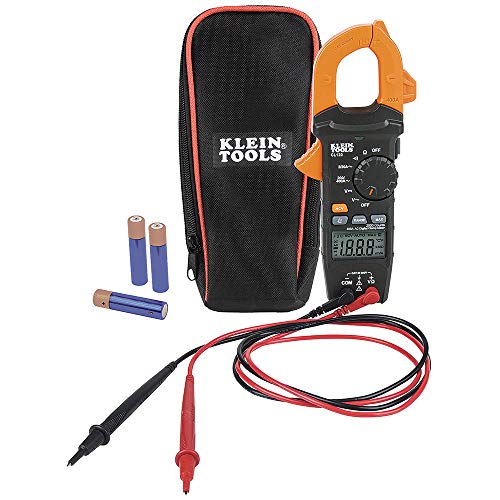
KLEIN TOOLS
Klein CL120 Digital Clamp Meter
$64.98
Auto-ranging to 400 amps AC, plus voltage, resistance and continuity. It turns the phrase "it feels slow" into an actual current reading during a session.
- Current
- To 400 A
- Also
- V, ohms, continuity
- Ranging
- Auto
Trade-off Any reading taken inside an energised panel is electrician work. Owning the meter does not change that.
Check pricePaid links. Prices shown when researched and change without notice.
Used well, these answer questions rather than fix problems. The Klein NCVT3P voltage tester confirms whether a circuit you switched off is genuinely dead. The Klein 80025 outlet and GFCI tester kit settles whether a 120 volt receptacle is wired correctly, which is the usual cause of a Level 1 cord that charges at a crawl or stops overnight. The Klein CL120 clamp meter turns an impression into a number, though any measurement taken inside an energised panel remains work for the electrician holding the licence.
What a fault code is actually telling you
Manufacturers do not share a fault code standard, so a code from one brand means nothing on another. What they do share is a small set of categories, and identifying the category is more useful than decoding the number.
- Ground fault or leakage. The charger has detected current going somewhere it should not. Physical, usually moisture or damage, and worth taking seriously if it repeats.
- Over-temperature. The enclosure, connector or contactor is too hot. Usually environmental, occasionally a failing contactor.
- Over-current or over-voltage. The supply is outside the window the unit accepts. On a long run this can be voltage sag under load rather than a supply problem.
- Pilot or communication error. The handshake with the car failed. Reseat the connector, then suspect the connector or the inlet.
- Relay or contactor welded. An internal hardware failure. The unit has correctly refused to operate and should be replaced rather than reset.
Write the code down with the time, the ambient temperature, the state of charge and whether the car was on a schedule. A pattern across five events tells an electrician more than a photograph of one error screen.
Problems that are really installation decisions
A handful of persistent complaints cannot be fixed by troubleshooting because they were decided when the circuit went in. A charger that derates every summer afternoon is mounted on the wrong wall. A unit that never reaches its rated output on a long run may be seeing sagging voltage under load, which is a conductor size question rather than a charger question. A garage where the cable will not reach the port is a placement problem that a longer cable or a different mounting position solves and no amount of diagnosis will.
If several of these apply at once, it is usually cheaper to look at the installation as a whole than to chase each symptom. The hardwired 48 amp buildout lists what a specification-led install actually contains, which is a useful yardstick for deciding whether what you have is worth repairing or worth redoing.
What to have ready before you call an electrician
Four pieces of information turn a diagnostic visit into a repair visit. Write down the breaker size and the conductor size if you know them, the charger model and its configured current limit, the supply voltage reported by the app, and the exact pattern of the fault including how long charging ran before it occurred. Add photographs of the receptacle face and of any discolouration.
That set of facts distinguishes a thermal problem from a leakage problem before anyone opens a cover, which is most of the diagnosis. It also protects you from paying for an hour of somebody rediscovering what you already knew.
Common questions
Why is my EV charging slower than the charger is rated for?
Nearly always because the car is the limit rather than the wall unit. Most electric cars cap their onboard AC charger at 11.5 kW or below, and a Nissan Leaf or an early Toyota bZ4X caps at 6.6 kW, so a 48 amp station feeding either delivers 6.6 kW and no more. The other two causes are a charger dialled to a lower current at commissioning, and a 208 volt supply instead of 240.
What does it mean when the breaker trips after an hour rather than instantly?
It means the trip is thermal rather than magnetic. An instant trip usually indicates a short or a ground fault. A trip that arrives after 40 to 90 minutes of steady current points at heat building up somewhere in the circuit: a loose lug, an undersized conductor, a crowded breaker position or a failing breaker. Stop using the circuit and have a licensed electrician inspect it before charging again.
Why does my charger reduce its output when it is hot outside?
Because it is designed to. Charging stations and their cables monitor internal temperature and reduce current when the enclosure, the contactor or the connector gets hot, which protects the hardware and the car inlet. Direct afternoon sun on a dark enclosure is the usual trigger. Shade, a small awning or moving the unit off a west-facing wall generally removes the derating entirely.
What is a CCID20 lockout?
Charging equipment includes charging circuit interrupting device protection that opens the circuit when it detects around 20 milliamps of leakage current to ground. That is far more sensitive than a breaker and much less sensitive than a 5 milliamp personnel-protection device. Water in the connector, a damp vehicle inlet or a damaged cable are the common causes, and repeated lockouts are a genuine fault to have looked at rather than an annoyance to reset.
My charger keeps dropping off Wi-Fi. Does that stop it charging?
No. Every listed home charging station charges without a network connection, because the handshake with the car is a local signal and has nothing to do with the internet. Losing Wi-Fi costs you scheduling, energy reporting and remote start, not charging. Garage walls, distance from the router and units that only join a 2.4 GHz network on a combined band are the usual reasons.
When should I stop using the circuit rather than keep troubleshooting?
Three symptoms end the conversation: any burning smell, any discolouration or warmth at a receptacle face or a charger termination, and any breaker that trips repeatedly after a period of steady charging. All three describe heat at a connection carrying high current for hours a night, which is the failure mode that starts fires. Switch the circuit off at the panel and call a licensed electrician.
Getting your own panel and load numbers ready for an electrician? The EV Home Charging Install Planner is the paid version of these pages: 8 printable worksheets you fill in with your own numbers, plus the full PDF, $29.
How this page was researched
Specifications come from manufacturer documentation, listed safety certifications and verified owner reviews. We do not perform hands-on product testing and never claim to. Figures are researched planning information, not professional electrical advice. Last reviewed 2026-08-17.