Load Management Devices
Short answer
A listed load management device lets an EV charger share an existing service instead of forcing a panel upgrade, and it typically costs 700 to 1,600 dollars installed against 3,000 to 7,000 dollars for a 100 to 200 amp service upgrade.
The most expensive sentence in home EV charging is "your panel is full". It usually arrives at the end of a site visit, attached to a service upgrade quote in the thousands, and it usually ends the project. What that sentence rarely means is that the house cannot supply the current. It means the arithmetic on paper does not leave room, because a load calculation has to assume the charger draws its full nameplate output at the same moment as everything else in the house.
Load management attacks the assumption rather than the service. A listed device watches the real current on the mains and reduces or pauses charging whenever the total approaches the limit, so the charger is no longer an uncontrolled load on paper. The result is a charging circuit added to a panel that a plain calculation said was finished, for roughly a quarter of what a service upgrade costs.
If you want the management inside the charger
Management built in
EMPORIA
Emporia Pro 48A with PowerSmart Load Management
$599.00
A 48 amp hardwired station with PowerSmart load management built into the unit, so the throttling logic and the current sensing arrive as one listed assembly rather than as a charger plus a separate box. That matters when an inspector wants to see a single listing covering the whole energy management function.
- Continuous
- 48 A
- Breaker
- 60 A
- Power
- 11.5 kW
- Management
- Built in
- Install
- Hardwired
- Connector
- J1772
Paid link. Price shown when researched.
What does a load management device actually do?
Strip away the branding and every one of these products does the same three things. It measures current somewhere upstream of the charger, usually with a pair of clamp-on current transformers on the service conductors. It compares that measurement to a configured ceiling, which is normally the service rating with a margin. Then it commands the charger to reduce its output, or to stop entirely, whenever the measurement climbs toward the ceiling.
The command half is the part people underestimate. Every J1772 charging station already knows how to tell a car to draw less, because that is how the standard works: the station signals an available current and the car obeys it. A management device does not need to switch heavy current or interrupt anything. It simply changes the number the station is advertising, from 48 amps down to 24, or to six, or to zero. The switching is done by the car, in software, in under a second, which is why this works at all.
That is also why the response is smooth rather than abrupt. When the electric range and the dryer both come on during dinner, the charger does not trip anything. It quietly drops to a lower current and climbs back afterwards, and the only person who would notice is somebody watching the app. The car keeps charging the entire time at a reduced rate, which is a much better outcome than a tripped main.
Why does a full panel not mean a full house?
A residential load calculation adds up nameplate ratings with defined demand factors. It is deliberately conservative, because it has to protect the worst case in a house the inspector has never seen. The calculation does not know that you never run the oven, the dryer and the air conditioning simultaneously, and it is not allowed to assume you will not.
Real measured demand tells a different story. Most houses with a 200 amp service peak somewhere well under half of it, and most houses with a 100 amp service spend the overwhelming majority of the year under 40 amps. The gap between calculated load and measured load is where load management lives. Run the numbers on your own house with the panel load calculator first, because the answer decides which of the three families below you should even be reading about.
A monitor makes the gap visible before you spend anything. Fit current transformers, watch the service for a few weeks through a heatwave and a cold snap, and you will have a measured peak instead of an argument. In a meaningful number of houses the measured peak makes the upgrade obviously unnecessary, and in a few it makes the upgrade obviously overdue.
Family one: an EV charger with management built in
The cleanest arrangement is a charging station that includes the sensing and the logic in its own listing. The Emporia Pro with PowerSmart is the clearest example in this catalogue: a 48 amp hardwired station whose management function is part of the product rather than an accessory bolted on afterwards. You install the station, the electrician fits the supplied sensors on the mains, and the whole assembly is what gets inspected.
The advantage is administrative as much as technical. When an inspector asks what limits the charger to a controlled maximum, pointing at one listed product with one set of instructions is a much shorter conversation than explaining how three separate devices interact. Manufacturer documentation for a listed energy management function is exactly the paperwork an inspection office wants.
The disadvantage is that you have chosen your charger and your management strategy in a single purchase. If you later want a different charging station, the management goes with it. If you have two vehicles and eventually want a second station, you are committed to whatever power sharing that manufacturer supports. Power sharing between two stations on one circuit is a real feature and worth asking about directly, because the marketing term varies between brands even where the behaviour is identical.
Family two: a current-transformer monitor that throttles the charger
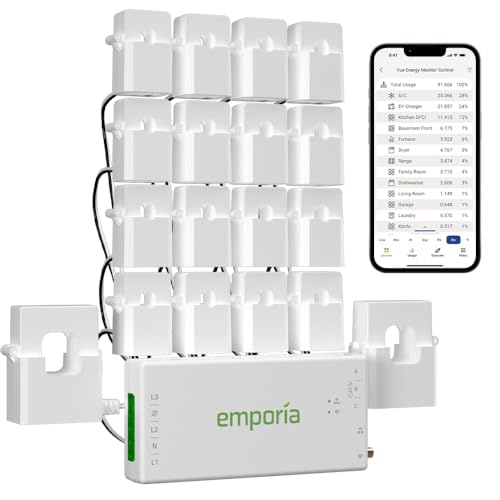
The second family separates measurement from charging. A panel-mounted energy monitor clamps current transformers around the service conductors and individual branch circuits, reports what it sees, and in the right pairing tells the charger to back off. The Emporia Vue 3 with sixteen circuit sensors is the full version, the eight sensor Vue 3 covers the handful of circuits that actually matter in most houses, and the Siemens Inhab monitor offers the same idea inside a panel manufacturer's own ecosystem. The Refoss sixteen circuit monitor is the option for anyone who wants the data staying on the local network.
Two things are worth separating carefully here, because product pages blur them constantly. Monitoring is not management. A monitor that shows you a beautiful graph of your service current has not limited anything, and it does not change a load calculation by one amp. Management requires the monitor to actually command the charger, which requires the two to speak the same protocol, which in practice usually means buying both from the same manufacturer or confirming a documented integration.
Where the split pays off is visibility. A charger with built-in management knows the total and nothing else. A circuit-level monitor tells you the electric water heater is responsible for your evening peak, which is actionable in a way a single number is not. The full set of options is laid out in the energy monitor roundup, which separates the devices that merely watch from the devices that also control.
Panel monitors, from measuring to managing
Sensor count is the practical difference. Everything here measures the mains; check the documented charger integration before assuming any of it will throttle anything.
EMPORIA
Emporia Vue 3 Energy Monitor, 16 Sensors
$199.99
Sixteen circuit sensors and two mains sensors, so you can see what the service actually draws hour by hour before anyone quotes you an upgrade. Pairs with Emporia charging hardware for throttling rather than simple monitoring.
- Circuits
- 16
- Mains
- 2
- Data
- Per circuit
Trade-off Sixteen sensors is more than a small panel needs, and the install adds bench time inside a live panel.
Check price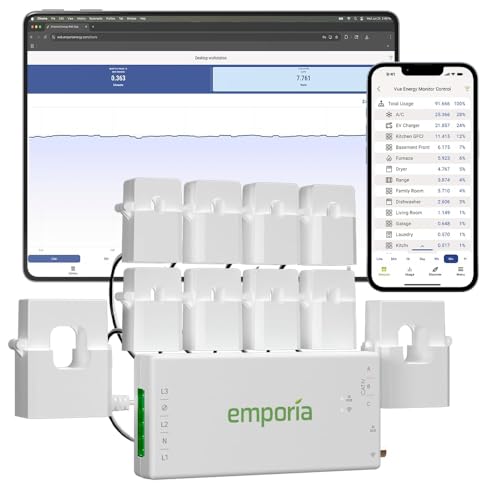
EMPORIA
Emporia Vue 3 Energy Monitor, 8 Sensors
$149.99
The same platform with eight circuit sensors, which covers the branch circuits that actually move a load calculation in a typical house: range, dryer, water heater, air conditioning and the charger.
- Circuits
- 8
- Mains
- 2
- Data
- Per circuit
Trade-off Eight sensors runs out quickly if you have two heat pumps and a shop subpanel.
Check price
SIEMENS
Siemens Inhab Smart Energy Monitor
$267.75
Sixteen circuit sensors and two 200 amp mains sensors from a panel manufacturer, which some electricians prefer because the monitoring lives in the same product family as the load centre.
- Circuits
- 16
- Mains
- 200 A
- Brand
- Siemens
Trade-off Costs meaningfully more than the equivalent third-party monitor for similar measurement.
Check price
Refoss
Refoss Smart Home Energy Monitor, 16 Circuits
$169.99
Sixteen 60 amp circuit sensors with local control, which suits anyone who would rather the measurement stayed on the home network instead of depending on a manufacturer cloud.
- Circuits
- 16
- Rating
- 60 A
- Control
- Local
Trade-off A smaller ecosystem, so integration with charging hardware needs checking before you buy.
Check pricePaid links. Prices shown when researched and change without notice.
Family three: an interlock or splitter on a circuit you already have
The third family does not manage current at all. It manages access. A splitter sits on an existing 240 volt circuit, usually the dryer outlet, and ensures only one of the two appliances can draw at a time. The Splitvolt 14-30 to 14-50 splitter switch is the established version and includes its own overcurrent protection, and the islewire smart dryer splitter is a cheaper automatic switching device that gives the dryer priority and returns the circuit to the car when the dryer finishes.
This is genuinely the lowest cost path to Level 2 charging that exists, because the circuit is already installed, already inspected and already terminated. On a 30 amp dryer circuit you get 24 amps continuous, which is 5.8 kW. That is roughly four times what a household outlet delivers and enough for almost any commute.
The constraints are real and worth stating plainly. The device must be listed for the purpose rather than improvised from adapters, because an unlisted splitter is exactly the sort of thing that fails an inspection and voids insurance. Legacy three-wire dryer outlets without an equipment ground need extra care. And you are permanently capped at whatever the existing circuit supports, so this is a bridge rather than a destination for a household that will eventually run two electric cars. The splitter roundup covers which devices carry the certifications that matter.
What does load management save against a panel upgrade?
The researched install ranges below come from published flat-rate pricing, reported homeowner quotes and permit schedules. The relevant comparison is the load management row against the service upgrade row, and the gap is the entire reason this page exists.
| Scenario | Low | High | What drives the number |
|---|---|---|---|
| Charger plugged into an existing NEMA 14-50 in the garage | $0 | $100 | No electrical work. You may still want an in-use cover or a holster. |
| New 50 amp circuit, panel on the same garage wall, run under 15 ft | $450 | $900 | The cheapest real install. Half a day of labour. |
| New 50 amp circuit, 30 to 50 ft run through finished wall | $900 | $1,600 | Most common quote. Fishing wire is what costs the money. |
| New 60 amp hardwired circuit, 40 ft run | $1,100 | $2,000 | Bigger conductor and a hardwired termination. |
| Detached garage, 80 to 150 ft with trenching | $2,500 | $6,500 | Trenching dominates. A subpanel is usually the right answer. |
| Load management device instead of a panel upgrade | $700 | $1,600 | Device plus install. Often the cheapest path on a full panel. |
| 100 to 200 amp service upgrade, then the charger circuit | $3,000 | $7,000 | Utility coordination, meter work, permits and inspection. |
| Panel relocation or a new meter main | $4,500 | $12,000 | The worst case, and the reason to get the load calculation done early. |
Read across the two rows. Load management lands at 700 to 1,600 dollars installed. A 100 to 200 amp service upgrade lands at 3,000 to 7,000 dollars, and that is before the charging circuit itself. The saving ranges from about 1,400 dollars in the most favourable upgrade case to about 6,300 dollars in the worst. If the job turns into a panel relocation or a new meter main, the ceiling climbs to 12,000 dollars and the argument for management stops being close.
The upgrade number also hides a schedule cost that quotes rarely show. A service upgrade involves the utility, which means a disconnect appointment, a meter change, an inspection and a reconnect, all coordinated between three parties. Owners routinely report waits measured in weeks. A management device is an afternoon. Where the two options produce the same charging outcome, that difference matters more than most people expect at the point of deciding. The direct head to head is in load management versus a panel upgrade.
What does a listed energy management system mean for the load calculation?
This is the part that decides whether any of the above is worth pursuing. The National Electrical Code contains provisions for energy management systems: equipment that limits current on one or more loads. Where such a system is used and is listed for the purpose, the load calculation may be based on the maximum current the system permits rather than the nameplate rating of the controlled equipment. That is the entire mechanism. A 48 amp charger that a listed system will never allow above 24 amps can be calculated as a 24 amp load.
Three words in that paragraph carry all the weight. Listed means the product carries a certification from a recognised testing laboratory covering the energy management function, not merely a listing as a charging station. Permits means the limit is enforced by the equipment rather than by a setting a homeowner can raise. And maximum means the calculation uses the ceiling the system enforces, not the average draw or the typical behaviour.
Which code cycle your jurisdiction has adopted matters here, because the provisions have been revised across editions and local amendments add or remove detail. A jurisdiction on an older cycle may handle this differently from one on the current edition. This is why the honest answer to "is this allowed" is always the same: it depends on your local adoption, and the person who knows is the plans examiner in your building department. Read how permits and inspections work before you make a purchase that depends on the answer.
Will my electrician and my inspector accept it?
Not automatically, and pretending otherwise would be doing you a disservice. Two separate approvals sit in front of every management install. The electrician has to be willing to sign their name to a load calculation that relies on the device, and the inspector has to accept that calculation. Either can say no, and both are within their rights to.
Electricians decline for practical reasons more often than philosophical ones. A device they have never installed means unfamiliar documentation, an unfamiliar commissioning procedure and a return visit if the homeowner later changes a setting. Several contractors quote a service upgrade by default simply because it is the outcome they can guarantee. That is not dishonest, it is risk management, and the way around it is to name the specific product early and ask directly whether they will work with it.
Inspectors decline when the paperwork does not establish the limit. Bring the manufacturer's listing documentation, the commissioning record showing the configured ceiling and the load calculation that uses it. A permit application that arrives with all three is a different conversation from one that arrives with a product name. If the answer is still no, you have lost the price of the device rather than the price of the upgrade, which is the cheaper way to find out.
How much charging speed do you actually give up?
Owners worry about this far more than the numbers justify, so it is worth expressing the trade-off in range rather than amps. The table below shows what each charger output delivers, and how many miles a ten hour overnight window returns at 3.5 miles per kWh with the 90 percent efficiency figure used across this site.
| Charger output | Breaker | Power | Miles per hour | Miles in 10 hours |
|---|---|---|---|---|
| 16 A | 20 A | 3.8 kW | 13 | 120 |
| 24 A | 30 A | 5.8 kW | 20 | 183 |
| 32 A | 40 A | 7.7 kW | 27 | 243 |
| 40 A | 50 A | 9.6 kW | 34 | 302 |
| 48 A | 60 A | 11.5 kW | 40 | 362 |
| 64 A | 80 A | 15.4 kW | 54 | 485 |
| 80 A | 100 A | 19.2 kW | 67 | 605 |
The last column is the one that settles the argument. Even a charger permanently held at 24 amps returns roughly 180 miles overnight. The median American driver covers under 40 miles a day. A managed charger that throttles for two hours during dinner and runs at full output for the other eight is giving up an amount of range most households would need a week to notice.
Throttling also tends to happen at the least costly moment. Household peaks cluster in the early evening, which is exactly when a time-of-use tariff makes charging most expensive anyway. A managed charger that backs off during the peak window and runs hard afterwards is doing something you would want it to do regardless. That overlap is covered in how time-of-use rates work.
Where load management is the wrong answer
The panel has no physical space
Management fixes the calculation, not the geometry. A two-pole breaker needs two adjacent full-height spaces, and tandem breakers cannot serve a 240 volt load. A panel packed with tandems can be electrically underused and still have nowhere to put the charger. That is a subpanel problem or an upgrade problem, and no device solves it.
The service equipment itself is at the end of its life
If the panel is a recalled brand, if the bus shows heat damage, or if the service entrance conductors are undersized for the existing rating, you are not deferring an upgrade, you are deferring a repair. Adding a managed charger to failing equipment concentrates load on the part of the system you already know is weak. Spend the money on the upgrade.
You are about to add other large electric loads
A household planning a heat pump, an induction range, an electric water heater and a second EV inside a few years will hit the ceiling repeatedly. Managing four large loads against a 100 amp service becomes an exercise in constant compromise. If the whole-house electrification plan is already written, the upgrade is the cheaper decision taken once. The panel upgrade buildout prices that path in full.
Nobody local will inspect it
Some jurisdictions simply have not developed a position on energy management for EV loads and will not approve what they cannot evaluate. Finding out costs one phone call to the building department. Making that call before you buy hardware is the single highest-value ten minutes in this entire project.
How to choose between the three families
Start from the panel. If your service is 100 amps, read the 100 amp panel guide first, because that is where management earns its keep most often and where a plain calculation most often says no. If your service is 200 amps and the calculation is merely tight, a monitor that proves the real peak may be all you need.
Then decide whether you want one product or two. A charger with management built in is simpler to permit, simpler to commission and simpler to explain, at the price of tying the two decisions together. A separate monitor gives circuit-level data and survives a charger replacement, at the price of needing a documented integration between the two.
If neither is affordable, a listed splitter on an existing dryer circuit is a legitimate starting point rather than a compromise to apologise for. It costs a fraction of either alternative and delivers 5.8 kW. Plenty of households run that arrangement for years and never find a reason to change it.
Where to go next
The order that saves money is: measure, calculate, then buy. Fit a monitor or borrow a clamp meter, run the panel load calculator with the real numbers, and only then decide between a managed charger, a monitor pairing and a splitter. If the calculation comes back comfortable, you have saved yourself the cost of a device you never needed, and the standard hardwired 48 amp buildout is the straightforward path from there.
Common questions
What is a load management device for an EV charger?
It is equipment that measures how much current the house is already drawing and reduces or pauses the charger so the total never exceeds the service rating. That lets a full panel accept a charging circuit it could not accept on a straight load calculation. The three common forms are management built into the charger, a separate current-transformer monitor that commands the charger, and a switching device that shares one existing circuit between two appliances.
Does load management let me skip a panel upgrade entirely?
Often yes, and that is the whole appeal. A device plus install runs roughly 700 to 1,600 dollars against 3,000 to 7,000 dollars for a service upgrade, so the saving is usually a few thousand dollars. It is not universal. If the panel has no physical space for a two-pole breaker, or the bus is damaged, or the service entrance conductors are undersized, management does not solve any of those and the upgrade is still the answer.
Will an inspector accept load management on a load calculation?
The National Electrical Code recognises energy management systems that limit current on a circuit, and where a listed system is used the calculation can be based on the controlled maximum rather than the charger nameplate. Whether your inspector accepts a particular product, and what documentation they want to see, varies by jurisdiction and by the code cycle adopted locally. Confirm the specific model with the electrician and the inspection office before you buy anything.
How much charging speed do I lose to throttling?
Far less than people expect, because throttling only happens while the house is drawing heavily and most charging happens overnight when it is not. Even a permanently reduced 24 amp setting delivers 5.8 kW, which is roughly 180 miles of range across a ten hour overnight window at 3.5 miles per kWh. Almost no household drives that in a day, so the practical cost of management is close to zero.
Is a dryer splitter the same thing as load management?
Not quite, although it solves the same problem from the other end. A splitter shares one existing 240 volt circuit between the dryer and the charger and prevents both drawing at once, either by a manual switch or automatic switching. It adds no capacity, it just prevents two loads coinciding. It is the cheapest option available, it is limited to 24 amps on a 30 amp dryer circuit, and it still needs a listed device rather than an improvised adapter.
Do I need an energy monitor if my charger already manages load?
Not for the throttling itself, since a charger with built-in management already senses what it needs. A monitor is still worth having for a different reason: it shows what the service actually peaks at through a hot afternoon or a cold morning, which is the evidence that decides whether you ever need the upgrade at all. Many owners install the monitor first and find the upgrade was never necessary.
Getting your own panel and load numbers ready for an electrician? The EV Home Charging Install Planner is the paid version of these pages: 8 printable worksheets you fill in with your own numbers, plus the full PDF, $29.
How this page was researched
Specifications come from manufacturer documentation, listed safety certifications and verified owner reviews. We do not perform hands-on product testing and never claim to. Figures are researched planning information, not professional electrical advice. Last reviewed 2026-08-17.