Best GFCI Breakers for EV Chargers
Short answer
For a 60 amp EV charger circuit that needs ground-fault protection at the panel, the Eaton BRN260GF two-pole 60A GFCI breaker at around $112.81 is the pick, provided your load centre is an Eaton BR panel. Breakers are not interchangeable across brands: the device must be listed for the specific load centre it goes into, and the panel label names the acceptable catalogue numbers.
If your EV charger circuit needs ground-fault protection at the panel and your load centre is an Eaton BR panel, the breaker is the Eaton BRN260GF 60A GFCI at around $112.81 for a 48 amp charger, or the Eaton BRN250GF 50A GFCI at around $91.00 for a 40 amp one. If your panel label lists Square D QO breakers, it is the Square D QO250GFI at around $99.75. If it lists Siemens, it is the Siemens QF250A at around $83.00.
That list is the entire shape of this category and it is why the page is organised by situation rather than by price. Breakers are not a general-purpose commodity. A circuit breaker is listed for use in specific load centres, the panel label inside the door names the acceptable catalogue numbers, and a breaker from the wrong family is not an economy, a workaround or a matter of taste. There is no universally best GFCI breaker for an EV charger. There is only the one your panel is listed to accept, at the rating your charger requires, and the genuinely useful question underneath it is whether you need a ground-fault breaker at all.
Top pick, two-pole GFCI breaker
Best 60 amp GFCI
Eaton
Eaton BRN260GF 60A GFCI
$112.81
A two-pole 60 amp GFCI breaker, which is the size a 48 amp hardwired charger sits on, from the brand whose BR load centres are in a very large share of American houses. It is the only 60 amp two-pole GFCI device in this catalogue, and 60 amps is the size most modern charger circuits land on. Buy it only if your panel is an Eaton BR panel, because a breaker that does not belong in your load centre is not a bargain at any price.
- Rating
- 60 A
- Poles
- Two
- Volts
- 120/240 V
- Family
- Eaton BR
- Type
- GFCI
Paid link. Price shown when researched.
Why can you not just buy the cheapest 60 amp GFCI breaker?
Because a breaker is not an accessory, it is a listed component of a listed assembly. The load centre and the breakers that go in it are tested together, and the manufacturer's label states which catalogue numbers may be installed. Using anything else voids the listing of the panel, and inspectors look for exactly this. The bus stab geometry, the interrupting rating, the way the breaker seats and the mechanical retention are all part of that tested combination.
The trap is that several families are close enough to clip in. Square D sells two entirely separate residential families, QO and Homeline, and the breakers are not interchangeable even though both boxes say Square D. Siemens, Murray and ITE panels share a good deal of history and a similar footprint, and a breaker that fits one is not automatically listed for another. Eaton sells BR and CH families with different footprints entirely. Any of these can be made to physically go in. None of them should be.
There is also a whole category of so-called classified breakers, sold as compatible replacements across brands. They carry their own listing and their sellers will tell you they are acceptable. Panel manufacturers say otherwise on their own labels, plenty of inspectors reject them, and for a circuit that runs at near its rating for eight hours a night it is a strange place to look for a saving. Read the panel label, buy the family it names, and if the panel label is missing or illegible that is itself something your electrician needs to see.
| Panel family | 50 A GFCI | 60 A GFCI | Standard equivalent | The trap |
|---|---|---|---|---|
| Eaton BR | BRN250GF | BRN260GF | BR250 or BR260 | Eaton CH panels are a different family and take CH breakers, not BR. |
| Square D QO | QO250GFI | QO260GFI | QO250 or QO260 | The narrow-footprint premium family. QO breakers do not fit Homeline. |
| Square D Homeline | HOM250GFI | HOM260GFI | HOM250 or HOM260 | Builder-grade Square D. Same brand name, different breaker entirely. |
| Siemens QP | QF250A | QF260A | Q250 or Q260 | Murray and ITE panels often share the footprint but check the label. |
| GE or ABB | Check panel label | Check panel label | Check panel label | Sold under ABB now, and catalogue numbers have moved. Confirm locally. |
Catalogue numbers move over time and the table above is a starting point for a conversation, not a purchase order. The authority is the label inside your own panel door. If you are shopping ahead of an electrician's visit, photograph that label and read it against whatever you are about to buy.
What size breaker does the charger actually need?
The rating comes from the charger, not from the panel and not from the receptacle. EV charging is a continuous load, so the branch circuit is sized at 125 percent of the charger's continuous output. A 32 amp charger needs a 40 amp breaker, a 40 amp charger needs a 50 amp breaker, and a 48 amp charger needs a 60 amp breaker. Read the rule the other way and a 50 amp breaker supports a charger drawing 40 amps continuously, which is exactly why a NEMA 14-50 receptacle is always paired with a 40 amp unit.
| Charger output | Breaker | Power at 240 V | Typical copper | Where it fits |
|---|---|---|---|---|
| 32 A | 40 A | 7.7 kW | 8 AWG | Plenty for a car with a 6.6 or 7.2 kW onboard charger. |
| 40 A | 50 A | 9.6 kW | 6 AWG | The most common home install. Fits a NEMA 14-50 outlet. |
| 48 A | 60 A | 11.5 kW | 6 AWG | Hardwired only. Saturates almost every onboard charger sold. |
| 64 A | 80 A | 15.4 kW | 4 AWG | Rare. Very few vehicles can use it. |
Two things follow from that table and both of them shape what you buy. The first is that 50 and 60 amps are the only two ratings most home charger circuits will ever use, which is why this page carries those two sizes and not a full catalogue. The second is that the 60 amp row is hardwired, because a NEMA 14-50 receptacle tops out at 40 amps continuous and no mainstream manufacturer builds a 48 amp plug-in unit. The arithmetic for any output is in the breaker size calculator, and the plug-in against hardwired decision is argued out in hardwired versus plug-in.
GFCI, GFPE and the protection already inside your charger
Three different things get called ground-fault protection and they are not equivalent. A Class A GFCI trips at about 5 milliamps of imbalance between the conductors. That threshold is set below the level at which current across a human body becomes dangerous, which is the entire point: a GFCI is people protection. Ground fault protection of equipment, usually written GFPE, trips far higher, commonly around 30 milliamps, and exists to limit damage to wiring and equipment rather than to protect a person.
Then there is the protection inside the charger. Listed EV charging equipment contains a charge circuit interrupting device that monitors the cable and the vehicle connection and opens the circuit on a fault, typically at around 20 milliamps. That is why many hardwired charging units are treated differently from a plain receptacle: the equipment itself carries listed protection for the part of the circuit that a person actually handles, which is the cable and the connector.
| Device | Trips at | Protects | Lives where | Typical use |
|---|---|---|---|---|
| Class A GFCI breaker | 5 mA | People | At the panel, protecting the whole branch circuit | Receptacle-fed charger in a garage or outdoors |
| GFPE device | 30 mA typical | Equipment and wiring | At the panel or in equipment | Feeders and some commercial charging equipment |
| Charge circuit interrupting device | 20 mA typical | People at the cable and vehicle | Inside the charging unit itself | Built into listed EV charging equipment |
| Standard two-pole breaker | No ground-fault function | Conductors from overcurrent only | At the panel | Hardwired charger with listed internal protection |
The practical consequence is the single most useful thing on this page. A receptacle-fed installation in a garage, a basement or outdoors generally requires ground-fault protection on the branch circuit, because the receptacle is a general-purpose outlet that anything could be plugged into and nothing about it knows a car is on the other end. A hardwired unit with listed internal protection is a different case, and in many jurisdictions it sits on a standard breaker. Which code cycle your jurisdiction has adopted changes the answer, and the 2020 and 2023 cycles both widened the receptacle requirement. The background is in GFCI requirements for EV chargers, and the receptacle side of the job is in NEMA 14-50 outlet installation.
Situation one: a receptacle-fed 50 amp circuit
This is the most common case on the page and the one where the answer is least ambiguous. You are having a NEMA 14-50 or 6-50 receptacle installed in a garage, in a carport or on an exterior wall, and a 40 amp plug-in charger will hang next to it. The receptacle needs ground-fault protection under current code cycles, the circuit is 50 amps, and the device you need is a two-pole 50 amp GFCI breaker listed for your panel. All four options below do the identical job. The only question is which panel you own.
Situation one: 50 amp two-pole GFCI, $83 to $132
Four panel families, one function. Read your panel label and buy the row that matches it, because none of these is a substitute for another.

Square D
Square D QO250GFI 50A GFCI
$99.75
A two-pole 50 amp GFCI breaker carrying the Square D QO-series catalogue number, which is the family distinct from Homeline despite both being sold as Square D. On a 50 amp circuit it protects a NEMA 14-50 or 6-50 receptacle feeding a 40 amp charger. Confirm the catalogue number against your panel label before ordering.
- Rating
- 50 A
- Poles
- Two
- Series
- Square D QO
- Charger
- 40 A max
Trade-off A Homeline load centre takes HOM breakers instead, even though both boxes say Square D.
Check price
Schneider Electric
Square D HOM250GFICP Homeline 50A GFCI
$132.30
The Homeline version of the same device. Homeline is the builder-grade Square D family found in an enormous number of houses built or re-panelled in the last thirty years, and it takes HOM breakers rather than QO breakers.
- Rating
- 50 A
- Poles
- Two
- Series
- Homeline
- Charger
- 40 A max
Trade-off The dearest 50 amp GFCI breaker here, and the price gap over the QO version buys you nothing except fit.
Check price
SIEMENS
Siemens QF250A 50A GFCI
$83.00
A two-pole 50 amp ground fault circuit interrupter breaker, 240 volt, rated 10,000 AIC, carrying a Siemens catalogue number. It is the least expensive 50 amp GFCI in the group. Older Murray and ITE panels look similar to Siemens ones and are not all covered, so the panel label rather than the appearance decides.
- Rating
- 50 A
- Poles
- Two
- Series
- Siemens
- Interrupting
- 10 kAIC
Trade-off Verify the panel label rather than assuming, because lookalike panels are common in this family.
Check price
Eaton
Eaton BRN250GF 50A GFCI
$91.00
The 50 amp Eaton BR device with a pigtail neutral, for the receptacle-fed case where the charger is a 40 amp plug-in unit on a 14-50. Same family as the 60 amp top pick, so if your panel takes one it takes the other.
- Rating
- 50 A
- Poles
- Two
- Family
- Eaton BR
- Neutral
- Pigtail
Trade-off The pigtail neutral needs a free neutral bar position, which a crowded panel may not have.
Check pricePaid links. Prices shown when researched and change without notice.
The Siemens QF250A is the cheapest of the four at around $83.00 and carries a 10,000 AIC interrupting rating, which is the normal residential figure. The Square D HOM250GFI is the dearest at around $132.30, and the gap between it and the QO250GFI at around $99.75 is a good illustration of the point. Both are Square D. Both are 50 amp two-pole GFCI breakers. Neither belongs in the other's panel, and the price difference buys you fit rather than function.
The Eaton BRN250GF has one detail worth flagging before the electrician arrives. The N in the catalogue number is the pigtail neutral, a factory-fitted white lead that has to land on the panel's neutral bar. On a panel that is already full of neutrals with no spare position, that is a small extra job. It is not a reason to choose differently, but it is a reason to have the panel open and looked at rather than ordering parts blind.
Situation two: a 60 amp hardwired circuit that still needs GFCI at the panel
A 48 amp charger sits on a 60 amp circuit and is hardwired, because the receptacle options have run out. Most of those units carry listed internal protection, which is why the tier below this one exists. But some jurisdictions, some inspectors and some unit-specific installation instructions still call for ground-fault protection at the panel, and when they do the device gets noticeably harder to source. There is exactly one 60 amp two-pole GFCI breaker in our verified catalogue, and the other two cards here run a category search for comparable hardware rather than naming a part number we cannot vouch for.
Situation two: 60 amp two-pole GFCI, around $113 for the verified one
The 48 amp charger case. Availability at 60 amps is thinner than at 50, and a local supply house often beats a marketplace listing on both price and lead time.
Eaton
Eaton BRN260GF 60A GFCI
$112.81
The 60 amp two-pole GFCI breaker, which is the size a 48 amp hardwired charger requires under the 125 percent continuous load rule. If your jurisdiction wants ground-fault protection at the panel for a 60 amp charger circuit and your load centre is an Eaton BR, this is the device.
- Rating
- 60 A
- Poles
- Two
- Family
- Eaton BR
- Charger
- 48 A max
Trade-off Costs roughly six times a standard 60 amp breaker, and it is the layer most likely to nuisance trip.
Check priceVarious
60 Amp Two-Pole GFCI Breakers, Other Panel Families
If your panel is not an Eaton BR, you need the 60 amp two-pole GFCI device from your own panel family, and we have no verified listing for one. This button runs a category search for comparable hardware rather than a specific unit, so read every result against your panel label before ordering.
Trade-off Availability at 60 amps is genuinely patchy, and a local supply house often beats a marketplace.
Check priceVarious
50 Amp Two-Pole GFCI Breakers, Compared Side by Side
The step below, listed here because a 40 amp charger on a 50 amp circuit is a far more common project than a 48 amp one and the 50 amp devices are stocked everywhere. Again a category search rather than one product, since the correct device is decided by your panel label.
Trade-off A 50 amp breaker caps you at a 40 amp charger, so it is the wrong size if 48 amps is the plan.
Check pricePaid links. Prices shown when researched and change without notice.
The Eaton BRN260GF is the top pick on this page for a simple reason: it is the size that matches the charger most people should be buying, in the panel family most likely to be on the wall. At around $112.81 it costs about six times what a plain Eaton BR260 costs, and understanding whether you need that difference is worth a five minute conversation with your electrician before anybody orders anything.
The two category-search entries in that group are deliberate. We have not verified a live listing for a 60 amp two-pole GFCI device in any panel family other than Eaton BR, so rather than print a catalogue number as though we had, those buttons run a search for comparable hardware instead of pointing at one specific unit. That is the correct behaviour and not a gap in the page. A fabricated part number on an electrical component is worse than no part number at all, because somebody will order it.
Situation three: a hardwired unit with internal protection, where a standard breaker may be enough
This is the tier most 48 amp hardwired installations actually land in, and it is the reason the page is worth reading before you spend a hundred dollars on a breaker. A large share of hardwired charging units contain listed ground-fault protection inside the enclosure. Where that is the case, and where the jurisdiction and the manufacturer's instructions both allow it, the branch circuit sits on an ordinary two-pole breaker and the ground-fault function you were about to buy is already in the box on the wall.
Situation three: standard two-pole breakers, $17 to $33
Overcurrent protection only, at a fifth the price. Correct only when the charging unit carries listed internal protection and your inspector signs off on it.

Eaton
Eaton BR260 60A Two-Pole Breaker
$19.49
A plain two-pole 60 amp Eaton BR breaker, roughly a fifth the price of the GFCI version. This is the device on a large share of hardwired 48 amp charger installs, because many hardwired chargers carry listed ground-fault protection inside the unit.
- Rating
- 60 A
- Poles
- Two
- Family
- Eaton BR
- Type
- Standard
Trade-off Only correct if the charger genuinely carries listed protection and your inspector agrees.
Check price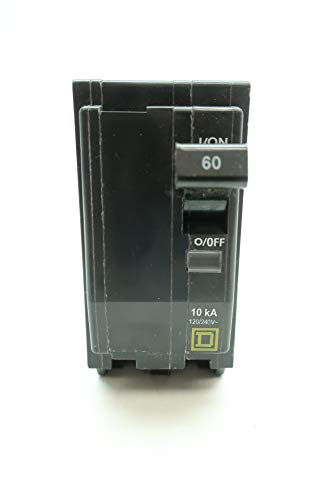
Square D
Square D QO260 60A Two-Pole Breaker
$32.75
The standard two-pole 60 amp breaker carrying the Square D QO-series catalogue number. This is the ordinary version of the device a 48 amp hardwired charger sits on when no panel-level ground-fault protection is required. Confirm the number against your panel label first.
- Rating
- 60 A
- Poles
- Two
- Series
- Square D QO
- Type
- Standard
Trade-off Costs more than the Eaton and Siemens equivalents for the same function.
Check price
SIEMENS
Siemens Q260 60A Two-Pole Breaker
$19.39
The Siemens standard two-pole 60 amp QP breaker, the cheapest device on this page and the one a great many 48 amp hardwired installs actually end up on. Two adjacent full-size spaces in a Siemens load centre is all it asks for.
- Rating
- 60 A
- Poles
- Two
- Type
- Siemens QP
- Function
- Standard
Trade-off No ground-fault function at all, so it is the wrong device for a receptacle-fed install.
Check price
SIEMENS
Siemens Q250 50A Two-Pole Breaker
$16.95
The 50 amp Siemens standard breaker, for a 40 amp hardwired charger where protection lives in the unit. Worth listing because plenty of 40 amp chargers are hardwired rather than plugged in, and that changes which breaker is correct.
- Rating
- 50 A
- Poles
- Two
- Type
- Siemens QP
- Charger
- 40 A max
Trade-off Not a legitimate choice behind a receptacle in a garage or outdoors under current code cycles.
Check pricePaid links. Prices shown when researched and change without notice.
The Siemens Q260 at around $19.39 and the Eaton BR260 at around $19.49 are the two cheapest parts on this page, and between them they cover a very large share of American residential panels. The Square D QO260 at around $32.75 costs more because QO costs more, which is a fact about the family rather than about the device. The Siemens Q250 at around $16.95 is there for the 40 amp hardwired case, which is more common than people expect: plenty of 40 amp chargers are wired in permanently rather than plugged into anything.
Who should not buy from this tier
Anyone installing a receptacle. If the plan involves a NEMA 14-50 or a 6-50 in a garage, a basement, a carport or anywhere outdoors, a standard breaker is very likely not the correct device under the code cycle your jurisdiction has adopted, and choosing one to save eighty dollars on a job costing well over a thousand is the wrong trade in the wrong place. Anyone whose charger documentation calls for a GFCI breaker should also stay out of this tier, because the manufacturer's installation instructions are part of the listing and an inspector can hold you to them.
How we chose these breakers
We did not test any of these devices and we do not claim to. There is no bench here, no instrumented panel and no trip-curve data of our own. For a component whose entire job is to open a circuit at 5 milliamps, saying otherwise would be worse than useless.
What the picks are built from is published manufacturer specifications, the listing information for each device, panel compatibility as stated by the panel manufacturers, and verified owner reviews read in volume. The first filter is listing and fit, and it is not negotiable: a breaker is included here only where the manufacturer states the load centre families it belongs in, and every card names that family explicitly rather than implying universal compatibility. The second is interrupting rating, where 10,000 AIC is the ordinary residential figure and anything lower would be a reason to look harder at the application.
The third filter is availability, which sounds mundane and is not. A 50 amp two-pole GFCI breaker is a stocked item in every panel family. A 60 amp two-pole GFCI breaker is not, and the difference shows up as back-orders and inflated marketplace pricing. Where we could not verify a live listing, the card is a search link with no part number attached. The fourth filter is the failure pattern visible in owner reviews, which for this category is overwhelmingly nuisance tripping rather than failure to trip, and that pattern is what the buying tips below are built around. Prices were accurate when researched and change without notice.
Buying tips: the four things that go wrong
Photograph the panel label before you buy anything
The label inside the panel door lists the breaker catalogue numbers that load centre is listed to accept. That label, not a table on a web page and not a marketplace compatibility chart, is the authority. If the label is missing, painted over or unreadable, the panel needs an electrician's eyes on it anyway, and ordering parts before that happens is how the wrong breaker ends up in a drawer.
Do not stack two layers of ground-fault protection without a reason
Listed charging equipment already contains a charge circuit interrupting device. Putting a Class A GFCI breaker upstream of it does not double your safety, but it does measurably increase the chance of false trips, because two devices are now watching the same small leakage currents with different thresholds and different filtering. Where the code and the manufacturer's instructions permit a standard breaker on a hardwired unit, that is usually the more reliable installation as well as the cheaper one.
Expect nuisance tripping on long runs, and plan the run accordingly
This is the specific complaint that dominates owner reviews in this category, and it is real rather than imagined. Longer conductor runs accumulate more capacitive leakage to ground, moisture in a receptacle or a connector adds more, and normal leakage from the vehicle's own electronics sums with all of it. A circuit that trips intermittently at 2am is not a circuit anybody diagnoses happily. Keeping the run as short as the layout allows, keeping the receptacle genuinely dry, and choosing a receptacle position that does not sit in the weather all reduce the odds. If it still trips, that is a diagnosis for an electrician, and the answer is never to bypass the device.
Buy the breaker last, not first
The order of decisions is charger, then circuit, then panel capacity, then breaker. If the load calculation comes back tight the whole project may change shape, and a breaker bought early becomes a part you cannot return. Run the breaker size calculator to fix the rating, and let the electrician confirm the family and the position before anything is ordered.
Budget the permit and the inspection in from the start
Ground-fault protection is one of the specific items an inspector looks at on an EV charging circuit, which makes it a poor place to improvise. A permit and inspection are normally required, they are usually a small fraction of the total invoice, and the signed inspection is what an insurer or a future buyer asks about. What that process involves is set out in EV charger permit and inspection.
Where to go next
If you have not yet settled whether the charger plugs in or is wired in, that decision drives everything on this page, so read hardwired versus plug-in first. If the plan is a receptacle, the whole job including the ground-fault question is in NEMA 14-50 outlet installation. And if you want the code background rather than the shopping list, that is in GFCI requirements for EV chargers.
Common questions
Do I need a GFCI breaker for an EV charger?
It depends on whether the charger plugs in and on which code cycle your jurisdiction adopted. A receptacle in a garage, a basement or outdoors generally requires ground-fault protection, and the 2020 and 2023 code cycles widened that to cover the 240 volt receptacles used for charging. A hardwired charger with listed protection built into the unit is treated differently and often sits on a standard breaker. Your electrician and inspector decide, not a web page.
Can I use any brand of GFCI breaker in my panel?
No. A breaker must be listed for the specific load centre it goes into, and the panel label lists the acceptable catalogue numbers. An Eaton BR breaker does not belong in a Square D panel, and a Square D QO breaker does not belong in a Square D Homeline panel despite the shared brand. A breaker that physically clips in is not the same as a breaker that is listed for the bus it clips onto.
What is the difference between GFCI and GFPE?
A Class A GFCI is people protection and trips at about 5 milliamps of imbalance, which is below the level that causes serious harm. Ground fault protection of equipment trips much higher, commonly around 30 milliamps, and exists to protect wiring and equipment rather than a person. They are not interchangeable, and a specification that calls for one is not satisfied by the other.
Why does my EV charger keep tripping the GFCI breaker?
The common causes are a long conductor run, moisture in a receptacle or connector, two layers of ground-fault protection fighting each other, and normal leakage current from the vehicle summing with the circuit. Listed charging equipment already contains a charge circuit interrupting device, so stacking a panel GFCI on top of it makes false trips more likely. Diagnosing it is electrician work, not something to solve by defeating the protection.
How much does a GFCI breaker for an EV charger cost?
Between roughly 83 and 132 dollars for a two-pole 50 amp device depending on the panel family, and about 113 dollars for the 60 amp Eaton version. A standard two-pole breaker of the same rating is closer to 17 to 33 dollars. The difference matters when the charger itself already contains listed protection, because you may be buying the same function twice.
Can I install a breaker in my own panel?
No. The interior of a load centre stays energised at the lugs even with the main breaker off, the bus is unforgiving of a partially seated breaker, and torque values on the lugs are specified for a reason. A licensed electrician must size and install the breaker and the circuit, a permit and inspection are normally required, and code requirements vary by jurisdiction.
Getting your own panel and load numbers ready for an electrician? The EV Home Charging Install Planner is the paid version of these pages: 8 printable worksheets you fill in with your own numbers, plus the full PDF, $29.
How this page was researched
Specifications come from manufacturer documentation, listed safety certifications and verified owner reviews. We do not perform hands-on product testing and never claim to. Figures are researched planning information, not professional electrical advice. Last reviewed 2026-08-17.