Conduit for an EV Charger Circuit
Short answer
A 60 amp EV charger circuit in 6 AWG THHN normally lands on 1 inch conduit. Four 6 AWG conductors occupy 0.2028 square inches and the 40 percent fill limit in three quarter inch schedule 40 PVC is 0.2032, a margin nobody wants to pull against. Schedule 40 PVC is buried at 18 inches of cover, direct burial conductors at 24.
Conduit is the part of an EV charger install that homeowners think about least and installers think about most. It decides whether the conductors can be pulled at all, whether the run survives a lawn mower and a winter, whether the circuit can be upsized later without opening a wall, and whether the inspector signs the card. It is also the only part of the job you can look at afterwards, which is why a tidy raceway is a reasonable proxy for the quality of everything hidden behind it.
Three products cover almost every home charging install: EMT for exposed indoor runs, schedule 40 PVC for anything outdoors or underground, and a short liquid-tight whip at the charger. The rest of this page is about which belongs where, how much conductor fits inside, and the handful of rules that turn a working install into a passing one.
For the 6 AWG run on a 60 amp circuit
The 6 AWG raceway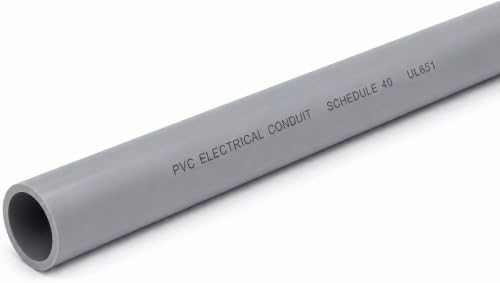
Generic
1 inch Schedule 40 PVC Electrical Conduit
$17.21
One inch schedule 40 PVC is the raceway a 60 amp charger circuit lands on, indoors on a garage wall or outdoors on a run to a detached building. Marked sunlight resistant and rated for underground burial, which are the two markings that decide whether it is legal where you want to put it.
- Trade size
- 1 in
- Schedule
- 40
- Fill at 40%
- 0.333 sq in
- Sunlight
- Resistant
- Burial
- Rated
- Listing
- UL 651
Paid link. Price shown when researched.
Which raceway belongs where?
The choice is made by location rather than by preference. Indoors, exposed on a garage wall, EMT is the default because it is tough, it bends cleanly and it looks like somebody meant it. Outdoors and underground, PVC is the default because it does not corrode, it glues rather than threads and it is rated for burial. The flexible piece at the charger is liquid-tight because rigid raceway cannot absorb movement or alignment error.
| Raceway | Where it belongs | What it is good at | What to watch |
|---|---|---|---|
| EMT, electrical metallic tubing | Exposed indoor runs on a garage wall, and exposed outdoor runs with wet-location fittings. | Thin wall steel, physically tough, bends cleanly with a hand bender, looks deliberate. | Corrodes where it meets concrete or standing water. Not for direct burial. |
| PVC, schedule 40 | Underground runs, and exposed outdoor runs where it is marked sunlight resistant. | Cheap, glued rather than threaded, immune to corrosion, rated for burial. | Expands and contracts with temperature. Needs an expansion fitting on long outdoor runs. |
| PVC, schedule 80 | Anywhere exposed to physical damage, including the section that comes out of the ground. | Thicker wall than schedule 40 for the same outside diameter. | The thicker wall means less internal area, so fill is calculated from the schedule 80 figures. |
| Liquid-tight flexible, non-metallic | The short flexible whip between rigid raceway and the charger, and at the panel. | Absorbs vibration and alignment error, seals against water at both ends. | Carries no fault path of its own, so the equipment ground is pulled inside it. |
| Rigid metal conduit | Where physical protection matters most, such as a bollard or a pedestal riser. | The toughest option, and the shallowest permitted burial depth of the common types. | Threaded, heavy and slow. Rarely justified on a residential charger circuit. |
One rule cuts across the whole table. The moment a run leaves a dry interior, everything changes: the raceway, the fittings, the conductor insulation and often the boxes. A conduit that leaves a heated garage and enters an unheated crawlspace has crossed into a location where condensation forms inside the pipe, and the wiring method has to be rated for that whether or not it ever sees rain.
Do you even need conduit indoors?
Not always. A run through finished framing in a dry interior can use jacketed cable, which is faster and cheaper than pulling individual conductors through pipe. That is the normal method for a charger on the other side of a finished garage wall from the panel, and it is why a short interior job is the cheapest install on the list.
Conduit wins in three situations and they are common. Exposed runs on a garage wall need physical protection, and cable stapled across open block or studs at car-bumper height is asking to be damaged. Any run that leaves the interior needs raceway with the correct conductors inside. And a raceway is the only version of this circuit that can be re-pulled later, which matters more than people expect: a household that upgrades from a 40 amp charger to a 48 amp one can pull new conductors through existing conduit for a fraction of the cost of a new run. Conductor selection for either method is covered in wire size for an EV charger.
What is the 40 percent fill rule, and why does 6 AWG land on 1 inch?
Conduit fill is a ratio between the cross-sectional area of the conductors and the internal area of the pipe. The published limits are 53 percent for a single conductor, 31 percent for exactly two, and 40 percent for three or more, which is every EV charger circuit. The limit exists because conductors have to be pullable without stripping insulation, and because a tightly packed raceway traps heat around conductors that are already running near their rating for hours at a time.
Now the arithmetic that decides the job. A 6 AWG THHN conductor occupies 0.0507 square inches and an 8 AWG occupies 0.0366. A hardwired charger circuit with two hots and a ground comes to 0.1380 square inches. Add a neutral, which a receptacle circuit needs, and it is 0.1887. Run a full-size 6 AWG ground instead of an 8 and it is 0.2028.
| Trade size | PVC 40 internal area | PVC at 40 percent | EMT at 40 percent | 6 AWG THHN that fit | Verdict for a charger circuit |
|---|---|---|---|---|---|
| 1/2 in | 0.285 | 0.114 | 0.122 | 2 | Too small for a 60 amp charger circuit in 6 AWG. |
| 3/4 in | 0.508 | 0.203 | 0.213 | 4 | Four 6 AWG fit on paper, with almost nothing spare. |
| 1 in | 0.832 | 0.333 | 0.346 | 6 | Comfortable for four 6 AWG, with room to add a conductor later. |
| 1 1/4 in | 1.453 | 0.581 | 0.598 | 11 | Comfortable for four 6 AWG, with room to add a conductor later. |
| 1 1/2 in | 1.986 | 0.794 | 0.814 | 15 | Comfortable for four 6 AWG, with room to add a conductor later. |
| 2 in | 3.291 | 1.316 | 1.342 | 25 | Comfortable for four 6 AWG, with room to add a conductor later. |
Look at the three quarter inch row. The 40 percent limit is 0.2032 square inches and four 6 AWG conductors are 0.2028. It fits by four ten-thousandths of a square inch. That is a compliant installation on paper and a miserable one in the hand, because the pull force through two ninety degree bends at that packing factor is enough to skin insulation, and because there is no room whatsoever for a future change. One inch takes the limit to 0.333 square inches, which is a cushion of roughly 60 percent over what the circuit needs, costs a few dollars more across a residential run and pulls like a different job. That is why the answer is 1 inch.
Which PVC schedule, and does it need to be sunlight resistant?
Schedule 40 is the standard weight and covers underground runs and most exposed work. Schedule 80 has a thicker wall for the same outside diameter and is used where the raceway is exposed to physical damage, which most often means the section that comes vertically out of the ground before it enters a wall or a pedestal. Because the wall is thicker, the internal area is smaller, so fill for a schedule 80 run is calculated from the schedule 80 dimensions rather than the ones above.
Sunlight resistance is a marking, not an assumption. PVC exposed to ultraviolet without that listing becomes chalky and brittle over a few years, and a brittle raceway on an outside wall stops being protection at the first knock. The 1 inch schedule 40 PVC in the catalogue is marked sunlight resistant and rated for underground burial, which is the combination an outdoor charger run needs. Check the print on the pipe rather than the listing page.
Why does a long outdoor PVC run need an expansion fitting?
PVC moves with temperature far more than steel does. The published figure is roughly 4 inches of length change per 100 feet of conduit for every 100 degrees Fahrenheit of temperature swing. An exposed run on a south-facing wall in a climate that goes from below freezing to well over 100 degrees at pipe surface temperature is living through most of that range every year.
An expansion fitting is normally required once the calculated movement passes about a quarter of an inch, which arrives sooner than people expect: a 50 foot exposed run in a climate with a wide swing is already there. Without one, the movement has to go somewhere, and it goes into the glued joints, the strap positions and eventually the box the run terminates in. Underground runs need this far less because soil temperature below the frost line barely moves, which is one more small advantage of burying the run rather than surface mounting it.
Support spacing belongs in the same conversation. PVC at 1 inch trade size is supported at close intervals and within a short distance of every box, and it sags between straps in heat if it is not. EMT is supported within 3 feet of each box and at regular intervals along the run. A raceway that passes inspection and then sags into a graceful curve over one hot summer was supported to the letter and not to the intent.
Where does liquid-tight belong on an EV install?
In two places, both of them short. The first is at the charger. A hardwired unit is a piece of equipment bolted to a wall, and connecting it with rigid conduit means every alignment error becomes stress on the enclosure knockout. A liquid-tight whip absorbs that, seals the entry against water, and lets a failed charger be swapped without cutting into the raceway. Many hardwired units ship with a whip already fitted, which is a strong hint about how the manufacturer expects it to be installed.
The second is at the panel or at a disconnect, where the same argument applies in reverse. Beyond those two, liquid-tight is not a substitute for rigid raceway. Flexible conduit used as a general wiring method for a long run is unsupported, hard to protect and expensive per foot, and a run made entirely of flexible conduit is a tell that somebody was avoiding the bending.
Size the whip to the conductors, not to the charger's knockout. Squeezing 6 AWG into a three quarter inch whip because the fitting was in the van produces exactly the fill problem described above at the hottest point in the circuit. The 1 inch liquid-tight kit matches 1 inch rigid raceway, and the three quarter inch roll with seven fittings covers the smaller conductor cases and gives you spare fittings, which you will want.
One structural point about non-metallic liquid-tight: it provides no metallic fault-current path at all, so the equipment grounding conductor has to be pulled inside it. That is normal and expected, and it is worth knowing because it is the sort of detail that gets skipped when somebody assumes the metal fittings are doing the job.
The flexible sections and the one tool that matters
Prices researched from published listings and current when this page was written. They change without notice.

Wocloer
3/4 inch Liquid-Tight Flexible Conduit, 25 ft
$26.79
Three quarter inch liquid-tight in a 25 foot roll with straight and angled fittings included. The right size for a hardwired charger fed by 6 AWG when the flexible section is short.
- Size
- 3/4 in
- Length
- 25 ft
- Type
- Non-metallic
- Fittings
- 7 included
Trade-off Non-metallic liquid-tight gives no metal fault path, so the equipment ground must be pulled inside it.
Check price
Wocloer
1 inch Liquid-Tight Conduit Kit, 10 ft
$21.99
One inch liquid-tight in a 10 foot kit with four fittings, sized to match the 1 inch rigid raceway the rest of the circuit runs in so the conductors are not squeezed at the transition.
- Size
- 1 in
- Length
- 10 ft
- Type
- Non-metallic
- Fittings
- 4 included
Trade-off Ten feet is enough for one charger and one panel connection, and no more.
Check price
KLEIN TOOLS
Klein 51605 Iron Conduit Bender, 1 inch EMT
$104.97
A 1 inch EMT bender with a wide foot pedal and angle markings. Bending your own offsets is what makes an EMT run look intentional rather than improvised, and it removes a fitting at every turn.
- For
- 1 in EMT
- Also
- 3/4 in rigid
- Marks
- Benchmarks
- Build
- Iron
Trade-off Only worth buying if you are running EMT and doing more than one project with it.
Check pricePaid links. Prices shown when researched and change without notice.
How deep does the trench have to be?
Burial depth is set by what is in the trench and what is above it, and the differences are large enough to change a weekend of digging into a different weekend of digging. The general case for schedule 40 PVC is 18 inches of cover. Conductors buried directly with no raceway at all need 24 inches. Rigid metal conduit, which is the toughest of the three, is permitted at 6 inches in the general case.
| Location | Direct burial | PVC raceway | Rigid metal | Note |
|---|---|---|---|---|
| General, all locations not listed below | 24 in | 18 in | 6 in | The default for a trench across a lawn to a detached garage. |
| Under a one or two family dwelling driveway or parking area | 18 in | 18 in | 18 in | Everything goes to the same depth under a driveway, metal included. |
| Under a concrete exterior slab at least 4 inches thick, no vehicles | 18 in | 4 in | 4 in | The slab itself counts as protection, which is why the numbers collapse. |
| Under a building | 0 in | 0 in | 0 in | In raceway only. Conductors are never direct buried under a structure. |
The figure to stop repeating is 12 inches. It is a real number from the published table, and it applies to residential branch circuits at 120 volts and 20 amps or less with ground-fault protection. A 240 volt 60 amp charger feeder is not that circuit and does not get that depth. People quote the 12 inch figure at each other constantly because it is the one they remember from a low voltage lighting job.
Two other trench details are worth budgeting for. A warning ribbon buried above the raceway is required in some jurisdictions and is cheap insurance everywhere, because the next person to dig in that lawn will be somebody who has never seen this page. And the transition where the conduit leaves the ground is the point that gets hit by mowers, so it is where schedule 80 or a rigid metal sweep earns its cost. The whole trenching question, including whether a subpanel beats a home run, is in detached garage EV charger.
Why is NM-B cable not permitted outdoors or in a wet location?
Because its jacket is not a wet-location product and the conductors inside it are not wet-location rated. NM-B is designed for dry, protected interior spaces: inside walls, through joists, in conditioned areas. Water that reaches the conductors travels along them by capillary action and degrades the insulation from inside, and the failure appears years later as a ground fault that nobody can locate.
The trap is that putting NM-B inside conduit feels like it solves the problem. It does not, for two reasons. Underground conduit and outdoor conduit are wet locations by definition in the code, because condensation forms inside them and water tracks along them regardless of how well the ends are sealed. And NM-B inside conduit is difficult to pull and difficult to derate correctly even where it is permitted.
The correct products are straightforward. In raceway outdoors or underground, use individual conductors with a wet-location rating: THWN-2 or XHHW-2. For a direct-buried run with no raceway, use a cable listed for direct burial. And where the run transitions from a wet exterior into a dry interior, the conduit is sealed and often sloped so that water in the pipe drains outward rather than into the house. That detail sits alongside the enclosure and cover requirements in outdoor EV charger installation.
How many bends can one run have?
A total of 360 degrees between pull points, which is four ninety degree bends or any combination that adds to the same number. The count includes the small offsets that get made at a box or to clear an obstruction, and those are what push a run over without anybody noticing. Once the total is reached, a pull box or a conduit body goes in and the count starts again from there.
This is not a paperwork rule. Pulling force rises steeply with each bend, and 6 AWG conductors in a tightly filled raceway around four bends can be pulled hard enough to stretch the conductor and scrape insulation off against a fitting edge. Both failures are invisible once the wire is in. The practical version for a homeowner planning a route is simple: fewer corners is a cheaper and better install, and a route with one long straight and two turns beats a route that hugs every architectural feature.
What tools does the conduit portion need?
If the run is PVC, very little. A fine-tooth saw or a PVC cutter, a deburring tool, solvent cement and a rag. PVC is glued, which is the main reason it is the amateur-friendly raceway and the professional's choice for trenches at the same time.
If the run is EMT, the bender is the tool that separates a clean job from a fitting-heavy one. A 1 inch EMT bender with benchmark symbols and an angle setter lets one length of tubing turn a corner without a coupling, and every coupling removed is one fewer place for the raceway to loosen or admit water. It is only worth owning if EMT is your method and you have more than one project. The wider tool question is in electrical tools for an EV install.
What an inspector looks at on the raceway
Raceway is the visible part of the job, so it gets looked at closely. Support spacing and the distance from each box are checked with an eye rather than a tape most of the time, but a sagging run gets measured. Fittings are checked for the right rating: an indoor compression fitting used outdoors is a common and immediate correction. Terminations at boxes are checked for bushings where conductor insulation would otherwise bear on a metal edge.
Fill is checked by inspection and by asking. If four 6 AWG conductors appear out of a three quarter inch raceway, expect the question, and expect to have the arithmetic ready. Burial depth is checked before backfill, which is why the trench inspection is scheduled separately and why covering a trench early is one of the more expensive mistakes available on this job.
None of it is difficult when it is planned. All of it is expensive when it is not, because a raceway correction usually means undoing work rather than adding to it. If you want to see the whole thing assembled with prices, the hardwired 48 amp buildout lists the conduit, fittings, conductors and terminations as a single parts list with a total.
Common questions
What size conduit does a 60 amp EV charger circuit need?
One inch in practice. Four 6 AWG THHN conductors occupy 0.2028 square inches, and the 40 percent fill limit for three quarter inch schedule 40 PVC is 0.2032 square inches. It fits by a margin no installer wants to defend or pull against. One inch raises the limit to 0.333 square inches, roughly a 60 percent cushion, and the material cost difference over a residential run is small.
Can I run NM-B cable outdoors inside conduit?
No. NM-B is a dry-location interior wiring method, and putting it inside conduit does not change that. Underground conduit and most outdoor conduit are wet locations by definition, because water condenses inside them and travels along them. The correct products for those runs are individual conductors with a wet-location rating such as THWN-2 or XHHW-2, pulled in raceway, or a cable listed for direct burial.
How deep does conduit for an EV charger have to be buried?
Eighteen inches of cover for schedule 40 PVC in a general location, and 24 inches for direct burial conductors with no raceway. Under a driveway at a one or two family dwelling, everything goes to 18 inches. The 12 inch figure people quote applies to residential 120 volt branch circuits at 20 amps or less with ground-fault protection, which a 240 volt charger circuit is not.
Does outdoor PVC need an expansion fitting?
On a long exposed run, yes. PVC moves roughly 4 inches per 100 feet for every 100 degrees Fahrenheit of temperature change, and an expansion fitting is normally required once the calculated movement passes about a quarter of an inch. A 50 foot wall run in a climate with a wide seasonal swing already exceeds that. Buried conduit moves far less because ground temperature is stable.
What is a liquid-tight whip for?
It is the short flexible section that connects rigid raceway to the charger, and often to the panel as well. Rigid conduit cannot absorb an alignment error or the small movement of a wall-mounted unit, and a flexible whip lets the charger be removed and replaced without cutting anything. Many hardwired chargers ship with a whip already fitted for exactly this reason.
How many bends can one conduit run have?
A total of 360 degrees between pull points, which is four ninety degree bends. That is a limit on the sum of every bend in the run, including the gentle offsets that do not feel like bends. Past that the friction makes the pull genuinely dangerous to conductor insulation, so a pull box or a conduit body goes in and the count restarts.
Getting your own panel and load numbers ready for an electrician? The EV Home Charging Install Planner is the paid version of these pages: 8 printable worksheets you fill in with your own numbers, plus the full PDF, $29.
How this page was researched
Specifications come from manufacturer documentation, listed safety certifications and verified owner reviews. We do not perform hands-on product testing and never claim to. Figures are researched planning information, not professional electrical advice. Last reviewed 2026-08-17.