Detached Garage EV Charger
Short answer
Past roughly 60 feet, a detached garage is normally fed with a four-wire feeder to a small subpanel in the garage rather than a single long branch circuit. A separate structure needs its own grounding electrode system, one disconnecting means, and 18 inches of cover for buried PVC. Trenching, not the charger, is the largest line on the bill.
A detached garage turns a straightforward charger install into a small civil engineering project. The electrical part is not harder than an attached garage; the difference is that somewhere between the house and the garage there is a stretch of lawn, patio or driveway that has to be opened, and that stretch is what you are actually paying for. Get the architecture right before the first shovel goes in the ground, because the expensive mistake is not choosing the wrong conductor, it is digging the trench twice.
The decision that matters is whether you run one branch circuit all the way out to the charger or run a feeder out to a small subpanel in the garage and take the branch circuit off that. Under about 60 feet the single circuit wins on simplicity. Past that, the subpanel wins, and it wins by more the further you go.
If the garage is getting its own panel
The feeder-and-subpanel pick
Schneider Electric
Square D Homeline 100A Outdoor Main Breaker Panel
$140.29
An outdoor-rated 100 amp main breaker load centre, which is the shape a detached garage feeder wants: the main breaker satisfies the single disconnecting means the separate structure needs, and the enclosure is rated to mount on the exterior wall right where the trench comes up.
- Rating
- 100 A
- Spaces
- 12
- Circuits
- 24
- Main
- Breaker
- Mounting
- Outdoor
- Neutral
- Plug-on
Paid link. Price shown when researched.
What are the two ways to get power out to a detached garage?
Architecture one is a home run branch circuit. A two-pole breaker in the house panel feeds two hot conductors, an equipment grounding conductor and, if the charger needs one, a neutral, all the way out to a single charger in the garage. There is no panel at the far end. The charger is the only thing on the circuit, which is exactly what a dedicated circuit is supposed to be.
Architecture two is a feeder to a subpanel. A larger breaker in the house panel feeds four conductors out to a small load centre mounted in or on the garage. The charger circuit, the garage lights, the receptacles and any future second charger all come off that load centre. The trench carries one set of conductors instead of one set per circuit, and everything downstream of the load centre is a short indoor run.
Both are legal. Both are common. The trench is identical in either case, which is the whole reason the second one usually wins: you are already paying for the excavation, so the marginal cost of a feeder over a branch circuit is a slightly larger conductor and a hundred and fifty dollar load centre.
Why does the subpanel usually win past about 60 feet?
Three reasons stack up, and they all point the same way.
The first is voltage drop. A branch circuit sized purely on ampacity will be undersized on distance long before it is undersized on heat, so a 150 foot home run in 6 AWG copper carrying 48 amps is thermally fine and electrically poor. Fixing it means going up one or two conductor sizes for the whole run. A feeder has the same problem, but a feeder is already a larger conductor, and the drop is spread across a higher voltage margin because the charger circuit itself is only twelve feet long at the far end.
The second is everything else in the garage. Detached garages tend to be fed by whatever somebody ran in 1974: one 15 amp circuit for a bulb and a receptacle, often on a cable that would not pass an inspection today. Once a load centre is out there, the lighting, the door opener, a couple of proper receptacles and a future circuit for a compressor or a second car all become breaker-sized decisions rather than excavation-sized decisions.
The third is the panel back at the house. A 60 amp branch breaker and a 100 amp feeder breaker occupy the same two spaces, so a subpanel does not cost you panel real estate. It does add to the service load calculation, which is why the panel load calculator is the first thing to run and not the last. If the answer comes back tight, the fix is usually a smaller feeder or load management rather than abandoning the plan.
The full argument for the second architecture, including how the load centre is fitted out, is in the subpanel for an EV charger guide. This page is about what happens in the ninety feet between the two buildings.
What size feeder does the garage actually need?
A feeder is sized for the subpanel rating you intend to use, not for the charger. That sounds like an invitation to oversize, and to an extent it is a good one: a 100 amp feeder to a detached garage costs modestly more in conductor than a 60 amp feeder and permanently removes the question of whether the garage has enough capacity. But the conductor has to be sized on ampacity first, so here is the shared ampacity table read as a feeder table.
| Copper AWG | 75 C ampacity | 90 C ampacity | Usable | Largest device | Continuous load |
|---|---|---|---|---|---|
| 14 | 20 A | 25 A | 15 A | 15 A | 12 A |
| 12 | 25 A | 30 A | 20 A | 20 A | 16 A |
| 10 | 35 A | 40 A | 30 A | 30 A | 24 A |
| 8 | 50 A | 55 A | 50 A | 50 A | 40 A |
| 6 | 65 A | 75 A | 65 A | 60 A | 48 A |
| 4 | 85 A | 95 A | 85 A | 80 A | 64 A |
| 3 | 100 A | 110 A | 100 A | 100 A | 80 A |
| 2 | 115 A | 130 A | 115 A | 110 A | 88 A |
| 1 | 130 A | 150 A | 130 A | 125 A | 100 A |
| 1/0 | 150 A | 170 A | 150 A | 125 A | 100 A |
Read the middle of that table and the shape of a typical job appears. A 60 amp feeder is 6 AWG copper. A 100 amp feeder is 3 AWG copper. The continuous load column is the number that matters for charging, because a device rated 100 amps supports 80 amps of continuous load, and a 48 amp charger is a 48 amp continuous load with room to spare.
Now the same table in aluminium, which is where a long trench starts saving real money.
| Aluminium AWG | 75 C ampacity | 90 C ampacity | Usable | Largest device | Continuous load |
|---|---|---|---|---|---|
| 12 | 20 A | 25 A | 15 A | 15 A | 12 A |
| 10 | 30 A | 35 A | 25 A | 25 A | 20 A |
| 8 | 40 A | 45 A | 40 A | 40 A | 32 A |
| 6 | 50 A | 55 A | 50 A | 50 A | 40 A |
| 4 | 65 A | 75 A | 65 A | 60 A | 48 A |
| 3 | 75 A | 85 A | 75 A | 70 A | 56 A |
| 2 | 90 A | 100 A | 90 A | 90 A | 72 A |
| 1 | 100 A | 115 A | 100 A | 100 A | 80 A |
| 1/0 | 120 A | 135 A | 120 A | 110 A | 88 A |
| 2/0 | 135 A | 150 A | 135 A | 125 A | 100 A |
The penalty for aluminium is roughly one to two sizes. Where copper gives you 100 amps at 3 AWG, aluminium wants 1 AWG. That sounds expensive until you price 180 feet of it: the 6 AWG XHHW-2 aluminium building wire here is listed for wet locations and direct burial and costs a small fraction of the same length in copper. Over a long trench the material saving comfortably funds the size increase and then some. The conditions are non-negotiable, though: AL/CU rated terminations, anti-oxidant compound such as Ideal Noalox at every lug, and torque to specification. The full comparison lives in aluminium or copper wiring.
What does 100 to 200 feet cost you in volts?
This is where a detached garage differs from every other install on this site. The three percent voltage drop figure is a design recommendation rather than a hard requirement, but on a run this long it is the figure that picks the conductor, because ampacity stops being the binding constraint somewhere around eighty feet.
The table below is calculated at 48 amps, the actual continuous current a 48 amp charger draws, and not at the feeder breaker rating. Calculating drop at the breaker rating is a common way to talk yourself into two sizes of copper you do not need.
| Conductor | 100 ft | 150 ft | 200 ft | Verdict at 48 A |
|---|---|---|---|---|
| 6 AWG copper | 1.96% | 2.95% | 3.93% | Fine short, sized up long |
| 4 AWG copper | 1.23% | 1.85% | 2.46% | Within target at 200 ft |
| 3 AWG copper | 0.98% | 1.47% | 1.96% | Within target at 200 ft |
| 2 AWG copper | 0.78% | 1.16% | 1.55% | Within target at 200 ft |
| 1/0 AWG copper | 0.49% | 0.73% | 0.98% | Within target at 200 ft |
| 4 AWG aluminium | 2.03% | 3.05% | 4.06% | Fine short, sized up long |
| 2 AWG aluminium | 1.28% | 1.91% | 2.55% | Within target at 200 ft |
| 1/0 AWG aluminium | 0.80% | 1.21% | 1.61% | Within target at 200 ft |
| 2/0 AWG aluminium | 0.64% | 0.95% | 1.27% | Within target at 200 ft |
The pattern is worth internalising. At 100 feet a 6 AWG copper conductor is marginal and 4 AWG is comfortable. At 200 feet, 6 AWG copper is no longer a sensible answer at all, and the choice becomes 2 AWG copper or a size or two up in aluminium. Here is the 200 foot case spelled out in volts, because percentages hide what the charger actually sees at the far end.
| Conductor at 200 ft | Drop | Percent | Volts at the charger | Against the design target |
|---|---|---|---|---|
| 6 AWG copper | 9.4 V | 3.93% | 231 V | Beyond the 3 percent design target |
| 4 AWG copper | 5.9 V | 2.46% | 234 V | Meets the 3 percent design target |
| 3 AWG copper | 4.7 V | 1.96% | 235 V | Meets the 3 percent design target |
| 2 AWG copper | 3.7 V | 1.55% | 236 V | Meets the 3 percent design target |
| 1/0 AWG copper | 2.3 V | 0.98% | 238 V | Meets the 3 percent design target |
A charger seeing 225 volts instead of 240 does not fault. It delivers less power for the same current, which means a longer session for the same miles, and it runs the whole installation warmer than the design intended. Work your own distance through the voltage drop calculator with the real measured route length, not the straight-line distance between the buildings. Trenches go around trees, septic fields and patios, and the route is routinely a third longer than the map suggests.
Why does the feeder need four wires?
A feeder to a separate structure carries two hot conductors, an insulated neutral and a separate equipment grounding conductor. Four wires, always, for new work. The older practice of running three wires and re-bonding the neutral to the grounding bar at the outbuilding, which is why so many 1970s garages have three-wire feeders, is no longer permitted.
The reason is that neutral and equipment ground are deliberately bonded together at exactly one point in the whole system, at the service disconnect. Bond them a second time at the garage and normal return current now has two paths home: the neutral conductor, and every metallic thing that happens to connect the two buildings, including the equipment grounding conductor, the conduit, a water line, and a metal gate. That is a shock hazard on hardware nobody expects to be energised.
So at the garage load centre the neutral bar floats and the equipment grounding bar is bonded to the enclosure. Physically that means removing or not installing the bonding screw that ships with most load centres, and buying a separate ground bar kit if the panel does not include one. It is a two minute detail that is one of the most common findings when an inspector opens an outbuilding panel.
If the charger is a modern hardwired unit it may not need the neutral at all, because most Level 2 stations run on two hots and a ground. The feeder still carries one. A subpanel feeding lights and receptacles needs the neutral, and leaving it out to save money in a trench you will never open again is a decision you get to regret exactly once.
Does the garage need its own ground rods?
Normally yes. A separate structure supplied by a feeder requires a grounding electrode system at that structure, which in most residential cases means one or two eight foot copper bonded ground rods driven near the garage and bonded to the equipment grounding bar in the load centre with an appropriately sized grounding electrode conductor.
Two things confuse people here. The rods are in addition to the equipment grounding conductor in the trench, not instead of it. The rods handle lightning and stray potential; the grounding conductor is what actually clears a fault by carrying enough current to trip the breaker back at the house. Soil is far too resistive to do that job. And the rods never carry neutral current, which is the same separation rule from the previous section stated a different way.
If the garage has a concrete footing with rebar in it and the structure is new, a concrete-encased electrode may be available and is a better electrode than driven rods. On an existing garage that ship has sailed, and rods are what you get. Rocky or shallow soil where a rod cannot be driven its full length turns this into a genuine engineering question rather than a parts question, and it is one for your electrician.
What is the single disconnecting means rule?
A separate structure gets one disconnecting means that shuts off all the power to it, located where it is readily accessible, either outside the building at the point the feeder enters or immediately inside nearest that point. One structure, one switch. It exists so that a firefighter or an electrician can kill the whole outbuilding from one place without going back to the house.
In practice that is why a main breaker load centre is the usual choice for a detached garage rather than a main lug box. The main breaker in the Square D Homeline outdoor panel above is the disconnecting means, the outdoor rating lets it sit on the exterior wall where the feeder surfaces, and nothing else has to be added. A main lug panel needs a separate disconnect ahead of it, which is more parts and one more enclosure.
The single circuit architecture handles this differently: a branch circuit is not a feeder to a structure in the same sense, and the breaker back at the house is the disconnect. That is one of the genuine simplifications of the home run approach, and part of why it stays sensible on short runs.
How deep does the trench have to be?
Burial depth is set by the wiring method, not by the voltage. The published cover table is the baseline, and jurisdictions amend it, so treat these as planning numbers and confirm the depth before anybody rents a trencher.
| Wiring method | Minimum cover | Under a driveway | In practice |
|---|---|---|---|
| Rigid metal conduit or intermediate metal conduit | 6 in | 18 in | Shallowest legal trench, but the most expensive raceway to buy and to assemble. |
| Schedule 40 or Schedule 80 PVC listed for direct burial | 18 in | 18 in | The normal answer for a residential feeder. Cheap, glued, and pullable later. |
| Direct burial cable or conductors, no raceway | 24 in | 18 in | Six more inches of digging and no future pull path. Rarely worth it. |
| Any method under a 4 in concrete slab with no vehicle traffic | 4 in in raceway | Not applicable | The slab counts as part of the protection. Only helps if a slab is already there. |
| Under a building, in a raceway | No cover required | Not applicable | Relevant if the run passes under a porch or a slab-on-grade addition. |
Note what is not on that list: the 12 inch allowance some homeowners have heard about applies to residential branch circuits of 120 volts or less rated 20 amps or under with ground-fault protection. A 240 volt charging circuit does not qualify, so nobody digging a trench for an EV charger gets to stop at a foot.
Cover is measured to the top of the raceway, not to the bottom of the trench, so the hole is deeper than the number by the diameter of the conduit plus whatever bedding sand you put in. Add the sand: it protects the conduit from rock point-loading and costs almost nothing.
PVC in a trench, or direct burial cable?
Two legitimate methods, and one of them is nearly always right.
Direct burial conductors or cable go in the ground with no raceway at 24 inches of cover. It is fewer parts and six more inches of digging, and when it is done you have a permanently buried cable that cannot be replaced, upgraded or added to without opening the trench again.
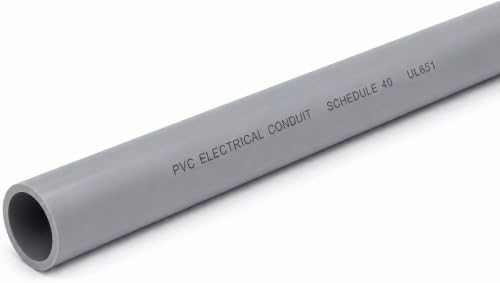
Schedule 40 PVC listed for burial goes in at 18 inches, is glued together in ten foot lengths, and leaves you a pull path. The one inch Schedule 40 conduit here is the size a 60 amp copper feeder typically wants; a 100 amp feeder in larger conductor usually moves up to an inch and a quarter or an inch and a half, and conduit fill is a calculation rather than a guess. Where the raceway comes out of the ground and enters an enclosure, a short section of liquid-tight flexible conduit handles the transition. The full treatment of raceway types, fill and sunlight resistance is in conduit for an EV charger circuit.
Schedule 80 PVC has a thicker wall and is used where the raceway is exposed to physical damage, typically the section above grade. It has less internal area than Schedule 40 for the same trade size, which matters for fill.
Why pull a spare conduit while the trench is open?
Because the trench is the expensive part and it will never be this cheap again. A second one inch conduit laid alongside the first adds perhaps twenty dollars of pipe and no digging whatsoever, and it buys you every low-voltage thing you will want later: a network cable to the garage, a camera, an alarm contact, a landscape lighting circuit, a well or irrigation control line.
Put a pull string in it, cap both ends, and record where it is. Keep power and communications in separate raceways rather than sharing one, because mixing them in a single conduit runs into separation rules and induced noise. If you have any suspicion the garage may eventually get a second charger or a workshop subpanel, this is also the moment to consider whether the primary conduit should be one size larger than today's conductor needs.
While you are being forward-looking: a network path to the garage is the single most useful spare, because a garage-mounted smart charger frequently cannot see the house Wi-Fi through two exterior walls and forty feet of yard. Solving that after the fact with mesh nodes or an outdoor access point is possible, and it is a great deal easier when a cable path already exists.
Why does trenching dominate the cost?
Because it is labour, restoration and machine time, and none of it scales with how much you spent on the charger. Here are the researched ranges from the shared cost table with the detached case alongside two attached-garage comparisons.
| Scenario | Low | High | Note |
|---|---|---|---|
| New 50 amp circuit, panel on the same garage wall, run under 15 ft | $450 | $900 | The cheapest real install. Half a day of labour. |
| New 60 amp hardwired circuit, 40 ft run | $1100 | $2000 | Bigger conductor and a hardwired termination. |
| Detached garage, 80 to 150 ft with trenching | $2500 | $6500 | Trenching dominates. A subpanel is usually the right answer. |
The spread inside the detached row is the interesting part. The low end is a straight run across a lawn with a trencher, soft soil and nothing in the way. The high end is a run that crosses a paved driveway, a mature root system or a sprinkler zone, or a site where the machine cannot get to the route and the trench is dug by hand. Saw-cutting and patching concrete alone can add a four figure sum.
Three things move the number most, and you can find out about all three before you get a quote: the route length as walked rather than as measured on a plan, the surface it crosses, and whether the garage already has a feeder you can replace in an existing raceway. That last one occasionally turns the whole project into an ordinary install. Put your own figures into the installation cost calculator and get at least two written quotes so you can tell a fair bid from an optimistic one. Ask for the trench and the electrical as separate line items; some homeowners dig their own trench to the electrician's specification and leave it open for inspection, which is legitimate on many jobs and is the one part of this project that is not 240 volt work.
What if you cannot trench at all?
There are three fallbacks, in descending order of how often they apply. An overhead span between the buildings is still permitted and has its own clearance and support rules; it is unattractive and it is occasionally the only option on a rock site. Directional boring under a driveway avoids saw-cutting and is a specialist sub-trade rather than something an electrician does with a shovel. And an existing raceway, if one is out there and is in usable condition, may be able to accept new conductors without any excavation.
The fourth option is to stop trying. If the garage is 200 feet away, the car lives on a driveway apron near the house half the time, and the daily commute is short, a charger on the house wall with a longer cable, or a pedestal on the driveway, may be a better use of three thousand dollars than a trench. That is not a defeat. It is what the numbers say on plenty of properties.
What actually goes in the ground
A parts list for planning, not a specification. Quantities and sizes come from your electrician's calculation for your distance, your conductor material and your local amendments.
The trench and feeder parts
Researched from published specifications and listed ratings. Conductor material, size and raceway diameter all depend on the distance and the feeder rating your electrician calculates.
Generic
1 inch Schedule 40 PVC Electrical Conduit
$17.21
Schedule 40 PVC listed for underground burial, which is the raceway almost every residential feeder trench uses. One inch handles a 60 amp copper feeder comfortably and leaves fill headroom.
- Size
- 1 in
- Type
- Sch 40 rigid
- Rating
- UL 651
Trade-off A 100 amp feeder in larger conductor usually wants an inch and a quarter or an inch and a half instead.
Check price
Relaxweex
6 AWG XHHW-2 Aluminium Building Wire, 50 ft
$39.99
XHHW-2 aluminium building wire rated for wet locations and direct burial, which is the conductor type a long feeder is usually run in because the price per foot is a fraction of copper.
- Gauge
- 6 AWG
- Type
- XHHW-2
- Length
- 50 ft
Trade-off Aluminium needs AL/CU rated lugs, anti-oxidant compound and a size increase over copper.
Check price
XRDS -RF
6 AWG THHN Stranded Copper, 100 ft Black
$139.99
Stranded 6 AWG THHN in 100 foot lengths, the conductor a shorter copper feeder or the branch circuit inside the garage is normally pulled in.
- Gauge
- 6 AWG
- Type
- THHN
- Length
- 100 ft
Trade-off Copper costs several times what the equivalent aluminium does over 150 feet.
Check price
MOKIKUBA
8 ft Copper Bonded Ground Rod with Clamp
$55.00
An eight foot copper bonded rod with a clamp, which is what a separate structure needs for its own grounding electrode system. Most installs drive two of them.
- Length
- 8 ft
- Diameter
- 5/8 in
- Clamp
- Included
Trade-off Rocky ground can make a rod impossible to drive, and then the electrode becomes a different detail entirely.
Check price
Ideal Industries
Ideal Noalox Anti-Oxidant Compound
$59.88
Anti-oxidant compound for aluminium conductor terminations at the lugs, which is not optional on an aluminium feeder and is one of the details an inspector looks for.
- Size
- 8 oz
- Use
- AL lugs
- Type
- Zinc paste
Trade-off Messy, and useless on copper, so it only belongs in the kit if the feeder is aluminium.
Check price
Wocloer
1 inch Liquid-Tight Conduit Kit, 10 ft
$21.99
Liquid-tight flexible conduit and fittings for the short exposed sections where the raceway leaves the trench and enters an enclosure, and for the whip to the charger.
- Size
- 1 in
- Length
- 10 ft
- Fittings
- 4 included
Trade-off Flexible conduit is for transitions, not for a run. Rigid raceway does the distance.
Check pricePaid links. Prices shown when researched and change without notice.
At the garage end of the feeder
For the garage end of the feeder
EMPORIA
Emporia Level 2 EV Charger, 48A J1772
$449.00
Once a 100 amp feeder is in the ground, the incremental cost of the 60 amp branch circuit inside the garage is small, so this is the point where a 48 amp hardwired station makes sense. It delivers 11.5 kW on a 60 amp breaker and ships with a 25 foot cable and a hardwired whip.
- Continuous
- 48 A
- Breaker
- 60 A
- Power
- 11.5 kW
- Cable
- 25 ft
- Install
- Hardwired
- Connector
- J1772
Paid link. Price shown when researched.
A detached garage is also the case where enclosure rating matters more than usual, because the unit is often on an exterior wall or in an unheated, unconditioned building that swings from freezing to humid. The outdoor charger roundup covers the ratings that actually mean something and the cold-weather cable question, which is a real one in an uninsulated garage in the winter.
Where to go next
Work the distance first with the voltage drop calculator, then read wire size for an EV charger for how ampacity and distance interact, then subpanel for an EV charger for the load centre end of the job. If you want the whole thing assembled with prices, the panel upgrade buildout is the tier that includes a subpanel and solar-ready wiring, and it is the closest published build to a detached garage project.
Common questions
Do I need a subpanel in a detached garage, or can I run one circuit?
Either is legal, and the distance usually decides. A single branch circuit is simpler and cheaper under roughly 60 feet. Past that, one feeder to a small load centre in the garage costs about the same in the trench, gives you garage lighting and receptacles from the same run, and lets a second charger be added later by fitting a breaker rather than digging the yard up again.
How deep does the trench for a garage feeder have to be?
For planning purposes, 18 inches of cover for Schedule 40 PVC listed for burial and 24 inches for direct burial cable with no raceway. Rigid metal conduit can be as shallow as 6 inches. Under a driveway at a one or two family dwelling the figure is 18 inches. Local amendments change these, so confirm the depth with your inspector before anybody rents a trencher.
Why does the feeder to a detached garage need four wires?
Because current code requires a separate equipment grounding conductor to run with the feeder to a separate structure. The older practice of pulling three wires and re-bonding the neutral to ground at the outbuilding is no longer permitted for new work. Four wires means two hot conductors, an insulated neutral and an equipment grounding conductor, with neutral and ground kept apart at the garage panel.
Does the garage still need ground rods if I run a ground wire out to it?
Normally yes. A separate structure supplied by a feeder requires its own grounding electrode system, which in most residential cases means one or two eight foot rods bonded to the equipment grounding bar in the garage panel. The rods are in addition to the equipment grounding conductor in the trench, never a substitute for it, and they never carry neutral current.
Can I use aluminium wire for the feeder to save money?
Yes, and on a long run it is the normal choice rather than a compromise. Aluminium feeders are listed, common and legitimate. The conditions are that the terminations are rated AL/CU, that anti-oxidant compound is used, and that the conductor goes up roughly one to two sizes against copper for the same ampacity. Over 150 feet the savings are large enough to fund the extra size.
Why is a detached garage install so much more expensive?
Because the trench is the job. Excavation, restoring the lawn or cutting and patching a driveway, and the extra conductor length dominate the bill, and none of them get cheaper because you bought a less expensive charger. Researched ranges for a detached garage run of 80 to 150 feet with trenching land between 2,500 and 6,500 dollars, against 900 to 1,600 for a typical attached garage circuit.
Getting your own panel and load numbers ready for an electrician? The EV Home Charging Install Planner is the paid version of these pages: 8 printable worksheets you fill in with your own numbers, plus the full PDF, $29.
How this page was researched
Specifications come from manufacturer documentation, listed safety certifications and verified owner reviews. We do not perform hands-on product testing and never claim to. Figures are researched planning information, not professional electrical advice. Last reviewed 2026-08-17.