Installation Cost Chart
Short answer
A typical Level 2 EV charger installation costs $450 to $2,000 including parts and labour. A short run on the panel wall is $450 to $900, a 30 to 50 foot run through finished walls is $900 to $1,600, and a service upgrade takes the project to $3,000 to $7,000. Labour, permits and fees are usually 55 to 65 percent of the total, and they are the largest single line on most jobs.
The single most useful thing to understand before reading any quote is that the charger is rarely what costs the money. A good 48 amp hardwired station is around $449. The labour to run a 60 amp circuit 40 feet through a finished wall is frequently more than twice that, and if the panel cannot carry the circuit, the number that matters is not on the charger's product page at all.
This chart exists so that a quote can be sanity-checked against something. It is not a price list and it is not a quote. Ranges are wide because real bids are wide, and the width itself is the information: a scenario with a two thousand dollar spread is telling you that something about your house, rather than something about the market, will decide the number.
The hardware line, for scale
The hardware line, for scale
EMPORIA
Emporia Level 2 EV Charger, 48A J1772
$449.00
The hardware line in a mid-range install, and a useful anchor for reading this chart: at around $449 it is a fraction of the labour on the same job. A 48 amp hardwired station with a 25 foot cable and energy reporting sits at the price point where paying more buys brand rather than capability.
- Price class
- Around $449
- Output
- 11.5 kW
- Circuit
- 60 A
- Cable
- 25 ft
- Install
- Hardwired
- Reporting
- Yes
Paid link. Price shown when researched.
Installation cost by scenario
| Scenario | Low | High | Midpoint | Notes |
|---|---|---|---|---|
| Charger plugged into an existing NEMA 14-50 in the garage | $0 | $100 | $50 | No electrical work. You may still want an in-use cover or a holster. |
| New 50 amp circuit, panel on the same garage wall, run under 15 ft | $450 | $900 | $675 | The cheapest real install. Half a day of labour. |
| New 50 amp circuit, 30 to 50 ft run through finished wall | $900 | $1600 | $1250 | Most common quote. Fishing wire is what costs the money. |
| New 60 amp hardwired circuit, 40 ft run | $1100 | $2000 | $1550 | Bigger conductor and a hardwired termination. |
| Detached garage, 80 to 150 ft with trenching | $2500 | $6500 | $4500 | Trenching dominates. A subpanel is usually the right answer. |
| Load management device instead of a panel upgrade | $700 | $1600 | $1150 | Device plus install. Often the cheapest path on a full panel. |
| 100 to 200 amp service upgrade, then the charger circuit | $3000 | $7000 | $5000 | Utility coordination, meter work, permits and inspection. |
| Panel relocation or a new meter main | $4500 | $12000 | $8250 | The worst case, and the reason to get the load calculation done early. |
Read the top row first, because it is the one people forget to consider. If your garage already has a NEMA 14-50 receptacle from an RV or a workshop, and it is on a circuit an electrician confirms is suitable, the installation cost of Level 2 charging is close to zero. Verifying that is worth an hour of somebody's time before you plan anything more expensive.
What actually moves the number
Ranked by how much money is at stake rather than by how often it comes up. The bottom of this list is the part most buyers spend their research time on.
| Factor | Swing | Why |
|---|---|---|
| Panel capacity | $0 to $7,000 | A service upgrade is the single largest possible line. A load management device often avoids it. |
| Run length and access | $300 to $2,000 | Fishing conductors through finished walls is slow. An unfinished basement or an exposed garage wall is fast. |
| Trenching to a detached structure | $1,500 to $5,000 | Excavation, restoration and the feeder itself. Rock or hardscape multiplies it. |
| Local labour rate | $200 to $800 | The same job priced in two metros can differ by this much before any parts are counted. |
| Breaker type | $30 to $130 | A GFCI breaker for a receptacle install costs several times a standard one, and brands differ. |
| Permit and inspection | $60 to $400 | Set by the jurisdiction. Normally required, and not the place to economise. |
| Charger choice | $170 to $700 | The most visible number and rarely the one that decides the total. |
Panel capacity sits at the top because it is the only line that can be zero or five thousand dollars depending on a calculation. If your load calculation shows headroom, the project is a circuit. If it does not, you are choosing between a load management device at several hundred dollars and a service upgrade at several thousand, and that choice is worth more research than the charger brand. Start with the panel load calculator and then read load management vs panel upgrade.
Three complete installs, priced line by line
These are the totals from the buildouts on this site, where every line item is priced and linked and the labour is included rather than assumed away. They are the most concrete version of this chart.
| Buildout | Hardware | Labour, permit and fees | Total | Labour share |
|---|---|---|---|---|
| Tier 1: Plug-in Level 2 | $680 | $925 | $1,605 | 58% |
| Tier 2: Hardwired 48 amp | $1,116 | $1,350 | $2,466 | 55% |
| Tier 3: Full install with panel work | $3,595 | $6,075 | $9,670 | 63% |
The labour share column is the honest headline of this whole page. On the cheapest complete install, labour, permit and inspection are 58 percent of what you spend. On the full install with panel work they are 63 percent. Any comparison of chargers that treats the box as the project is describing a small fraction of the invoice, which is why shopping harder on hardware saves less than most people expect and why getting a second quote saves more.
How to spend less without buying worse
Find out about the panel before anything else
This is the only decision on the list with a four figure swing. A load calculation, or better, measured demand from a panel-level monitor, tells you whether you are in the cheap version of this project or the expensive one. Read electrical panel load calculation and, if the answer is tight, load management devices before accepting a service upgrade quote.
Shorten the run, or make it accessible
Mounting the charger on the wall nearest the panel rather than the wall nearest the car can halve the labour. Where that leaves the cable short, a longer cable costs twenty dollars and fixing the run costs hundreds. The trade is worked out in charger placement in a garage.
Ask whether a receptacle install is cheaper than hardwiring
Sometimes, and sometimes not. A plug-in install on a 50 amp circuit usually needs a GFCI breaker costing 80 to 130 dollars, while a hardwired unit often does not because it contains listed ground fault protection internally. That can close most of the gap. See hardwired vs plug-in.
Supply your own parts if the electrician agrees
Removing the markup on the charger, the receptacle and the breaker is a real saving, and the buildouts on this site are written as parts lists partly for that reason. Ask first, because some contractors will not install owner-supplied equipment.
Claim the rebates before you start
Federal credits and utility programmes can take a meaningful bite out of these numbers, and several require pre-approval, a permitted install, or a specific model from an approved list. Check rebates and tax credits before booking the work rather than afterwards.
Hardware that reduces the largest lines
Each of these targets the expensive end of the chart rather than the cheap end: the panel, the service upgrade and the new circuit itself.
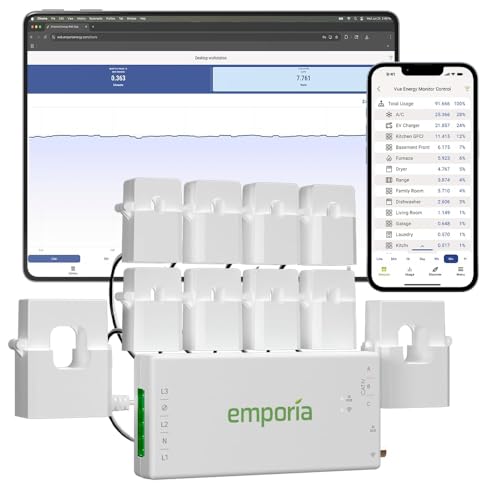
EMPORIA
Emporia Vue 3 Energy Monitor, 8 Sensors
$149.99
The cheapest way to answer the most expensive question on this chart. Measured demand at the mains tells you whether your service is genuinely near its limit, which decides between a load management device and a service upgrade costing thousands more.
- Sensors
- 8
- Measures
- Mains and circuits
- Install
- At the panel
- Answers
- Do I need an upgrade
Trade-off Installed in the panel, so it usually happens during an electrician visit rather than before one.
Check price
EMPORIA
Emporia Pro 48A with PowerSmart Load Management
$599.00
A charger with dynamic load management built in, which on a tight panel replaces a service upgrade with a device. The 150 dollar premium over the standard unit is the cheapest insurance against the largest line on this chart.
- Output
- 48 A
- Load management
- Dynamic
- Circuit
- 60 A
- Replaces
- A panel upgrade
Trade-off Only helps if your situation is capacity rather than a lack of breaker spaces.
Check price
Splitvolt
Splitvolt 14-30 to 14-50 Splitter Switch
$380.00
Shares an existing 240 volt dryer circuit between the dryer and the car with automatic switching, which avoids a new circuit entirely. The right answer for a rental, a tight panel or a garage that already has a dryer outlet in it.
- Sharing
- 14-30 and 14-50
- Switching
- Automatic
- Draw
- 24 A
- New circuit
- Not needed
Trade-off Caps charging at 24 amps, and it depends on there being a suitable existing circuit in the right place.
Check pricePaid links. Prices shown when researched and change without notice.
How this chart was researched
Installation cost ranges are assembled from published flat-rate installation pricing, reported homeowner quotes and published permit fee schedules, and they are stated as ranges because the underlying data is a range. Buildout totals are calculated from the itemised parts lists and researched labour estimates on the buildout pages of this site, using the same figures rather than a separate set. Product prices were accurate when researched and change without notice.
We do not perform hands-on product testing and never claim to. Nothing here is a quote, an estimate for your property, or professional advice. Labour rates, permit fees and code amendments vary by jurisdiction, a permit and an inspection are normally required, and a licensed electrician must size and install the circuit.
Where to go next
Estimate your own job with the installation cost calculator, then read what electricians charge for how hourly and flat-rate pricing differ. The complete priced installs are in the buildouts, and if the whole question is whether it pays for itself, use the payback calculator.
Common questions
How much does it cost to install a Level 2 EV charger?
Most straightforward installs land between $450 and $2,000 including parts and labour. A short run on the same wall as the panel is commonly $450 to $900, a 30 to 50 foot run through finished walls is $900 to $1,600, and a 60 amp hardwired circuit at 40 feet is $1,100 to $2,000. A service upgrade takes the whole project to $3,000 to $7,000, and a detached garage with trenching runs $2,500 to $6,500.
Why do EV charger installation quotes vary so much?
Because the charger is not what costs the money. The variables that move a quote by hundreds or thousands are panel capacity, run length, whether the conductors can be run in an open space or have to be fished through finished walls, whether trenching is involved, and local labour rates. Two houses on the same street can differ by a factor of three on identical hardware.
What percentage of an EV charger install is labour?
Typically 55 to 65 percent on a normal install, and more on a service upgrade. On the three complete buildouts priced on this site, labour, permits and fees come to 58 percent of the plug-in install, 55 percent of the hardwired 48 amp install and 63 percent of the full install with panel work. A quote that appears to have almost no labour in it is usually missing something.
Can I supply my own charger and parts to save money?
Often yes, and it is a legitimate way to reduce a quote, but ask first. Some electricians will not install owner-supplied equipment because they carry the warranty risk, and some price the job the same either way. Where it works, supplying the charger, the receptacle and the breaker yourself removes the markup on those items. It does not reduce the labour, which is the larger number.
Is a permit really required for an EV charger?
In most jurisdictions, yes, for a new 240 volt branch circuit. Permit and inspection fees typically run $60 to $400. Skipping the permit saves that fee and creates two problems: no independent check on work you cannot see, and an unpermitted circuit that can complicate insurance claims and property sales. Utility rebate programmes also frequently require proof of a permitted, inspected install.
How do I know whether a quote is fair?
Ask for it itemised into parts and labour, then check the scenario in this chart that matches your house and compare. Get at least two written quotes. The specific things worth querying are the breaker type, the conductor size against the run length, whether the permit is included, and whether the quote assumes the panel has capacity or has actually verified it.
Getting your own panel and load numbers ready for an electrician? The EV Home Charging Install Planner is the paid version of these pages: 8 printable worksheets you fill in with your own numbers, plus the full PDF, $29.
How this page was researched
Specifications come from manufacturer documentation, listed safety certifications and verified owner reviews. We do not perform hands-on product testing and never claim to. Figures are researched planning information, not professional electrical advice. Last reviewed 2026-08-17.