EV vs Gas Fuel Cost
Short answer
Charging at home costs about 5.2 cents per mile for a mid-size electric crossover at the US average residential rate of 16.5 cents per kWh, including charging losses. A 28 mpg petrol car at $3.40 a gallon costs about 12.1 cents per mile. Over 12,000 miles that is $629 against $1457, roughly 2.3 times cheaper. Public fast charging at 48 cents per kWh costs about 13.7 cents per mile, which is close to petrol.
The headline number is that home charging costs roughly 5.2 cents per mile and petrol costs roughly 12.1, so driving on electricity from your own garage is about 2.3 times cheaper per mile than driving on fuel. Over 12,000 miles a year that is $629 against $1457.
That comparison is only useful if it is honest about three things that most versions of it are not. Charging losses are included here, because the energy your meter records is always more than the energy that reaches the battery. The electricity rate is the one you actually pay rather than a national headline, and the spread between states is enormous. And public fast charging is priced in its own column rather than being averaged into the home figure, because it costs three to four times as much and it changes the conclusion.
The hardware behind the cheap column
Where the cheap column comes from
EMPORIA
Emporia Level 2 EV Charger, 48A J1772
$449.00
The whole saving on this page depends on charging at home rather than in public, and this is the unit that makes that the default: hardwired 48 amps, a 25 foot cable so plugging in is never a chore, and per-session energy reporting so you can check the arithmetic here against your own utility bill.
- Output
- 11.5 kW
- Circuit
- 60 A
- Cable
- 25 ft
- Reporting
- Per session
- Install
- Hardwired
- Connector
- J1772
Paid link. Price shown when researched.
What electricity costs per mile
The arithmetic is simple enough to do in your head once you have seen it. Take your electricity rate in cents per kWh, divide by your car's miles per kWh, and add about ten percent for charging losses. Everything in this table is that calculation at four rates and four vehicle efficiencies.
| Vehicle | Efficiency | 11.5 cents | 16.5 cents | 24 cents | 31.8 cents |
|---|---|---|---|---|---|
| Large electric truck | 2.2 mi/kWh | 5.8c per mi | 8.3c per mi | 12.1c per mi | 16.1c per mi |
| Large crossover | 3 mi/kWh | 4.3c per mi | 6.1c per mi | 8.9c per mi | 11.8c per mi |
| Mid-size crossover | 3.5 mi/kWh | 3.7c per mi | 5.2c per mi | 7.6c per mi | 10.1c per mi |
| Efficient sedan | 4.2 mi/kWh | 3.0c per mi | 4.4c per mi | 6.3c per mi | 8.4c per mi |
Notice the range across that grid. A large electric truck in an expensive electricity state costs more per mile than an efficient sedan in a cheap one costs, by a factor of about four. "Electric cars are cheap to run" is true on average and almost useless as a personal statement, which is why the only figure worth acting on is the one built from your own rate and your own car.
What petrol costs per mile
The same treatment for the other side, at four pump prices and four fuel economy figures. Divide the price per gallon by miles per gallon and multiply by 100.
| Fuel economy | $2.90 | $3.40 | $3.90 | $4.50 |
|---|---|---|---|---|
| 22 mpg | 13.2c per mi | 15.5c per mi | 17.7c per mi | 20.5c per mi |
| 28 mpg | 10.4c per mi | 12.1c per mi | 13.9c per mi | 16.1c per mi |
| 35 mpg | 8.3c per mi | 9.7c per mi | 11.1c per mi | 12.9c per mi |
| 45 mpg | 6.4c per mi | 7.6c per mi | 8.7c per mi | 10.0c per mi |
Put the two grids beside each other and the pattern is consistent: the cheapest realistic petrol cell, a 45 mpg hybrid at $2.90, costs about 6.4 cents per mile, which is roughly what an inefficient electric truck costs on expensive electricity. Everywhere else, home charging wins, and in the middle of both tables it wins by a factor of three or more.
The state you live in matters more than the car you buy
Here is the same mid-size crossover, driven the same 12,000 miles, in the three cheapest and three dearest electricity states. The vehicle is identical in every row.
| State | Cents per kWh | Cents per mile | 12,000 miles | Saving against petrol |
|---|---|---|---|---|
| North Dakota | 11.1 | 3.5 | $423 | $1034 |
| Idaho | 11.4 | 3.6 | $434 | $1023 |
| Utah | 11.5 | 3.7 | $438 | $1019 |
| Hawaii | 41.0 | 13.0 | $1562 | $-105 |
| California | 31.8 | 10.1 | $1211 | $246 |
| Connecticut | 30.6 | 9.7 | $1166 | $291 |
Even in the most expensive states in that table, home charging still costs less per mile than petrol at $3.40 and 28 mpg. What changes is the size of the win, and therefore how quickly a charger installation pays for itself. The full fifty-state version is on the electricity rates by state chart.
Public fast charging changes the answer
At a typical DC fast charging price around 48 cents per kWh, a mid-size crossover costs about 13.7 cents per mile, or $1646 a year at 12,000 miles. Against $1457 for the petrol car, the fuel advantage has largely evaporated. That is the honest headline: an electric car charged exclusively in public is not obviously cheaper to fuel than a reasonably efficient petrol one.
This is why the charger install is the purchase that actually creates the saving, and why anyone comparing the two drivetrains on running cost should be comparing home charging with petrol rather than charging in general with petrol. The full breakdown of the two charging routes, including the time cost of each, is in home vs public fast charging.
Cost per mile for every car on this site
At the national average rate, sorted cheapest first. Efficiency does more work here than pack size or price does, which is why a compact sedan and a large truck can differ by a factor of two on the same electricity.
| Vehicle | Efficiency | Cents per mile | 12,000 miles | Saving against petrol |
|---|---|---|---|---|
| Tesla Model 3 | 4.2 mi/kWh | 4.4 | $524 | $933 |
| Tesla Model Y | 3.9 mi/kWh | 4.7 | $564 | $893 |
| Chevrolet Bolt EUV | 3.6 mi/kWh | 5.1 | $611 | $846 |
| Hyundai Ioniq 5 | 3.5 mi/kWh | 5.2 | $629 | $828 |
| Kia EV6 | 3.5 mi/kWh | 5.2 | $629 | $828 |
| Nissan Leaf | 3.5 mi/kWh | 5.2 | $629 | $828 |
| Toyota bZ4X | 3.5 mi/kWh | 5.2 | $629 | $828 |
| Chevrolet Equinox EV | 3.4 mi/kWh | 5.4 | $647 | $810 |
| Ford Mustang Mach-E | 3.3 mi/kWh | 5.6 | $667 | $790 |
| Volkswagen ID.4 | 3.2 mi/kWh | 5.7 | $688 | $769 |
| Honda Prologue | 3.2 mi/kWh | 5.7 | $688 | $769 |
| Tesla Cybertruck | 2.4 mi/kWh | 7.6 | $917 | $540 |
| Rivian R1T | 2.2 mi/kWh | 8.3 | $1000 | $457 |
| Ford F-150 Lightning | 2 mi/kWh | 9.2 | $1100 | $357 |
What this comparison deliberately leaves out
Fuel is one line in the cost of running a car and this page only claims to price that line. Purchase price, depreciation, insurance, tyres, registration and any incentives all differ between the two drivetrains and frequently dominate the fuel difference in either direction. Maintenance genuinely favours electric on the items that do not exist, such as oil changes, exhaust systems and timing components, and tyre wear can favour petrol because electric cars are heavier and torquier.
The installation cost is the one omission worth putting a number on, because it is the price of entry to the cheap column. A plug-in Level 2 install is $1,605 in the plug-in buildout including labour, permit and inspection, and the hardwired version is $2,466 in the 48 amp buildout. At a saving of about $828 a year the simple payback lands in the low single digit years, sooner if you are currently paying public rates and later if you are in an expensive electricity state. Work yours out in the payback calculator.
Hardware that lets you check these numbers
Every figure on this page is an estimate until you measure the circuit. These three turn it into a measurement.
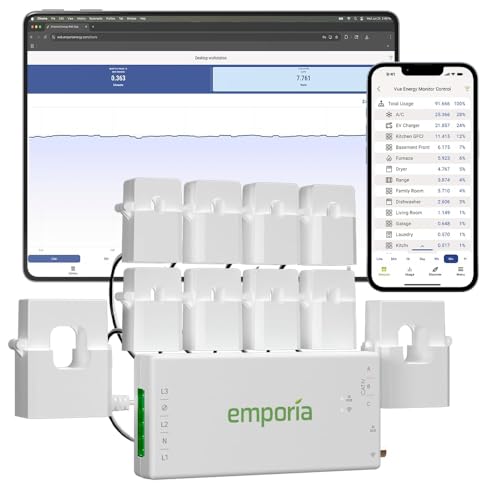
EMPORIA
Emporia Vue 3 Energy Monitor, 8 Sensors
$149.99
Clamps onto the charger circuit and the mains, so your cost per mile comes from measured energy rather than from an estimate. It is also the only way to prove a time-of-use plan is doing what it promised.
- Sensors
- 8
- Measures
- Mains and circuits
- Install
- At the panel
- Data
- Real time
Trade-off Installed at the panel, so it is part of an electrician visit rather than a plug-in device.
Check priceGrizzl-E
Grizzl-E Smart 40A
$250.00
A metal-cased 40 amp charger that reports session energy without costing much more than a dumb unit. Good enough to keep a running tally of what your driving actually costs.
- Output
- 9.6 kW
- Circuit
- 50 A
- Reporting
- Yes
- Case
- Metal
Trade-off The app is functional rather than polished, so treat it as a meter rather than a dashboard.
Check price
EMPORIA
Emporia Pro 48A with PowerSmart Load Management
$599.00
The version that also does dynamic load management, which matters if the panel is tight. Whole-home measurement plus a charger that throttles itself can save a service upgrade worth thousands.
- Output
- 48 A
- Circuit
- 60 A
- Load management
- Dynamic
- Measures
- Whole home
Trade-off Costs more, and the sensors have to be installed in the panel to do anything.
Check pricePaid links. Prices shown when researched and change without notice.
How to lower the electricity side further
Get on a time-of-use plan
Overnight charging fits off-peak windows almost perfectly, and EV rate plans commonly price those windows well below the standard residential rate. This is the single largest lever available and it costs nothing but a phone call. Quantify it with the time-of-use savings calculator and read time-of-use rates for the caveats, because the plan reprices the rest of your house too.
Charge to 80 percent for daily use
Not a cost saving directly, but it keeps most charging in the efficient part of the curve and shortens sessions, which makes off-peak windows easier to hit.
Stop paying for public charging you do not need
If your daily driving fits inside an overnight home charge, every public session is fuel bought at three times the price. Check the arithmetic against your own commute with the charge time calculator.
Claim what you are owed on the install
Federal credits and utility rebates can reduce the installation cost meaningfully, and several programmes require pre-approval before work starts. Check rebates and tax credits before booking an electrician, not after.
How these figures were researched
Electricity prices are average residential rates by state and the national average used throughout this site is 16.5 cents per kWh. Vehicle efficiency figures come from published manufacturer specifications and EPA ratings and vary with weather, speed, terrain and driving style. Charging losses are taken at ten percent consistently across this site. Fuel prices and fuel economy figures are stated explicitly in each table so you can substitute your own. Public fast charging is priced at a commonly observed rate rather than at any particular network's tariff, and those prices vary by network, location and time of day.
We do not perform hands-on product testing and never claim to. Everything here is researched planning information rather than professional financial advice, and prices change without notice.
Where to go next
Put your own rate and car into the cost per mile calculator, then check the install economics in the payback calculator. If you have not chosen hardware yet, best Level 2 home chargers is the main roundup, and your own car's requirements are on its page under home charging by vehicle.
Common questions
Is it cheaper to charge an EV than to buy petrol?
At home, almost always, and by a wide margin. At the US average residential rate of 16.5 cents per kWh, a mid-size electric crossover costs about 5.2 cents per mile including charging losses. A 28 mpg petrol car at $3.40 a gallon costs about 12.1 cents per mile. Over 12,000 miles that is $629 against $1457, a saving of about $828 a year. The comparison narrows in expensive electricity states and reverses only if you rely on public fast charging.
How much does it cost to charge an electric car per mile?
Divide your electricity rate in cents per kWh by your car's miles per kWh, then add about ten percent for charging losses. At 16.5 cents and 3.5 miles per kWh that is 5.2 cents per mile. An efficient sedan at 4.2 miles per kWh comes to about 4.4 cents, and a large electric truck at 2.2 miles per kWh comes to about 8.3 cents.
Does public fast charging cost more than petrol?
It can come close. At a typical DC fast charging price near 48 cents per kWh, a mid-size crossover costs about 13.7 cents per mile, against 12.1 cents for a 28 mpg petrol car at $3.40. Rely entirely on fast charging and the fuel saving largely disappears. This is the single most important reason to install home charging rather than plan around public infrastructure.
Do charging losses really matter in the comparison?
They matter by about ten percent, which is enough to be worth including and small enough that it does not change any conclusion. Some of the energy your meter records goes to conversion in the onboard charger, to battery thermal management and to keeping the car awake during the session. Cold weather makes it worse. Every figure on this page includes the loss, which is why the numbers here are slightly higher than comparisons that quietly leave it out.
Does a time-of-use rate change the answer?
It usually improves it substantially. Overnight charging fits neatly into off-peak windows, and EV rate plans commonly price those windows well below the standard residential rate. Moving every charge into an off-peak window can reduce the cents-per-mile figure by a third without changing anything about the car or the hardware. The trade is that on-peak consumption elsewhere in the house may be priced higher, so the plan has to be evaluated across the whole bill.
How long does the charger installation take to pay for itself?
At the national average rate and against a 28 mpg petrol car, the fuel saving is roughly $828 a year at 12,000 miles. Against the plug-in Level 2 buildout at $1,605 including labour and permit, that is a payback measured in years rather than months, and it comes sooner if you would otherwise be paying public fast charging rates. Run your own numbers in the payback calculator rather than trusting an average.
Getting your own panel and load numbers ready for an electrician? The EV Home Charging Install Planner is the paid version of these pages: 8 printable worksheets you fill in with your own numbers, plus the full PDF, $29.
How this page was researched
Specifications come from manufacturer documentation, listed safety certifications and verified owner reviews. We do not perform hands-on product testing and never claim to. Figures are researched planning information, not professional electrical advice. Last reviewed 2026-08-17.