EV Cost Per Mile Calculator
Short answer
At the national average residential rate of about 16.5 cents per kWh and 3.5 miles per kWh, home charging costs roughly 5.2 cents per mile including charging losses. A 28 mpg petrol car at $3.50 a gallon costs 12.5 cents per mile, so home charging is about 40 percent of the fuel cost.
Cost per mile is the number that makes charging costs comparable to fuel costs, and it depends on exactly two inputs: your electricity rate and your vehicle's efficiency in miles per kWh. Everything else is arithmetic.
At the national average of about 16.5 cents per kWh and a typical 3.5 miles per kWh, home charging costs roughly 5.2 cents per mile once charging losses are included. The same car in Hawaii costs about 13 cents. In Idaho, about 3.6. Local electricity price moves this figure more than anything about the car.
If you want the real rate, not an average
Get the real rate, not the average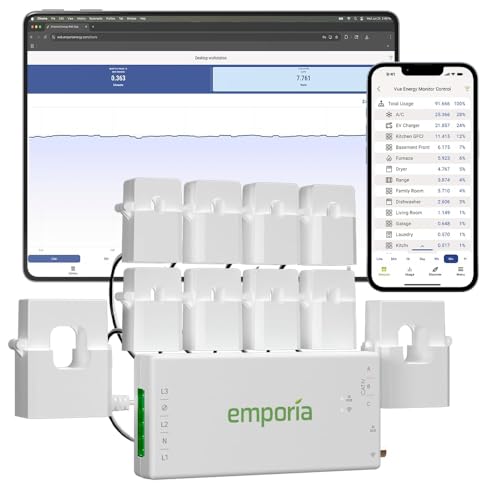
EMPORIA
Emporia Vue 3 Energy Monitor, 8 Sensors
$149.99
Cost per mile is only as good as the rate you put into it, and the only way to know your true marginal rate for charging is to meter the charger circuit on its own. This reports the charger circuit separately from the rest of the house, which is also the evidence most utility EV rate programmes ask for.
- Sensors
- 8
- Per circuit
- Yes
- Mains
- Yes
- Data
- Real time
- App
- iOS and Android
- Install
- Electrician
Paid link. Price shown when researched.
Cost per mile
cents / mileCompares home charging against petrol at your own numbers. Charging losses are included, because you pay for them at the meter.
All-in cents per kWh from your bill, energy plus delivery.
Your own trip computer average is better than the EPA figure.
Typical efficiencies
Compare against petrol
Home charging
5.2 cents per mile
Petrol equivalent 12.5 cents per mile
- Annual charging cost
- $629
- Annual petrol cost
- $1,500
- Annual saving
- $871
- Equivalent mpg at this rate
- 67 mpg
- Break-even petrol price
- $1.46
The formula, and the two inputs that matter
Cost per mile is your rate divided by your efficiency, adjusted for charging losses:
Cents per mile = rate in cents per kWh / (miles per kWh x charging efficiency)
At 16.5 cents and 3.5 miles per kWh with 90 percent efficiency, that is 16.5 divided by 3.15, which gives 5.2 cents per mile. Everything interesting is in the two inputs.
Get the rate right. Use the all-in figure from your bill, not the advertised supply rate, because delivery and distribution charges are frequently comparable to the energy charge. Divide the total bill less fixed monthly charges by the kWh used. The full discussion is on the charging cost calculator.
Get the efficiency right. Use your own trip computer average over several months, not the EPA number. Real efficiency swings widely with climate, speed and terrain, and unlike a petrol car, an electric car is worse on the highway than in town because aerodynamic drag dominates and there is no idling to avoid.
Cost per mile across rates and efficiencies
The grid below is the whole picture in one table. Columns are electricity rates from very cheap to very expensive, rows are vehicle efficiencies from a large truck to an efficient sedan.
| mi per kWh | 11c per kWh | 14c per kWh | 16.5c per kWh | 20c per kWh | 25c per kWh | 31.8c per kWh |
|---|---|---|---|---|---|---|
| 2.0 | 6.1c | 7.8c | 9.2c | 11.1c | 13.9c | 17.7c |
| 2.5 | 4.9c | 6.2c | 7.3c | 8.9c | 11.1c | 14.1c |
| 3.0 | 4.1c | 5.2c | 6.1c | 7.4c | 9.3c | 11.8c |
| 3.5 | 3.5c | 4.4c | 5.2c | 6.3c | 7.9c | 10.1c |
| 4.0 | 3.1c | 3.9c | 4.6c | 5.6c | 6.9c | 8.8c |
The spread is nearly five to one across this table, from 2.9 cents to 17.7. That range is wider than the difference between any two petrol cars on sale, which is the real lesson: where you live matters more than what you drive.
Petrol, for comparison
| mpg | $3.00 per gal | $3.50 per gal | $4.00 per gal | $4.50 per gal |
|---|---|---|---|---|
| 22 | 13.6c | 15.9c | 18.2c | 20.5c |
| 28 | 10.7c | 12.5c | 14.3c | 16.1c |
| 35 | 8.6c | 10.0c | 11.4c | 12.9c |
| 45 | 6.7c | 7.8c | 8.9c | 10.0c |
Set the two tables side by side and the picture is clear. Home charging at an average rate beats almost every petrol car on fuel cost, frequently by a factor of two or more. But the overlap is real: an inefficient electric truck in an expensive electricity market, at 17.7 cents per mile, costs more per mile than a 45 mpg hybrid at 3.50 a gallon, which is 7.8 cents. Anyone claiming electric is always cheaper per mile has not run the corners of these tables.
Two honest caveats in each direction. Fuel is only part of running cost, and electric cars typically need less scheduled maintenance, which this comparison ignores. And a household that does a meaningful share of its charging on public DC fast chargers has a blended cost well above its home figure, which is worked through in home versus public fast charging.
Cost per mile by vehicle
| Vehicle | Efficiency | At 11c | At 16.5c | At 31.8c | Cost per 1,000 miles at average |
|---|---|---|---|---|---|
| Tesla Model Y | 3.9 mi per kWh | 3.1c | 4.7c | 9.1c | $47 |
| Tesla Model 3 | 4.2 mi per kWh | 2.9c | 4.4c | 8.4c | $44 |
| Tesla Cybertruck | 2.4 mi per kWh | 5.1c | 7.6c | 14.7c | $76 |
| Ford F-150 Lightning | 2 mi per kWh | 6.1c | 9.2c | 17.7c | $92 |
| Ford Mustang Mach-E | 3.3 mi per kWh | 3.7c | 5.6c | 10.7c | $56 |
| Chevrolet Equinox EV | 3.4 mi per kWh | 3.6c | 5.4c | 10.4c | $54 |
| Chevrolet Bolt EUV | 3.6 mi per kWh | 3.4c | 5.1c | 9.8c | $51 |
| Hyundai Ioniq 5 | 3.5 mi per kWh | 3.5c | 5.2c | 10.1c | $52 |
| Kia EV6 | 3.5 mi per kWh | 3.5c | 5.2c | 10.1c | $52 |
| Rivian R1T | 2.2 mi per kWh | 5.6c | 8.3c | 16.1c | $83 |
| Nissan Leaf | 3.5 mi per kWh | 3.5c | 5.2c | 10.1c | $52 |
| Volkswagen ID.4 | 3.2 mi per kWh | 3.8c | 5.7c | 11.0c | $57 |
| Honda Prologue | 3.2 mi per kWh | 3.8c | 5.7c | 11.0c | $57 |
| Toyota bZ4X | 3.5 mi per kWh | 3.5c | 5.2c | 10.1c | $52 |
The break-even petrol price is the useful figure
Rather than arguing about averages, invert the question: how cheap would petrol have to be to match your home charging cost? The calculator gives this figure, and it is the most persuasive number on the page because it does not depend on anyone's assumptions about the future.
At the national average rate, 3.5 miles per kWh and a 28 mpg comparison car, the break-even petrol price is around 1.46 dollars a gallon. Petrol would have to fall to well under half its typical price for the petrol car to be as cheap to fuel. In a cheap electricity state the answer is under a dollar.
Where it gets close: an inefficient electric vehicle in an expensive electricity market compared against an efficient hybrid. That combination can produce a break-even petrol price above four dollars, meaning the hybrid is genuinely cheaper to fuel. It is a real scenario for a Rivian owner in Connecticut, and saying so is the point of running the numbers rather than reciting a slogan.
How to move the number down
- Switch to an EV or time-of-use tariff. The single biggest lever, and often a halving. Model it on the time-of-use savings calculator and read time-of-use rates.
- Charge at home rather than in public. Public DC fast charging is commonly two to four times the residential rate. The install pays for itself partly through this, which is what the payback calculator quantifies.
- Drive a little slower on the highway. Aerodynamic drag rises with the square of speed, and electric cars have no idle losses to hide it. The efficiency gain from 75 to 65 mph is larger than in a petrol car.
- Precondition on wall power. Heating the cabin from the grid while plugged in rather than from the pack on the road improves both range and effective efficiency in winter.
- Consider solar honestly. It can push the effective rate very low, and the payback is genuinely climate and tariff dependent. Run it on the solar charging calculator.
Where to go next
See the cost of a single charge on the charging cost calculator, work out whether the install pays back on the payback calculator, and compare against petrol in detail in EV versus gas fuel cost. The full grid also lives on the cost per mile chart.
Common questions
What does it cost per mile to drive an EV at home?
At the national average residential rate of about 16.5 cents per kWh and a typical efficiency of 3.5 miles per kWh, home charging costs roughly 5.2 cents per mile once charging losses are included. A large electric truck at 2.2 miles per kWh costs about 8.3 cents per mile, and an efficient sedan at 4.2 miles per kWh about 4.4 cents.
How does that compare to petrol?
A 28 mpg car at 3.50 dollars a gallon costs 12.5 cents per mile in fuel, so home charging at the national average is roughly 40 percent of that. The gap narrows sharply in expensive electricity markets and widens in cheap ones. In the most expensive states, home charging an inefficient electric truck can cost more per mile than a frugal petrol car.
Should I include charging losses?
Yes, always, because you pay for them. Energy is lost converting AC to DC in the onboard charger, in cable resistance and in battery thermal management. Roughly 90 percent efficiency is a fair Level 2 planning figure, so ignoring losses understates your real cost per mile by about 11 percent. This calculator includes them.
Why is my winter cost per mile higher?
Two effects compound. Cold reduces vehicle efficiency, sometimes by 20 to 30 percent, because cabin heating draws directly from the pack and cold air is denser. And charging efficiency falls because the pack may be warmed from wall power before or during the session. Expect winter cost per mile to run noticeably above your annual average.
Does public fast charging change the maths?
Substantially. Public DC fast charging commonly costs two to four times the residential rate per kWh, and some networks add session or idle fees. A driver who charges mostly at home and occasionally on the road has a blended cost well above their home figure, which is worth modelling honestly rather than quoting the home number alone.
What efficiency figure should I use for my car?
Use your own trip computer average over several months rather than the EPA figure, since real efficiency depends heavily on climate, speed and terrain. As rough guides: efficient sedans manage 3.8 to 4.3 miles per kWh, crossovers 3.0 to 3.6, and large trucks 1.8 to 2.4. Sustained highway speed costs more than city driving in an electric car, which inverts the petrol pattern.
Getting your own panel and load numbers ready for an electrician? The EV Home Charging Install Planner is the paid version of these pages: 8 printable worksheets you fill in with your own numbers, plus the full PDF, $29.
How this page was researched
Specifications come from manufacturer documentation, listed safety certifications and verified owner reviews. We do not perform hands-on product testing and never claim to. Figures are researched planning information, not professional electrical advice. Last reviewed 2026-08-17.