Solar and Battery EV Charging
Short answer
Covering 12,000 miles a year takes roughly 3922 kWh, which is about 2.5 kW of solar array in a good solar region and about 3.6 kW in a poor one, typically six to ten panels. Whether charging during the day is worth more than charging overnight depends entirely on your export rate: under full net metering it makes no difference at all, and under a low export rate every self-consumed kilowatt hour is worth the full retail rate.
Charging a car on your own solar production is one of the genuinely satisfying parts of owning both, and it is also the topic where the arithmetic is most often skipped. This page does the arithmetic. The short version is that the array size is smaller than people expect, the battery is far less useful for charging than people expect, and one number you probably have not looked up, your utility's export rate, decides whether any of the optimisation is worth doing.
Nothing here is financial advice and none of it is a substitute for a quote. Solar economics are local to the point of being per-address, and incentives change. What this page gives you is the shape of the problem so you can tell whether a proposal in front of you makes sense.
Best hardware for solar-paired charging
The cheap way to use your own production
EMPORIA
Emporia Pro 48A with PowerSmart Load Management
$599.00
The most useful piece of hardware for anyone pairing charging with solar, and it is not a battery. A charger that measures whole-home demand and modulates its own draw can be told to soak up production rather than import from the grid, which is the behaviour that captures most of the benefit for a fraction of the cost of storage.
- Output
- 48 A
- Circuit
- 60 A
- Load management
- Dynamic
- Measures
- Whole home
- Install
- Hardwired
- Connector
- J1772
Paid link. Price shown when researched.
How much array a car actually needs
Start from the mileage rather than from the panels. Twelve thousand miles a year in a car doing 3.4 miles per kWh is about 3529 kWh at the battery, and around 3922 kWh at the meter once charging losses are included. Then divide by what a kilowatt of array produces where you live.
| Solar resource | Annual output per kW | Array to cover 12,000 miles | Miles per kW of array per year |
|---|---|---|---|
| Excellent, desert southwest | 1700 kWh | 2.3 kW | 5202 mi |
| Good, most of the south and west | 1500 kWh | 2.6 kW | 4590 mi |
| Moderate, midwest and mid-atlantic | 1300 kWh | 3.0 kW | 3978 mi |
| Poor, pacific northwest and northeast | 1100 kWh | 3.6 kW | 3366 mi |
Two and a half to three and a half kilowatts is six to ten modern panels, which is a modest addition to a typical residential array rather than a project of its own. The last column is the one worth remembering: one kilowatt of array covers somewhere between 3,300 and 5,100 miles of driving a year. That is a much more intuitive number than kilowatt hours, and it lets you check any solar proposal that mentions your car in about ten seconds.
An important caveat on all of this: covering your annual driving on an annual basis is not the same as charging from sunlight. Production peaks in summer and at midday, and charging happens overnight and all year. Annual coverage is an accounting result that depends on how your utility treats exported energy, which brings us to the number that decides everything.
The export rate decides whether any of this matters
Under full retail net metering, a kilowatt hour exported at noon is credited at the same rate you pay for one imported at midnight. In that world, charging at 2pm and charging at 2am are financially identical and there is nothing to optimise. Charge overnight, because it is more convenient and often lands on a cheaper time-of-use window anyway.
Under a low export rate, and many jurisdictions have moved that way, exported energy is worth a fraction of what imported energy costs. Now every kilowatt hour you consume in your own house instead of exporting is worth the difference between those two rates, and shifting a charging session into daylight becomes a real saving rather than an aesthetic preference.
| Arrangement | What a kWh to the car is worth | Comment |
|---|---|---|
| Charge from the grid at the average residential rate | 16.5 cents | The baseline every other row is measured against |
| Charge from solar during the day, full retail net metering | 16.5 cents | Identical. Under full net metering the timing of your charging does not matter at all |
| Charge from solar during the day, low export rate | 16.5 cents | Now it matters. Self-consuming avoids buying at retail instead of selling at wholesale |
| Export at a low rate and charge at night off-peak | 8 to 12 cents | Often the cheapest arrangement of all, and it needs no battery |
| Store solar in a battery, discharge to the car after dark | 16.5 cents minus losses | Round trip losses of 10 to 15 percent, against hardware costing thousands |
So the sequence for anyone with both is: look up your export rate, then look up your import rate and whether a time-of-use plan is available. If export is close to retail, put every charge on the cheapest overnight window and stop thinking about it. If export is poor, move as much charging as you can into daylight hours. The savings from the second case are worked out in the time-of-use savings calculator, and the background is in time-of-use rates.
Charging from surplus without buying a battery
If daytime self-consumption is worth money to you, the cheapest way to capture it is not storage. It is timing and modulation, and it costs a few hundred dollars rather than several thousand.
The blunt version is a schedule: tell the car or the charger to run between 10am and 3pm on the days the car is home. That captures most of the benefit for nothing at all, and for a household with a car in the driveway on weekdays it is often the entire answer. The refined version is a charger that measures whole-home demand and adjusts its own current to track surplus production, so it soaks up what the roof is making without importing. The Emporia Pro is the accessible example of that class, and the same measurement hardware that enables it also does load management, which may be worth more to you than the solar behaviour.
The limitation of modulation is that it works within the current range the charger and the car can negotiate, and it cannot go below the minimum charging current the vehicle accepts. On a thin cloudy day, tracking surplus can mean not charging at all. That is fine when the car is only topping up and unhelpful when it needs to be full by morning, which is why the sensible configuration is surplus tracking during the day with a guaranteed overnight top-up as a fallback.
Where a battery does and does not pay
A home battery bought to charge a car has to justify itself on the difference between your export rate and your import rate, applied only to the energy it actually shifts, minus its round trip losses of 10 to 15 percent, against a capital cost in the thousands. Work that through with real numbers and the payback period is usually long, and often longer than the warranty.
Scale is the other problem, and it is worth making concrete. A 3.6 kWh portable battery holds roughly twelve miles of range in a mid-size electric crossover. A 75 kWh car pack is more than twenty times that capacity. Portable power stations are excellent for outages, tools and camping, and they are not a charging strategy for a car. Even a proper wall-mounted home battery in the 10 to 15 kWh class holds something like 35 to 50 miles of driving.
Measure first, then decide about storage
A monitor that shows you what is really happening costs a fraction of a battery, and it frequently makes the battery decision for you.
EMPORIA
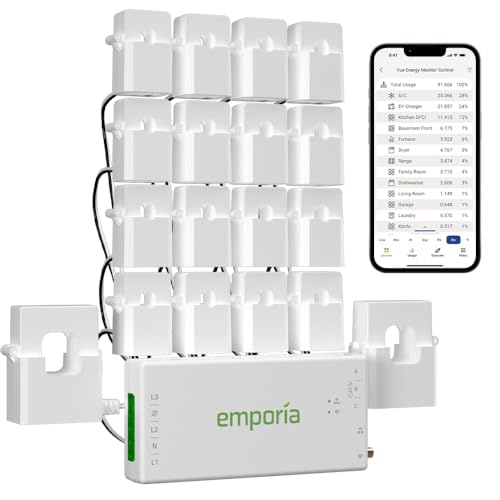
Emporia Vue 3 Energy Monitor, 16 Sensors
$199.99
Measure before you spend. Sixteen sensors show you production, the charger circuit and every other large load individually, which is the only way to find out how much of your charging already overlaps with daylight and how much a battery would actually shift.
- Sensors
- 16
- Solar
- Net metering aware
- Mains
- Yes
- Install
- At the panel
Trade-off It measures and reports. It does not move a single kilowatt hour by itself.
Check price
EF ECOFLOW
EcoFlow Delta 3 Max, 2048 Wh
$899.00
A 2 kWh portable battery, which is a useful way to understand the scale problem: it holds roughly seven miles of range for this car, and a full charge of a mid-size pack is forty times its capacity. Buy one for outages and tools, not to charge a car.
- Capacity
- 2.05 kWh
- Chemistry
- LFP
- Output
- 2400 W
- Car miles held
- About 7
Trade-off Charging a car from a portable station is a demonstration rather than a strategy.
Check price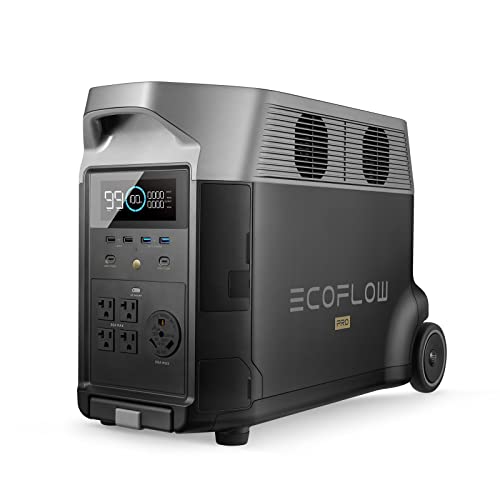
EF ECOFLOW
EcoFlow Delta Pro, 3600 Wh
$1,899.00
A 3.6 kWh battery that can absorb midday production and release it after dark, and keep the house running through an outage. That second job is what justifies the purchase. The charging benefit alone does not, at any electricity rate in the country.
- Capacity
- 3.6 kWh
- Output
- 3600 W
- Car miles held
- About 12
- Backup
- Yes
Trade-off Twelve miles of range per full battery. Read the payback arithmetic below before buying.
Check pricePaid links. Prices shown when researched and change without notice.
Where a battery does earn its place is resilience. If your area loses power regularly, if you work from home, if there is medical equipment in the house, or if outages last long enough to spoil a freezer, the value of riding through an outage is real and it has nothing to do with charging. Buy the battery for that, size it for the loads you want to keep running, and treat any solar-shifting benefit as a bonus. The EcoFlow Delta Pro appears in the panel upgrade buildout on exactly that basis, and the buildout says so in the line item rather than pretending it pays for itself.
Vehicle to home, and why it changes the question
A number of vehicles can now export power, either to individual outlets or, with the right equipment, to a house through a transfer arrangement. The relevant observation for this page is one of scale: a car pack holds five to fifteen times what a typical home battery holds, so a car that can export is by far the largest battery most households will ever own.
That capability requires specific vehicle support, specific equipment and a properly engineered connection to the house, and it is emphatically not something to improvise. But if you are weighing a home battery primarily for backup, and your next car can export, the honest advice is to find out what that path costs before committing to storage that duplicates it.
How this page was researched
Array production figures are rounded regional averages for annual output per installed kilowatt and vary substantially with roof orientation, tilt, shading, module choice and local climate. Vehicle efficiency uses 3.4 miles per kWh, a mid-range figure for a crossover, and charging losses are taken at ten percent consistently across this site. Electricity rate figures use the US average residential price of 16.5 cents per kWh. Product specifications come from manufacturer documentation and listed certifications. We do not perform hands-on product testing and never claim to.
Everything here is researched planning information rather than professional electrical, tax or financial advice. Export rates, net metering rules and incentive programmes are set locally and change, so confirm your own tariff with your utility before making a decision that depends on it.
Where to go next
Size the charging side first with the solar charging calculator, then check what your driving actually costs with the cost per mile calculator. If the panel is the constraint rather than the roof, electrical panel load calculation is the place to start, and the complete solar-ready install is priced line by line in the panel upgrade buildout.
We review them on their own too, in full detail: the Enphase IQ EV Charger 2 and the EcoFlow DELTA 3 Max.
Common questions
How many solar panels does it take to charge an electric car?
About 2.4 to 3.6 kW of array to cover 12,000 miles a year, depending on your solar resource. At 3.4 miles per kWh and including charging losses, that mileage needs roughly 3922 kWh a year. In a good solar region a kilowatt of array produces about 1,500 kWh annually, so 2.5 kW covers it; in a poor region producing 1,100 kWh per kW, you need closer to 3.6 kW. That is typically six to ten panels.
Can I charge my EV directly from solar?
Not directly in the sense of a wire from the panels to the car, and you would not want to. Production varies with cloud cover minute by minute, and a charger negotiates a fixed current with the vehicle at the start of a session. What actually happens is that everything joins at the panel: your array feeds the house, the charger draws from the house, and whether that energy came from the roof or the grid is an accounting question. Some chargers can modulate their draw to follow production, which is as close to direct as home equipment gets.
Does a home battery make sense for EV charging?
Rarely on charging economics alone. A battery large enough to matter costs thousands and loses 10 to 15 percent of everything that passes through it, and what it saves you is the difference between your export rate and your import rate on the energy it shifts. Where a battery does earn its place is backup power during outages, and in areas with severe peak demand charges or frequent outages that value can be substantial. Judge it on those, and treat the charging benefit as a bonus.
Is it better to charge during the day from solar or at night off-peak?
It depends entirely on what your utility pays for exported energy. Under full retail net metering, timing makes no difference at all, so charge overnight on the cheapest rate you can get. Under a low export rate, every kWh you self-consume avoids buying at retail instead of selling at wholesale, so daytime charging is worth real money. Look up your own export rate before optimising anything, because this single number reverses the answer.
Will adding solar avoid a panel upgrade for my charger?
No, and it can complicate the panel. A solar interconnection has its own requirements about how it connects to the busbar, and adding both solar and a large charger circuit to a full panel is more constrained than adding either alone. A load calculation covers the charger, and the solar interconnection is a separate calculation. If the panel is tight, load management is the cheaper answer to the charger side of the problem.
Do I need a special charger to use solar?
No. Any Level 2 charger will run on energy your array produced, because the energy meets at the panel. What some chargers add is the ability to modulate their draw to match surplus production rather than importing, sometimes called solar tracking or excess charging. That feature is worth having if your export rate is poor and you are home during the day, and worth nothing under full net metering.
Getting your own panel and load numbers ready for an electrician? The EV Home Charging Install Planner is the paid version of these pages: 8 printable worksheets you fill in with your own numbers, plus the full PDF, $29.
How this page was researched
Specifications come from manufacturer documentation, listed safety certifications and verified owner reviews. We do not perform hands-on product testing and never claim to. Figures are researched planning information, not professional electrical advice. Last reviewed 2026-08-17.