Autel vs Wallbox EV Charger
Short answer
The Autel MaxiCharger 50A hardwired at around $529 and the Wallbox Pulsar Plus 48A at around $699.99 both run at 48 amps on a 60 amp circuit and deliver 11.5 kW, so they charge at identical speed. Autel gives you a 25 foot cable, Bluetooth as well as Wi-Fi and $171 back; Wallbox gives you a far more compact enclosure.
Autel and Wallbox both sell premium connected home chargers, and they have almost nothing in common beyond the amperage. The Autel MaxiCharger 50A hardwired at around $529 is a conventionally sized wall box with a 25 foot cable and two radios in it. The Wallbox Pulsar Plus 48A at around $699.99 comes from a line built at the compact end of this class, with a design that looks deliberate on a wall. On the same 60 amp circuit they both deliver 11.5 kW, and the 171 dollar gap buys design rather than speed. Neither Wallbox listing states an enclosure size or a cable length, so confirm both against the manufacturer specification before you plan a mounting position.
That makes this an unusually clean decision, because the usual confusion about amperage does not apply. Both units are 48 amp chargers in practice. Both need the same breaker, the same conductor and the same permit. So the question reduces to two things: how good is your Wi-Fi where the charger is going, and does anybody look at the wall it is going on.
Best value at 11.5 kW
Connectivity redundancy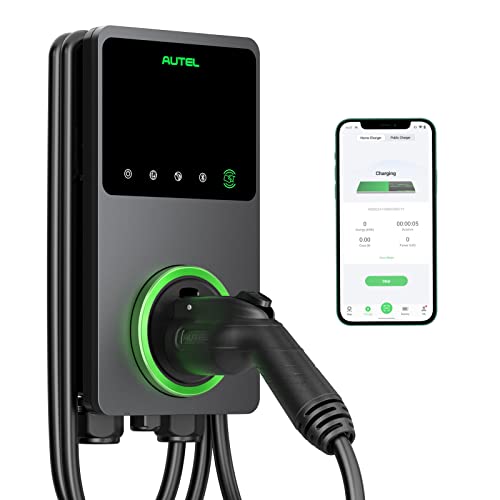
Autel
Autel MaxiCharger 50A Hardwired, 25 ft
$529.00
The same 11.5 kW as the Wallbox on the same 60 amp circuit, for around 171 dollars less, with a 25 foot cable and both Wi-Fi and Bluetooth on board. The Bluetooth is the quiet reason to buy it: a charger in a detached garage with weak Wi-Fi is still configurable from three feet away.
- Output
- 11.5 kW
- Continuous
- 48 A
- Circuit
- 60 A
- Cable
- 25 ft
- Radios
- Wi-Fi and Bluetooth
- Install
- Hardwired
Paid link. Price shown when researched.
Do they charge at different speeds?
They do not, and the specification sheets make it look like they might. Autel markets the hardwired MaxiCharger as a 50 amp unit and Wallbox markets the Pulsar Plus as a 48 amp unit, which reads on a shelf like a small Autel advantage.
It disappears in a garage. EV charging is a continuous load, so the circuit is sized at 125 percent of the charger's continuous draw. Forty-eight amps needs a 60 amp breaker. Fifty amps needs 62.5, which rounds up to 70 amps and a heavier conductor. Nobody installs a 70 amp branch circuit for a home charger, so the Autel is configured down to 48 amps at commissioning and both units run at 48 amps, 240 volts and 11.5 kW. Even on a 70 amp circuit, the extra 0.5 kW is under two miles of range per hour. You can watch the numbers move yourself in the breaker size calculator.
| Specification | Autel MaxiCharger 50A | Wallbox Pulsar Plus 48A |
|---|---|---|
| Price when researched | $529.00 | $699.99 |
| Nominal maximum output | 50 A | 48 A |
| Output on a 60 amp circuit | 48 A, 11.5 kW | 48 A, 11.5 kW |
| Circuit for the nominal maximum | 70 A | 60 A |
| Cable length on the listing | 25 ft | Not stated |
| Radios on the listing | Wi-Fi and Bluetooth | Not stated |
| Enclosure size | Conventional wall box | The compact end of the category |
| Install method | Hardwired | Hardwired |
| NACS option in this catalogue | None | Yes, same price |
| 80 amp option | Yes, $1,069.00 | None |
| Price per delivered kW | $46.00 | $60.87 |
Rows three and four are the honest summary of the speed question, and the last row is the honest summary of the value one. At $46.00 per delivered kilowatt the Autel is comfortably the better buy on arithmetic. At $60.87 the Wallbox is asking you to pay about a third more for the same electricity, which is only a sensible decision if you value what the extra money actually buys.
What does the Wallbox premium actually buy?
Physical size, mostly, and it is not a trivial benefit. The Pulsar Plus line is built small enough to disappear on a wall in a way a conventionally sized charger does not. That matters in three specific situations and in none of the others, and it is worth confirming the actual dimensions against the manufacturer specification, because the Amazon listing states only the amperage and the connector.
The first is a narrow garage where the charger sits at shoulder height beside a car door and every inch of projection is an inch you can catch a jacket on. The second is a visible location: a carport, a wall inside an open plan garage that doubles as a workshop, or the front of a house where a large grey box would be an eyesore. The third is a retrofit into a tight space, such as between a panel and a doorframe, where a conventional unit simply does not fit the available flat wall.
The cable is part of the same argument, with the caveat that the Wallbox listing does not state a length at all while the Autel listing states 25 feet. Twenty-five feet will reach a car parked awkwardly on the far side of a two bay garage but has to live somewhere when it is not in use. Which of those is better depends entirely on your garage. A 25 foot cable with no holster is a trip hazard and a cable with a crushed jacket; a short cable that does not reach the charge port is worse than useless. The trade is worked through properly in best long cable EV chargers, and where to put the unit in the first place is covered in charger placement in a garage.
The Wallbox Pulsar Plus range
Three compact units. The 48 amp model is the one to buy, the NACS version costs the same, and the 40 amp model is 23.99 dollars cheaper for 1.9 kW less.

Wallbox
Wallbox Pulsar Plus 40A
$649.99
The 40 amp Pulsar Plus, and the hardest unit on this page to justify. It delivers 9.6 kW and sits only 23.99 dollars below the 48 amp version that delivers 11.5 kW.
- Output
- 9.6 kW
- Circuit
- 50 A
- Continuous
- 40 A
- Connector
- J1772
Trade-off Pay 23.99 dollars more for the 48 amp model unless your circuit is fixed at 50 amps.
Check price
Wallbox
Wallbox Pulsar Plus 48A
$699.99
The reason to look at Wallbox: the Pulsar Plus line is built at the compact end of this category, with genuinely considered industrial design. The listing states the amperage and the J1772 connector and nothing about size or cable, so confirm both before you commit to a mounting position.
- Output
- 11.5 kW
- Circuit
- 60 A
- Continuous
- 48 A
- Connector
- J1772
Trade-off The most expensive way to buy 11.5 kW here, at $60.87 per delivered kilowatt.
Check priceWallbox
Wallbox Pulsar Plus 48A NACS
$699.99
The NACS version at the same price as the J1772 model, which makes the connector a free choice. Autel has no NACS unit in this catalogue, so a Tesla-only household has a real reason to prefer Wallbox.
- Output
- 11.5 kW
- Circuit
- 60 A
- Connector
- NACS
- Continuous
- 48 A
Trade-off A J1772 car then needs an adapter in the expensive direction, at well over 100 dollars.
Check pricePaid links. Prices shown when researched and change without notice.
Why does Bluetooth matter on a charger?
Because chargers get installed in the worst possible place for a wireless network. A detached garage is a separate building, often with a metal door and a concrete floor, thirty to a hundred feet from the router that serves the house. Wi-Fi that is adequate on a phone standing in the driveway is frequently marginal at a wall unit mounted at head height inside.
The Autel hardwired listing states both Wi-Fi and Bluetooth. The Wallbox listing states neither, so treat its connectivity as something to confirm rather than assume. The reason to care about a local radio is not remote control, it is local access: setting the amperage during commissioning, reading a fault code when the unit refuses to start a session, and re-pairing after you replace a router. A charger that can only be reached over the network it cannot reliably see is a charger you cannot configure without standing on a stepladder with a laptop.
| Situation | Autel | Wallbox | Verdict |
|---|---|---|---|
| Attached garage, router two rooms away | Wi-Fi works. Bluetooth unused. | Connects if the unit has Wi-Fi. Confirm on the listing. | No practical difference. Buy on price. |
| Detached garage, one bar of Wi-Fi at the wall | Bluetooth still configures and reads the unit locally. | The listing states no radios, so confirm what is on board before you rely on a local path. | Autel is the safer bet, and an access point in the garage is the real fix. |
| Detached garage, no Wi-Fi at all | Charges normally. Configure over Bluetooth. No remote features. | Charges normally. No remote features either way. | Both work. Schedule from the car instead. |
| Home network replaced, charger needs re-pairing | Bluetooth gives a local path that does not depend on the old network. | Confirm the unit has a local radio at all before you count on this. | A local radio is worth more than people expect on a permanent fixture. |
The honest conclusion from that table is that a second radio is insurance rather than a feature, and the real fix for a detached garage is a network that actually reaches it. If that describes your situation, read EV charger Wi-Fi setup before you buy either unit, because a 30 dollar access point solves more than a 700 dollar charger does.
The Autel MaxiCharger range
A plug-in 40 amp unit, the hardwired 48 amp pick, and the 80 amp ceiling. All three ship a 25 foot cable.

Autel
Autel MaxiCharger 40A
$375.99
The plug-in Autel. Forty amps on a NEMA 14-50 for 9.6 kW, with the same 25 foot cable as its bigger sibling, rated indoor or outdoor. The only Autel here you can unplug and take with you. The listing states no connectivity, so confirm that separately if the app matters to you.
- Output
- 9.6 kW
- Circuit
- 50 A
- Plug
- 14-50
- Cable
- 25 ft
Trade-off Capped at 40 amps by the receptacle, so 1.9 kW behind the hardwired unit.
Check price Autel
Autel MaxiCharger 50A Hardwired, 25 ft
$529.00
Nominally a 50 amp charger, configured to 48 amps on the 60 amp circuit almost everyone installs, so 11.5 kW in practice. Wi-Fi plus Bluetooth, 25 foot cable, hardwired J1772.
- Output
- 11.5 kW
- Circuit
- 60 A
- Cable
- 25 ft
- Radios
- Wi-Fi and Bluetooth
Trade-off Reaching the nominal 50 amps needs a 70 amp circuit that nobody installs for 0.5 kW.
Check price
Autel
Autel MaxiCharger 80A
$1,069.00
The ceiling of home AC charging. Eighty amps and 19.2 kW on a 100 amp branch circuit, which is half of a typical 200 amp residential service given to one appliance.
- Output
- 19.2 kW
- Continuous
- 80 A
- Circuit
- 100 A
- Install
- Hardwired
Trade-off Almost nobody should buy it. One mainstream vehicle can accept 19.2 kW at home.
Check pricePaid links. Prices shown when researched and change without notice.
Which one costs less per kilowatt you receive?
Price per delivered kilowatt is the fairest way to line up chargers that differ in nominal rating, because it prices what arrives at the car rather than what is printed on the box. The plug-in units are counted at 9.6 kW because a NEMA 14-50 receptacle supports 40 amps continuous and no more, whatever the unit is capable of on a hardwired termination.
| Unit | Price | Delivered kW | Per kW | Comment |
|---|---|---|---|---|
| Autel MaxiCharger 40A plug-in | $375.99 | 9.6 | $39.17 | Cheapest real Level 2 on this page. |
| Autel MaxiCharger 50A hardwired | $529.00 | 11.5 | $46.00 | The value choice at 11.5 kW. |
| Autel MaxiCharger 80A | $1,069.00 | 19.2 | $55.68 | Only sensible for the one truck that can use it. |
| Wallbox Pulsar Plus 48A | $699.99 | 11.5 | $60.87 | You are paying for the enclosure, not the charging. |
| Wallbox Pulsar Plus 48A NACS | $699.99 | 11.5 | $60.87 | No surcharge for the NACS connector. |
| Wallbox Pulsar Plus 40A | $649.99 | 9.6 | $67.71 | Worst value here. The 48 amp model is 23.99 dollars more. |
Two things jump out. The Autel MaxiCharger 40A at around $375.99 is the cheapest genuine Level 2 charger in this comparison at $39.17 per kilowatt, and it keeps the 25 foot cable while dropping the hardwired termination. If there is already a properly sized NEMA 14-50 in the garage, that unit is the whole project.
And the Wallbox Pulsar Plus 40A at around $649.99 is the one unit here that is difficult to recommend to anybody. It sits $23.99 below the 48 amp version and delivers 1.9 kW less. Unless your circuit is already fixed at 50 amps and will never change, the 48 amp model is the better purchase by a comfortable margin.
What about the ceiling and the connector?
Two gaps run in opposite directions between these ranges, and both are worth knowing.
Autel goes higher. The Autel MaxiCharger 80A at around $1,069.00 delivers 19.2 kW on a 100 amp branch circuit, which is the ceiling of home AC charging. Wallbox has nothing in that class here. Almost nobody should buy it: the Ford F-150 Lightning is essentially the only mainstream vehicle whose onboard charger accepts 19.2 kW, and a 100 amp circuit is half of a typical 200 amp residential service consumed by one appliance. On a Rivian R1T or a Cybertruck, both of which cap at 11.5 kW, an 80 amp charger charges at exactly the speed a 48 amp one does.
Wallbox covers a connector Autel does not. The Wallbox Pulsar Plus 48A NACS is the same $699.99 as the J1772 model, so the connector choice costs nothing, and Autel has no NACS unit in this catalogue. For a household where every car has a NACS inlet, that alone can settle the comparison. For a mixed household, put J1772 on the wall from either brand and add a J1772 to NACS adapter for around 30 dollars, because that adapter direction is cheap and the reverse direction is not.
| Charger output | Breaker | Power at 240 V | Typical copper | Where it fits |
|---|---|---|---|---|
| 40 A | 50 A | 9.6 kW | 6 AWG | The most common home install. Fits a NEMA 14-50 outlet. |
| 48 A | 60 A | 11.5 kW | 6 AWG | Hardwired only. Saturates almost every onboard charger sold. |
| 64 A | 80 A | 15.4 kW | 4 AWG | Rare. Very few vehicles can use it. |
| 80 A | 100 A | 19.2 kW | 3 AWG | Essentially the F-150 Lightning case only. |
Read the bottom two rows before you get excited about the 80 amp Autel. Sixty-four amps needs an 80 amp circuit and 4 AWG copper; 80 amps needs a 100 amp circuit and 3 AWG. Those conductors are expensive, the breakers are expensive, and on most services the load calculation says no. The 48 amp row is where the sensible ceiling sits for a home, and it is where both of the flagship units on this page live.
So which should you buy?
Buy the Autel if you are choosing on value, if the charger is going into a detached or awkwardly networked garage where a local radio earns its keep, or if you want the 25 foot cable because the car does not always park in the same place. It delivers exactly the same 11.5 kW for $171 less, and that is a meaningful share of an installation quote.
Buy the Wallbox if the charger is going somewhere visible or somewhere tight, if a large box on the wall would genuinely bother you every day, or if you want NACS on the cable without paying a surcharge. Design is a legitimate thing to buy with your own money. It is simply not a charging speed advantage, and nobody should pretend it is.
Buy the Autel 40A plug-in instead of either if a properly sized NEMA 14-50 already exists in the garage, because in that case the electrical work is already paid for and 9.6 kW is plenty for almost every daily pattern. And check what your own car accepts before spending anything at all: many vehicles top out between 10.5 and 11.5 kW, and a Nissan Leaf or early Toyota bZ4X accepts 6.6 kW and gains nothing from any unit on this page.
Where to go next
The complete 48 amp field, including Emporia, ChargePoint, Leviton, Lectron and Tesla, is in best 48 amp EV chargers. If app quality, scheduling and load management are what you are really shopping for, the cross-brand comparison is in best smart EV chargers.
We review them on their own too, in full detail: the Autel MaxiCharger 50A and the Wallbox Pulsar Plus 48A.
Common questions
Does the Autel charge faster than the Wallbox?
No. On the 60 amp circuit that almost every home install uses, both units run at 48 amps and deliver 11.5 kW. The Autel is nominally rated at 50 amps, but 50 amps continuous requires a 70 amp circuit under the 125 percent rule, and essentially nobody installs one for a gain of 0.5 kW. On identical wiring these two chargers finish at exactly the same minute.
Why does the Wallbox cost 171 dollars more for the same output?
Enclosure size and industrial design, mostly. The Pulsar Plus line is built far smaller than a conventional wall box, which is a real benefit if the charger lives somewhere visible or somewhere tight and worth nothing at all on a basement wall behind a chest freezer. The listing states no dimensions, so confirm them, then decide which of those two situations describes your install.
Does Bluetooth on a charger actually matter?
It matters in one common situation: a detached garage or a far garage wall where Wi-Fi is marginal. Bluetooth gives you a local path to configure amperage, read faults and re-pair the unit without depending on a network that barely reaches. It also survives a router replacement gracefully. In an attached garage with decent coverage it is a feature you will never think about again.
Should I buy the 40 amp Wallbox to save money?
No. The 40 amp Pulsar Plus is 23.99 dollars cheaper than the 48 amp version and delivers 1.9 kW less, which is the worst trade on this page. The only reason to choose it is a circuit that is already fixed at 50 amps and not going to change. If the circuit is still being planned, the 48 amp model plus the bigger breaker is the better buy.
Is the 80 amp Autel worth it for a truck?
Only for the Ford F-150 Lightning, which is essentially the only mainstream vehicle whose onboard AC charger accepts 19.2 kW. A Rivian R1T or a Cybertruck caps at 11.5 kW, so an 80 amp charger delivers exactly what a 48 amp one does while requiring a 100 amp branch circuit. That circuit is half a typical 200 amp residential service, and it frequently forces a service upgrade.
Which one should I buy if I drive a Tesla?
Wallbox, because it sells a NACS version at the same price as the J1772 model and Autel has no NACS unit in this catalogue. If you would rather have the Autel, buy the J1772 version and add a J1772 to NACS adapter for around 30 dollars, which is the cheap adapter direction and the one that keeps a mixed household working with a single wall unit.
Getting your own panel and load numbers ready for an electrician? The EV Home Charging Install Planner is the paid version of these pages: 8 printable worksheets you fill in with your own numbers, plus the full PDF, $29.
How this page was researched
Specifications come from manufacturer documentation, listed safety certifications and verified owner reviews. We do not perform hands-on product testing and never claim to. Figures are researched planning information, not professional electrical advice. Last reviewed 2026-08-17.