Grizzl-E vs Emporia EV Charger
Short answer
The Grizzl-E Classic 40A at around $299.99 delivers 9.6 kW on a 50 amp circuit inside a metal case with no cloud service. The Emporia 48A at around $449 delivers 11.5 kW on a 60 amp circuit with Wi-Fi and a 25 foot cable. Buy the Emporia for kilowatts and data, the Grizzl-E for a device that will still work when nobody is running the servers.
This comparison is not really about amperage, even though the two units differ by eight amps. It is about what kind of object you want screwed to your garage wall for the next fifteen years. The Grizzl-E Classic 40A at around $299.99 is a sealed metal box that does one job, has no app, no account and no firmware update path, and delivers 9.6 kW on a 50 amp circuit. The Emporia 48A at around $449 is a connected unit that delivers 11.5 kW on a 60 amp circuit, joins your Wi-Fi and reports energy per session in a way a Grizzl-E Classic never will.
Both are correct answers to different questions. The Emporia is the cheapest way to buy 11.5 kW from anybody, and the reporting is genuinely useful if you are on a time-of-use rate or trying to work out what the car actually costs you. The Grizzl-E is the cheapest real Level 2 install, it is built for weather rather than protected from it, and it carries no dependency on a company continuing to run a cloud service for a decade and a half. The honest way to decide is to work out which of those you will still care about in 2041.
If you want the kilowatts
More kilowatts, more software
EMPORIA
Emporia Level 2 EV Charger, 48A J1772
$449.00
The cheapest way to buy 11.5 kW. Hardwired 48 amps on a 60 amp circuit, a 25 foot cable, Wi-Fi and per-session energy reporting for around 150 dollars more than a 40 amp Grizzl-E, which is a small premium inside an installation you are already paying an electrician for.
- Output
- 11.5 kW
- Continuous
- 48 A
- Circuit
- 60 A
- Cable
- 25 ft
- Connector
- J1772
- Install
- Hardwired
Paid link. Price shown when researched.
How different are they on the wall?
Line them up specification by specification and the pattern is clear. Grizzl-E spends its money on the enclosure and the cable. Emporia spends its money on the electronics and the amperage. Neither company is wasting yours; they simply disagree about what a home charger is for.
| Specification | Grizzl-E Classic 40A | Emporia 48A |
|---|---|---|
| Price when researched | $299.99 | $449.00 |
| Continuous output | 40 A | 48 A |
| Power at 240 V | 9.6 kW | 11.5 kW |
| Circuit required | 50 A | 60 A |
| Install method | Plug-in or hardwired | Hardwired only |
| Enclosure stated on the listing | Metal case | Not stated |
| Cable length stated on the listing | Not stated | 25 ft |
| Connectivity | None on the Classic | Wi-Fi, required for features |
| Energy reporting | None | Per session and per circuit |
| Works with no internet | Always | Charges, but you lose the app |
| Certification on the listing | UL certified | Energy Star, on the NACS model only |
| Price per delivered kW | $31.25 | $39.04 |
Note the last row, because it contradicts something you will read elsewhere. Emporia is often described as the cheap 48 amp charger, and it is: nothing else delivers 11.5 kW for less. But cheap per kilowatt is a different claim, and at $31.25 per delivered kilowatt the Grizzl-E Classic beats the Emporia's $39.04 comfortably. The right way to read that is not that one is a rip-off, it is that 40 amps is the value sweet spot in this category and 48 amps is a premium you pay for a real but modest gain.
What does the extra 1.9 kW actually buy you?
Kilowatts are abstract, so convert them. The table below uses each vehicle's published onboard AC charger limit and its efficiency to show miles of range recovered per hour of charging at 9.6 kW and at 11.5 kW. The onboard charger is the ceiling, not the wall unit, which is why one row shows no difference at all.
| Vehicle | Onboard AC limit | At 9.6 kW | At 11.5 kW | Difference |
|---|---|---|---|---|
| Tesla Model 3 | 11.5 kW | 40 mi per hour | 48 mi per hour | 8 mi per hour |
| Tesla Model Y | 11.5 kW | 37 mi per hour | 45 mi per hour | 8 mi per hour |
| Hyundai Ioniq 5 | 10.9 kW | 34 mi per hour | 38 mi per hour | 4 mi per hour |
| Rivian R1T | 11.5 kW | 21 mi per hour | 25 mi per hour | 4 mi per hour |
| Nissan Leaf | 6.6 kW | 23 mi per hour | 23 mi per hour | No difference |
The Nissan Leaf row is the one worth staring at. A Leaf accepts 6.6 kW, so a 48 amp Emporia charges it at precisely the same speed as a 32 amp unit would, and the 60 amp circuit is money set on fire. If that is your car, the comparison on this page has already been decided in Grizzl-E's favour, and you could reasonably spend even less. Work your own vehicle through the charge time calculator, because the question that matters is not how fast the charger is, it is whether the car is full when you leave in the morning.
For the cars that can use the full 11.5 kW, the gain lands between six and eight miles of range per hour. Over an eight hour overnight session that is roughly 50 to 64 extra miles of recovery capacity. For most households that is headroom they never touch. For a Rivian R1T or a Cybertruck arriving home at fifteen percent, it is the difference between full by morning and not. The complete argument about where to stop on the amperage ladder is in 32A vs 40A vs 48A.
The Grizzl-E 40 amp range
Three units, all 40 amps and 9.6 kW on a 50 amp circuit, all in a metal case. The only real question is how much connectivity you want.
Grizzl-E
Grizzl-E Smart 40A
$250.00
The cheapest unit on this page and the odd one in the range: it adds connectivity while costing less than the Classic. Same 40 amps, same metal case, listed as UL tested and certified and Energy Star.
- Output
- 9.6 kW
- Circuit
- 50 A
- Case
- Metal
- Smart
- Yes
Trade-off Pricing in this range moves around, so confirm it is still below the Classic before you decide on price alone.
Check priceGrizzl-E
Grizzl-E Classic 40A
$299.99
The default recommendation for people who want a charger and not a subscription. The listing states a metal case enclosure, UL certification and indoor or outdoor rating, and there is no app at all.
- Output
- 9.6 kW
- Circuit
- 50 A
- Case
- Metal
- Cert
- UL
Trade-off No scheduling and no energy reporting, so a time-of-use plan has to be managed from the car.
Check price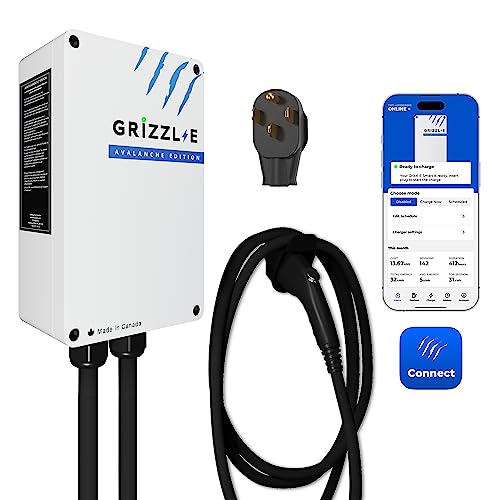
Grizzl-E
Grizzl-E Classic Connect 40A
$349.99
The middle path. The Classic hardware with connectivity added, so you keep the metal case and gain scheduling and reporting. Still 40 amps on a 50 amp circuit for 9.6 kW.
- Output
- 9.6 kW
- Circuit
- 50 A
- Case
- Metal
- Smart
- Yes
Trade-off Fifty dollars more than the Classic for features your car probably already has.
Check pricePaid links. Prices shown when researched and change without notice.
Do you want a cloud service on a fifteen year appliance?
This is the question the specification sheets do not ask. A charging circuit is permanent infrastructure. The conductors in the wall will outlive several phones, at least one home network and quite possibly the company whose logo is on the wall unit. Anything on that unit that depends on a company continuing to operate a server is a feature with an expiry date nobody will tell you in advance.
The reassuring part is that the failure is graceful. Every Level 2 charger is fundamentally a contactor plus a pilot-signal negotiator, and both live inside the box. If Emporia stopped running its cloud tomorrow, the charger would keep delivering 11.5 kW. What you would lose is scheduling, remote start and the energy reporting that is the main reason to buy it in the first place. That is a real loss, and it is also not a fire hazard or a brick.
The Grizzl-E Classic sidesteps the question by having nothing to lose. There is no account, no pairing flow, no firmware update that can go wrong in a garage with two bars of Wi-Fi, and no notification that the terms of service have changed. Set the amperage with the internal switch at install time and the unit is finished being configured forever.
If that sounds appealing but you still want scheduling, the Grizzl-E Classic Connect at around $349.99 is the deliberate middle path: metal case, 40 amps, connectivity added. And the Grizzl-E Smart at around $250.00 is the strange one in the range, because it is connected and cheaper than the Classic. If that pricing still holds when you shop, it is the best price per delivered kilowatt in this entire comparison at $26.04. Prices in this category move, so check before you decide on that basis alone. The wider field of connected units is in best smart EV chargers.
| Unit | Price | Delivered kW | Per kW |
|---|---|---|---|
| Grizzl-E Smart 40A | $250.00 | 9.6 | $26.04 |
| Grizzl-E Classic 40A | $299.99 | 9.6 | $31.25 |
| Grizzl-E Classic Connect 40A | $349.99 | 9.6 | $36.46 |
| Emporia 48A J1772 | $449.00 | 11.5 | $39.04 |
| Emporia 48A NACS | $479.00 | 11.5 | $41.65 |
| Grizzl-E Ultimate 80A | $899.00 | 19.2 | $46.82 |
| Grizzl-E Duo, two cables | $899.99 | 19.2 | $46.87 |
| Emporia Pro 48A | $599.00 | 11.5 | $52.09 |
Which one survives being mounted outside?
Plenty of home chargers live on an exterior wall, on a carport post or under a lean-to, and that is where the enclosure stops being a styling decision. A sealed metal case handles direct sun, freeze and thaw cycles, hose spray during a car wash and a knock from a bicycle handlebar in a way a moulded plastic one does not. Plastic that faces south for ten years chalks, and the UV resistance of a moulded enclosure is a property of the specific compound rather than of plastic in general.
That said, the enclosure rating on the listing tells you more than the material does. The ratings below are the ones you will see on charger documentation, and they are worth understanding before you assume outdoor-rated means weatherproof.
| Rating | Protects against | Rough IP equivalent | What it means for a charger |
|---|---|---|---|
| NEMA 3R | Falling rain, sleet, external ice | IP24 equivalent | The minimum for a wall under an eave. Not for direct spray. |
| NEMA 4 | Windblown dust, rain, splashing and hose-directed water | IP66 equivalent | What you want on an exposed exterior wall or a pedestal. |
| NEMA 4X | Everything in 4 plus corrosion | IP66 equivalent | Coastal salt air, or anywhere de-icing salt gets airborne. |
| NEMA 6P | Prolonged submersion | IP67 equivalent | More than a home charger needs. Not a reason to pay extra. |
Both brands describe their units as suitable for indoor or outdoor mounting, and both are. The difference shows up over a decade rather than in a rainstorm, and the cable matters as much as the case: a cable that stiffens to a coil of rebar at minus ten degrees is the part of a cheap charger you notice first in a cold climate. The full set of outdoor considerations, including in-use covers, sunlight and theft, is in best outdoor EV chargers.
The Emporia 48 amp range
All three deliver 11.5 kW on a 60 amp circuit. The choice is the connector on the cable and whether you need load management to make the circuit fit at all.
EMPORIA
Emporia Level 2 EV Charger, 48A J1772
$449.00
Hardwired 48 amps for 11.5 kW, a 25 foot cable and energy reporting per session. The cheapest unit in this comparison that saturates the onboard charger in nearly every electric car sold.
- Output
- 11.5 kW
- Circuit
- 60 A
- Cable
- 25 ft
- Connector
- J1772
Trade-off The listing does not state an enclosure material or an Energy Star listing, and the useful features depend on a cloud service.
Check price
EMPORIA
Emporia Level 2 EV Charger, 48A NACS
$479.00
The NACS version, preconfigured for a hardwired install with a whip, listed as UL and Energy Star. Grizzl-E has no NACS unit in this catalogue, so a Tesla-only household has a real reason to prefer it.
- Output
- 11.5 kW
- Circuit
- 60 A
- Connector
- NACS
- Install
- Hardwired
Trade-off Thirty dollars more than the J1772 unit, and a J1772 car then needs an expensive adapter.
Check price
EMPORIA
Emporia Pro 48A with PowerSmart Load Management
$599.00
The reason to look at Emporia if your panel is full. The listing names PowerSmart, which Emporia describes as throttling the charger against whole house draw, and that can replace a service upgrade.
- Output
- 11.5 kW
- Circuit
- 60 A
- Load mgmt
- PowerSmart
- Install
- Hardwired
Trade-off The most expensive unit here that still delivers only 11.5 kW. You are paying for panel headroom.
Check pricePaid links. Prices shown when researched and change without notice.
Where does one range have no answer to the other?
Two gaps run in each direction, and both are worth knowing before you assume this is a like-for-like contest.
Grizzl-E goes higher and wider. The Grizzl-E Ultimate 80A at around $899.00 delivers 19.2 kW on a 100 amp branch circuit, which is the ceiling of home AC charging and something Emporia does not sell at all. Almost nobody should buy it: the Ford F-150 Lightning is essentially the only mainstream vehicle whose onboard charger can accept 19.2 kW, and a 100 amp circuit is half of a typical 200 amp residential service handed to one appliance. The Grizzl-E Duo Connect at around $899.99 puts two 40 amp cables on one unit, which is a genuinely elegant answer for a two car electric household that would otherwise pay for two circuits, two breakers and two permits. Emporia has no equivalent to that either.
Emporia goes deeper on the electrical problem. The Emporia Pro at around $599.00 ships with PowerSmart, which measures whole house current at the main and throttles the charger when the rest of the house is drawing heavily. That is the mechanism that lets a 100 amp service carry a nominally 60 amp charger circuit without a service upgrade, and there is no Grizzl-E that does it. Emporia also sells a NACS unit, the Emporia 48A NACS at around $479.00, and Grizzl-E has no NACS option in this catalogue.
The two Grizzl-E units with no Emporia equivalent
Eighty amps for the one truck that can use it, and a dual-cable unit for a two car household that wants one circuit and one permit.

Grizzl-E
Grizzl-E Ultimate 80A
$899.00
Eighty amps and 19.2 kW, which is the ceiling of home AC charging and needs a 100 amp branch circuit to reach. Emporia has nothing in this class, so if you genuinely need it the comparison ends here.
- Output
- 19.2 kW
- Continuous
- 80 A
- Circuit
- 100 A
- Case
- Metal
Trade-off Almost nobody should buy it. One mainstream vehicle can use 19.2 kW and it consumes half a 200 amp service.
Check priceGrizzl-E
Grizzl-E Duo Connect, Dual 40A
$899.99
Two 40 amp charging cables from one unit, which is the answer for a two car electric household that does not want two separate circuits and two separate permits. Again, Emporia has no equivalent.
- Per cable
- 9.6 kW
- Cables
- Two
- Case
- Metal
- Smart
- Yes
Trade-off Two cars charging at once share the circuit, so each gets less than 9.6 kW when they overlap.
Check pricePaid links. Prices shown when researched and change without notice.
What does the circuit cost in each case?
The charger is the small number in this project and the circuit is the big one, which is why an eight amp difference on a spec sheet turns into a real budget difference in a house.
| Charger output | Breaker | Power at 240 V | Typical copper | Where it fits |
|---|---|---|---|---|
| 32 A | 40 A | 7.7 kW | 8 AWG | Plenty for a car with a 6.6 or 7.2 kW onboard charger. |
| 40 A | 50 A | 9.6 kW | 6 AWG | The most common home install. Fits a NEMA 14-50 outlet. |
| 48 A | 60 A | 11.5 kW | 6 AWG | Hardwired only. Saturates almost every onboard charger sold. |
| 64 A | 80 A | 15.4 kW | 4 AWG | Rare. Very few vehicles can use it. |
The 40 amp row is the last one where a receptacle is an option, because NEMA 14-50 supports 40 amps continuous and no more. That gives the Grizzl-E a flexibility the Emporia does not have: it can be plugged into an existing properly sized 14-50, which is sometimes a zero dollar electrical job, and it can be unplugged and taken to the next house. Above 40 amps continuous the charger is hardwired, so the Emporia is a permanent fixture that stays with the building.
On the panel side, a 60 amp continuous circuit is a materially larger ask than a 50 amp one. On a 200 amp service with normal loads both usually fit. On a 100 amp service with electric heat, the 50 amp circuit sometimes fits and the 60 amp one frequently does not, which is exactly the situation where the Emporia Pro and its load management stop looking like an upsell.
So which one should you buy?
Buy the Grizzl-E Classic if you want the cheapest honest Level 2 install, if the unit is going outside, if your car already schedules its own charging, or if the idea of a permanently installed appliance depending on a cloud account bothers you. Buy the Grizzl-E Smart instead if its lower price still holds when you shop, and the Classic Connect if you want the metal case with scheduling added.
Buy the Emporia 48A if your car can genuinely use 11.5 kW, if you want per-session energy data because you are on a time-of-use rate, or if you already own Emporia energy monitoring and want the charger inside the same dashboard. Buy the Emporia Pro if a load calculation says your service is tight, because load management at 150 dollars over the standard unit is far cheaper than a service upgrade.
And buy neither at 48 amps if your car accepts 6.6 kW. A Nissan Leaf or an early Toyota bZ4X gains nothing from the bigger circuit, and the money is better spent on cable length, a decent holster and getting the install done properly the first time.
Where to go next
The full 40 amp field, including the plug-in units that let you skip a hardwired termination entirely, is in best 40 amp EV chargers. If you are still deciding how much amperage to pay for, 32A vs 40A vs 48A works the whole ladder through in miles per hour and install cost, and the charge time calculator answers the only question that really matters: is the car full by morning either way.
We review them on their own too, in full detail: the Grizzl-E Smart and the Emporia 48 amp.
Common questions
Is the Grizzl-E better than the Emporia?
It is better at surviving and worse at reporting. The Grizzl-E Classic is a sealed metal box with no cloud dependency, which is the right shape for a device bolted to a wall for fifteen years. The Emporia delivers 11.5 kW instead of 9.6, reports energy per session and costs less per kilowatt than any other 48 amp unit. Neither is wrong. Decide whether you want data or durability first.
Do I actually need 11.5 kW instead of 9.6 kW?
Usually not. The gap is 1.9 kW, which is roughly six to eight miles of range per hour of charging. On a normal overnight session both units finish a normal day of driving with hours to spare. The 48 amp unit earns its money on a very large pack, on a household that regularly arrives home nearly empty, or when the incremental cost of the bigger circuit during the same install is small.
What happens to a smart charger when the company stops running its servers?
It keeps charging. The contactor, the pilot signal and the safety logic all live in the unit, so power delivery does not depend on a cloud service. What you lose is scheduling, energy reporting and remote control. Since almost every electric car can schedule its own charging, the practical hedge is to schedule from the car and treat the charger app as a convenience you can afford to lose.
Is a metal case worth paying for?
Outdoors, frequently yes. A sealed metal enclosure handles direct sun, freeze and thaw cycles, hose spray and the occasional knock from a wheelbarrow better than a moulded plastic one does, and it does not chalk or craze after a decade facing south. Inside an attached garage the difference is much smaller, and the enclosure rating on the listing matters more than the material itself.
Can I use a Grizzl-E with a Tesla?
Yes, with a J1772 to NACS adapter costing around 30 dollars, which is the cheap and widely certified adapter direction. Grizzl-E has no NACS unit in this catalogue, so a Tesla-only household that wants no adapter at all should look at the Emporia NACS model instead. If a J1772 car also lives in the house, put J1772 on the wall regardless and adapt for the Tesla.
Does the Grizzl-E Ultimate make sense for a truck?
Only for one truck. The Ultimate delivers 19.2 kW at 80 amps, which needs a 100 amp branch circuit, and the Ford F-150 Lightning is essentially the only mainstream vehicle whose onboard charger can accept it. A Rivian R1T or a Cybertruck caps at 11.5 kW, so the Ultimate charges them at exactly the speed a 48 amp unit does while consuming half a 200 amp service.
Getting your own panel and load numbers ready for an electrician? The EV Home Charging Install Planner is the paid version of these pages: 8 printable worksheets you fill in with your own numbers, plus the full PDF, $29.
How this page was researched
Specifications come from manufacturer documentation, listed safety certifications and verified owner reviews. We do not perform hands-on product testing and never claim to. Figures are researched planning information, not professional electrical advice. Last reviewed 2026-08-17.