Apartment and Condo Charging
Short answer
In an apartment or condo, the first question is whether your parking space is deeded to you or is a common element, because that decides who has to approve the work. Where a dedicated circuit is impossible, 12 amps on an ordinary 120 volt outlet still returns roughly 40 to 50 miles of range overnight, which covers the average 37 mile day with room to spare.
Everything else on this site assumes you own the panel. That single assumption is what makes a home install straightforward: you decide, you pay, you pull the permit, it is done. In an apartment or a condo almost none of that is true, and the useful version of this page is not a wiring diagram. It is an honest map of what is achievable, in what order to try it, and what to do when the answer is no.
The good news is bigger than most people expect. A large fraction of apartment residents do not need a Level 2 circuit at all, because a standard 120 volt outlet within reach of the car does more work than its reputation suggests. The rest of this page works from the best case down to that fallback.
If you are charging from whatever outlet you can reach
The renter pick
CHARGEHERE
ChargeHere 16A Portable, UL Listed
$129.99
A UL listed dual-voltage portable unit that runs at 16 amps on a 240 volt NEMA 6-20 and drops to a standard 120 volt household outlet with the included adapter, which is exactly the flexibility an apartment resident needs when the answer to "what can I plug into" keeps changing.
- Output
- 16 A
- Voltage
- 120 or 240 V
- Plugs
- 6-20 and 5-15
- Listing
- UL
- Connector
- J1772
- Install
- Portable
Paid link. Price shown when researched.
Is the parking space yours, or is it a common element?
This is the first question and it changes everything downstream. Multi-family parking generally falls into one of three categories, and each one has a different decision-maker.
A deeded space or a limited common element with exclusive use is the strongest position. The space is attached to your unit, nobody else parks there, and in many jurisdictions the association's ability to refuse a reasonable installation there is limited. This is the case where a real Level 2 circuit is genuinely on the table.
A general common element is a shared lot with no assigned spaces. Nothing there is yours, so nothing can be attached to a space you do not control. What is possible is a shared installation the association owns, which is a much bigger project with a much longer approval path.
A rented space in a leased building is a landlord conversation rather than an association one, and it is often faster. A single decision-maker who owns the building can approve in a week what an association takes two meetings and a vote to consider. Landlords also have a straightforward incentive: charging is a retention feature, and the wiring stays with the building.
Find out which of the three you are in before you spend an evening reading statutes. The answer is in your deed, your declaration of covenants or your lease, and if it is genuinely ambiguous that ambiguity is itself something to resolve first.
What do right-to-charge laws actually do?
A number of states have passed what are generally called right-to-charge statutes. As a category, they limit the ability of a homeowners association or a landlord to unreasonably prohibit the installation of electric vehicle charging equipment in a space a resident owns or has exclusive use of. They are not a blanket permission slip, and the conditions attached to them tell you what a successful application looks like anywhere, statute or not.
The recurring conditions across these laws are consistent enough to plan around. The resident normally pays all costs, including the electricity, the installation and any damage. The resident normally has to carry liability insurance naming the association. The work has to be done by a licensed contractor under permit and meet the building's architectural standards. The association can require a written application and can impose reasonable conditions, but usually cannot simply refuse indefinitely.
Several states have nothing at all, and in those places the association's governing documents are the whole of the law. Even where a statute exists, it will not force an association to run capacity it does not have or to fund a project. Check your own state and your own declaration, and treat this paragraph as a category description rather than a legal opinion, because it is one.
What does a good written proposal contain?
The single most effective thing you can do is turn a request into a package. Boards refuse vague requests because a vague request is unbounded risk. A specific proposal that answers the risk questions before they are asked converts a large fraction of the no answers.
A complete proposal covers: the exact location of the equipment and the route of the circuit, with a photograph or a sketch. The specification of the charger, its safety listing and its enclosure rating. The name and licence number of the electrician, and confirmation the work will be permitted and inspected. A statement of who pays for the installation, which is you. How the electricity will be metered and paid for, which is the question boards care about most. Proof of liability insurance. What happens if you sell or move out, which is usually that the equipment stays or is removed at your cost and the wall is made good. And an explicit statement that the work will not reduce anyone else's parking, block access or create a trip hazard.
Add one paragraph on building capacity, because that is the objection that sinks the most applications. If your proposal includes a load management device or a charger set to a modest amperage, you have already answered it. A 24 or 32 amp setting is often the difference between a project the building's service can absorb and one it cannot, and the difference in overnight charging is small enough that nobody notices. The mechanics of that are in load management devices.
Do not link or attach a contractor directory or a marketplace to a board proposal. Name the licensed electrician you have actually spoken to, with the permit path, and it reads as a plan rather than a wish.
Who pays for the electricity, and how do you prove it?
In a single-family house the charger sits behind your own meter and the question never arises. In a condo garage the circuit is very often fed from a house panel that serves common areas, which means the association is paying for your car unless somebody does something about it. Boards know this, and it is frequently the actual reason behind a refusal that gets phrased as a capacity concern.
There are three answers, in descending order of how clean they are. Feed the circuit from your own unit panel, so it lands on your meter with no accounting at all. This is the best outcome and it is often physically impossible, because the distance from a fourth floor unit panel to a basement parking bay is exactly the sort of run that cannot be made.
Install a submeter on the charger circuit, read it periodically and bill the resident. Simple, durable and it requires somebody to actually do the reading and the billing every month, which in a self-managed association means somebody volunteers to do it forever.
Or use a networked charger that reports energy per session and per authorised user, which is how most multi-family installations settle it now. No separate meter, an exportable record, and access control that stops a neighbour plugging in. Circuit-level monitoring such as the Emporia Vue 3 energy monitor is a reasonable cross-check for a small association, though consumer monitoring is not a billing-grade meter and should not be presented as one.
Whichever route, put the rate in writing. Charging at the building's blended commercial rate is not the same as the residential average of 16.5 cents per kWh, and a resident who assumed otherwise will be unhappy at the first bill. If your building has demand charges, that is a genuinely complicated conversation and it is one more argument for a modest amperage and a schedule.
Can several residents share one circuit?
Yes, and in a building with limited service capacity it is usually the only design that works. There are two shapes.
A dual-connector station puts two cables on one unit and one circuit, dividing the available current between whichever cars are plugged in. The Grizzl-E Duo Connect is this shape: two connectors sharing a single 40 amp supply. Two cars at once each get roughly half, which over a ten hour night is still far more than either needs.
Power sharing across several stations is the same idea at building scale. Multiple networked units on a common supply coordinate so the group total never exceeds the circuit rating, backing each unit off as more cars plug in. The Emporia Pro with PowerSmart and the ChargePoint HomeFlex both belong to ecosystems built around this. The important consequence for a proposal is arithmetic: eight cars sharing a 100 amp supply is a far easier ask of a building than eight separate 60 amp circuits, and it delivers a full night's charge to all eight.
Hardware for a shared garage
Researched from published specifications and listed certifications. In a multi-family building the specification is set by the electrical engineer and the association, not by the resident, so treat these as examples of the three shapes rather than a shopping list.
Grizzl-E
Grizzl-E Duo Connect, Dual 40A
$899.99
A dual-connector station that serves two vehicles from a single 40 amp circuit, splitting the available current between them rather than requiring a second circuit and a second run.
- Connectors
- 2
- Output
- 40 A
- Power
- 9.6 kW
Trade-off Two cars charging at once each get roughly half the power, which is fine overnight and slow in an emergency.
Check price
EMPORIA
Emporia Pro 48A with PowerSmart Load Management
$599.00
A 48 amp station with the manufacturer load management system, which lets several units on the same supply coordinate so the group never exceeds what the building circuit can carry.
- Output
- 48 A
- Breaker
- 60 A
- Install
- Hardwired
Trade-off Load management is only as good as the commissioning, and it ties the building to one ecosystem.
Check price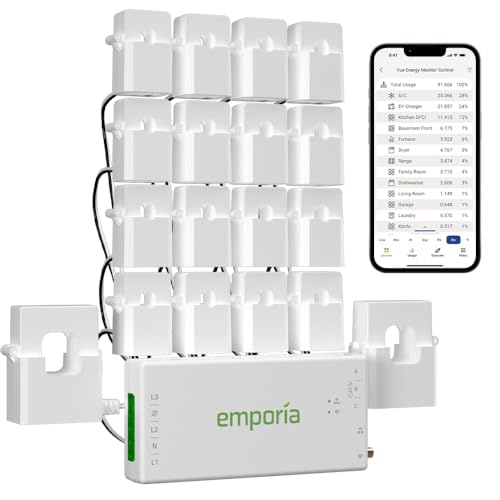
EMPORIA
Emporia Vue 3 Energy Monitor, 16 Sensors
$199.99
Circuit-level energy monitoring with sixteen sensors, which is how a small association answers the "who pays for that" question without installing a revenue-grade submeter on every space.
- Sensors
- 16
- Reads
- Per circuit
- Use
- Cost allocation
Trade-off Consumer monitoring is not a billing-grade meter, so a formal submetering programme needs the real thing.
Check pricePaid links. Prices shown when researched and change without notice.
What about a pedestal in an unassigned lot?
Where there is no wall near the parking, a freestanding pedestal is how the charger gets mounted. It is the normal solution for a surface lot, a carport row or a garage bay with no usable structure behind it, and it lets a station be positioned so one unit can reach two adjacent spaces.
Pedestals bring their own considerations. They need a footing or an anchored base, they sit in the path of snow ploughs and delivery vans, and in a shared lot they need bollard protection more than a home install does. They also make the cable management question urgent: a connector left on the ground in a public lot gets damaged and gets stolen. Options and mounting patterns are in the EV charger pedestal roundup, and the weather and enclosure side is in outdoor EV charger installation.
One honest caveat for a renter: a pedestal is a permanent improvement to somebody else's property. It is not a portable solution, it is a capital project you may be funding, and the negotiation about what happens to it when you move out should happen before it is bolted down.
Is Level 1 actually enough?
For a very large number of apartment residents, yes, and the reason this section exists is that almost nobody believes it until they see the arithmetic. A standard 120 volt household outlet is a 15 amp circuit that supports 12 amps continuous, which is 1.44 kW. Over a ten hour overnight session at the 90 percent efficiency figure used across this site, that is about 13 kWh in the battery.
| Vehicle | Efficiency | Usable pack | Range added overnight | Against a 37 mile day |
|---|---|---|---|---|
| Tesla Model Y | 3.9 mi/kWh | 75 kWh | 51 mi | Covers a typical day |
| Tesla Model 3 | 4.2 mi/kWh | 75 kWh | 54 mi | Covers a typical day |
| Tesla Cybertruck | 2.4 mi/kWh | 123 kWh | 31 mi | Short of a typical day |
| Ford F-150 Lightning | 2 mi/kWh | 131 kWh | 26 mi | Short of a typical day |
| Ford Mustang Mach-E | 3.3 mi/kWh | 91 kWh | 43 mi | Covers a typical day |
| Chevrolet Equinox EV | 3.4 mi/kWh | 85 kWh | 44 mi | Covers a typical day |
| Chevrolet Bolt EUV | 3.6 mi/kWh | 65 kWh | 47 mi | Covers a typical day |
| Hyundai Ioniq 5 | 3.5 mi/kWh | 84 kWh | 45 mi | Covers a typical day |
| Kia EV6 | 3.5 mi/kWh | 84 kWh | 45 mi | Covers a typical day |
| Rivian R1T | 2.2 mi/kWh | 135 kWh | 29 mi | Short of a typical day |
| Nissan Leaf | 3.5 mi/kWh | 60 kWh | 45 mi | Covers a typical day |
| Volkswagen ID.4 | 3.2 mi/kWh | 77 kWh | 41 mi | Covers a typical day |
| Honda Prologue | 3.2 mi/kWh | 85 kWh | 41 mi | Covers a typical day |
| Toyota bZ4X | 3.5 mi/kWh | 64 kWh | 45 mi | Covers a typical day |
Read the right-hand column. Every efficient car in that table more than covers the average American daily drive of about 37 miles on Level 1 alone. The cars that fall short are the heavy trucks and the largest packs, where 2.0 to 2.4 miles per kWh turns thirteen kilowatt hours into a modest number of miles. If you drive a Lightning or a Rivian and park in an apartment lot, Level 1 is genuinely not enough and the rest of this page matters much more.
A dedicated 120 volt 20 amp circuit, if one happens to exist near the space, raises the ceiling to 16 amps continuous and 1.92 kW. That is a third more range for no equipment change at all if your unit supports it.
| Vehicle | Overnight on a 20 amp 120 volt circuit |
|---|---|
| Tesla Model Y | 67 mi |
| Tesla Model 3 | 73 mi |
| Tesla Cybertruck | 41 mi |
| Ford F-150 Lightning | 35 mi |
| Ford Mustang Mach-E | 57 mi |
| Chevrolet Equinox EV | 59 mi |
| Chevrolet Bolt EUV | 62 mi |
| Hyundai Ioniq 5 | 60 mi |
The cost side is equally undramatic. An overnight Level 1 session at the national average residential rate of 16.5 cents per kWh costs about 2.14 dollars, or roughly 64.15 dollars a month if you plug in every single night. If your building bills you a flat parking surcharge for charging access, compare it against that number before agreeing to it. The full comparison of what each level actually delivers is in Level 1 versus Level 2, and you can run your own pack size and starting state of charge through the charge time calculator.
Three portable units for a resident with no circuit of their own
All three are safety listed portable EVSEs rather than fixed installations, which is the category that matters when nothing can be permanently attached to the building. Researched from published specifications and listed certifications.

Lectron
Lectron Level 1 Charger, 15A
$159.99
A 120 volt only unit on a NEMA 5-15 plug with a 16 foot cable, ETL certified. Nothing to configure and nothing to explain to a building manager, because it plugs into the same outlet a vacuum cleaner does.
- Voltage
- 120 V
- Rating
- 15 A
- Cable
- 16 ft
Trade-off No 240 volt path at all, so it cannot follow you to a better outlet later.
Check price CHARGEHERE
ChargeHere 16A Portable, UL Listed
$129.99
Dual voltage and UL listed, with both a NEMA 6-20 plug for a real 240 volt circuit and a 5-15 adapter for an ordinary outlet. The one to buy if there is any chance of a 240 volt receptacle appearing.
- Output
- 16 A
- Voltage
- 120 or 240 V
- Listing
- UL
Trade-off A 16 amp ceiling, so it will never be a fast charger even on 240 volts.
Check price
EVDANCE
EVDANCE Level 1 and 2 Portable, 16A
$119.99
A 25 foot cable is the difference between charging and not charging when the only accessible outlet is on a column two bays away. ETL listed, 12 amps on 120 volts and 16 amps on 240.
- Output
- 12 or 16 A
- Cable
- 25 ft
- Listing
- ETL
Trade-off A long cable coiled on a shared garage floor is a trip hazard and a theft target.
Check pricePaid links. Prices shown when researched and change without notice.
Which outlet gives you what?
If a receptacle already exists near your space, its type tells you the ceiling. The continuous column is 80 percent of the receptacle rating, because charging is a continuous load, and the overnight column applies the same ten hours and 90 percent efficiency at a typical 3.5 miles per kWh.
| Receptacle | Volts | Continuous | Power | Overnight | Range added |
|---|---|---|---|---|---|
| 5-15R | 120 V | 12 A | 1.44 kW | 13.0 kWh | 45 mi |
| 5-20R | 120 V | 16 A | 1.92 kW | 17.3 kWh | 60 mi |
| 6-15R | 240 V | 12 A | 2.88 kW | 25.9 kWh | 91 mi |
| 6-20R | 240 V | 16 A | 3.84 kW | 34.6 kWh | 121 mi |
| 10-30R | 240 V | 24 A | 5.76 kW | 51.8 kWh | 181 mi |
| 14-30R | 240 V | 24 A | 5.76 kW | 51.8 kWh | 181 mi |
| 6-30R | 240 V | 24 A | 5.76 kW | 51.8 kWh | 181 mi |
| 6-50R | 240 V | 40 A | 9.60 kW | 86.4 kWh | 302 mi |
| 14-50R | 240 V | 40 A | 9.60 kW | 86.4 kWh | 302 mi |
| 14-60R | 240 V | 48 A | 11.52 kW | 103.7 kWh | 363 mi |
Two rows in that table are the apartment sweet spot. A 6-20R is the cheapest genuine 240 volt outlet in existence, it uses the same box and roughly the same wire as an ordinary circuit, and it doubles a Level 1 result. If you are asking a landlord for one thing, ask for that rather than for a NEMA 14-50, because the install is smaller, cheaper and far less alarming to a building manager. A 14-30R, if there is a laundry room within reach, is the other one.
A word of caution on any existing outlet in a shared garage: it is almost certainly not a dedicated circuit, it may be sharing with lighting or a door opener, and it may be forty years old. A continuous 12 amp load overnight is exactly the kind of duty that finds a tired receptacle. Do not use one that gets warm, and do not use one you have not been given permission to use.
Can you share an existing 240 volt circuit?
Occasionally, in a townhouse-style condo with its own laundry, the answer is a dryer circuit. A listed splitter device such as the Splitvolt 14-30 to 14-50 splitter switch lets a 24 amp charging load share a 30 amp dryer circuit, switching automatically so both never draw at once. It is a real product category with real certifications, and it is far cheaper than a new circuit.
The constraints are that it needs an existing 240 volt receptacle you are entitled to use, that the run between the laundry and the car has to be plausible, and that the resulting 24 amp charging rate is about 5.8 kW, which is roughly four times Level 1. In a stacked apartment building none of that applies. In a two-storey townhouse with an attached garage it frequently does, and it is worth checking before assuming a new circuit is the only path.
Are extension cords and extension cables ever acceptable?
Two different products get confused here, and the distinction matters.
An AC extension cord on the input side, between the wall outlet and a portable charger, is prohibited by most vehicle and charger manufacturers outright. A household cord is not rated for a 12 amp continuous load for ten hours, the connection points add resistance and heat, and this is a genuine and well-documented cause of fires. If you take one thing from this page, take that.
A J1772 extension cable on the output side, between the charger's connector and the car, is a purpose-built product with a real current rating. The SEGUMA 40 amp J1772 extension at 21 feet and the BESENERGY 40 amp J1772 extension at 20 feet are examples of the category. They are heavy, they use the same connector standard on both ends, and they are meaningfully safer than an AC cord.
Even so, be honest about them. Many charger and vehicle manufacturers do not support any extension on either side, using one may affect a warranty claim, and every additional connector pair is another place for contact resistance and water to find. Treat a J1772 extension as a way to bridge the last fifteen feet when the geometry is otherwise impossible, not as a normal part of an installation. The full argument, including what ratings to insist on, is in EV charger extension cables.
What to try, in what order
Start by establishing whether your space is deeded, exclusive-use or common. If it is yours, find out what your state's right-to-charge position is and read your governing documents, then build the written proposal package rather than asking verbally. Ask for the smallest thing that solves your problem, which is very often a 240 volt 20 amp receptacle rather than a full Level 2 station, because small asks get approved.
In parallel, buy a safety listed dual-voltage portable unit and start charging from whatever legitimate 120 volt outlet exists, because that covers a normal commute from day one and removes the urgency from the negotiation. If the building says no, ask again in writing with metering and insurance addressed. If the answer is still no, workplace charging and a Level 1 routine is a perfectly liveable arrangement that a great many electric car owners run permanently without complaint.
If you do get a real circuit, the rate plan becomes the next lever worth pulling. Time-of-use rates can cut the running cost substantially, and in a shared building an off-peak charging window is also the easiest concession to offer a board that is worried about capacity.
We review them on their own too, in full detail: the Splitvolt splitter switch and the Tesla Mobile Connector.
Common questions
Can my HOA stop me installing an EV charger?
Sometimes, and it depends heavily on where you live and on whether the parking space is yours. A number of states have enacted right-to-charge statutes that limit an association from unreasonably refusing an installation in a space a resident owns or has exclusive use of, usually with conditions about insurance, cost and aesthetics. Others have nothing. Read your governing documents and your state law before you assume either answer.
Is Level 1 charging actually enough in an apartment?
For a lot of people, yes. Twelve amps on an ordinary 120 volt outlet is about 1.44 kW, so ten hours plugged in returns roughly 13 kWh, which is 40 to 50 miles of range in an efficient car. The average US driver covers about 37 miles a day. If your commute is short and the car is home every night, Level 1 quietly keeps up and costs nothing to install.
How do I pay for only the electricity I use in a shared garage?
Three ways. A dedicated circuit run from your own unit meter, which is cleanest but often physically impossible. A submeter on the charger circuit, read monthly and billed back by the association. Or a networked charger that reports kWh per session and per user, which is how most multi-family installations settle it now because it needs no separate meter hardware.
Can several residents share one charging circuit?
Yes, and it is often the only way the building electrical capacity works. Two common approaches: a dual-connector station that splits one circuit between two cars, or several networked stations running a power-sharing scheme that keeps the group total under the supply limit. Both charge slower when everybody plugs in at once, which overnight is almost never a real problem.
Can I run an extension cord to my car?
Most vehicle and charger manufacturers explicitly prohibit an AC extension cord on the input side of a portable unit, and doing it anyway with an undersized household cord is a genuine fire risk. A heavy gauge J1772 extension on the output side is a different product and is more defensible, but it is still outside what many manufacturers support. Neither is a substitute for a properly placed outlet.
What if my building simply says no?
You still have options. Level 1 from any 120 volt outlet you can legitimately reach covers a normal commute. A workplace charger, if your employer has one, shifts the problem entirely. And a written proposal that costs the association nothing, carries its own insurance and includes submetering is a very different conversation from a verbal request, so it is worth asking twice with paperwork.
Getting your own panel and load numbers ready for an electrician? The EV Home Charging Install Planner is the paid version of these pages: 8 printable worksheets you fill in with your own numbers, plus the full PDF, $29.
How this page was researched
Specifications come from manufacturer documentation, listed safety certifications and verified owner reviews. We do not perform hands-on product testing and never claim to. Figures are researched planning information, not professional electrical advice. Last reviewed 2026-08-17.