Best EV Charger Extension Cables
Short answer
If you must use one, the best EV charger extension cable is a short J1772 extension on the charger output side, such as the SEGUMA 21 foot 40 amp cable at around $145.99. Most manufacturers do not permit extensions and using one may void the warranty, no EV extension is rated above 40 amps, and the correct fix is almost always a charger with a 25 foot cable instead.
If you have already decided you need one, the best EV charger extension cable is the SEGUMA 21 foot J1772 extension rated for 40 amps at around $145.99, with the BESENERGY 20 foot equivalent at around $113.99 as the cheaper version of the same thing. Both sit on the charger output side, both are 40 amps maximum, and both are short, which is the specification that matters most.
This page is going to spend most of its length arguing against its own category, and that is deliberate. Most charger manufacturers do not permit extensions at all, the installation manual usually says so in plain language, and using one may void your warranty. There is no EV extension cable on the market rated above 40 amps, so a 48 amp charger has no compliant option. And the two things people call an extension are not the same product: a J1772 cable on the output side is arguable, and a NEMA 14-50 extension cord on the supply side is the one that turns up in photographs of melted plug faces.
If an extension is unavoidable
Shortest useful length
SEGUMA
SEGUMA J1772 Extension Cable, 40A, 21 ft
$145.99
A 21 foot J1772 extension rated for 40 amps, which is the shortest of the genuinely useful lengths and therefore the one that adds the least resistance and the least heat. It goes on the output side of the charger, downstream of the safety electronics, which is the only side of the installation where an extension is even arguable.
- Length
- 21 ft
- Rating
- 40 A
- Side
- Charger output
- Connector
- J1772
- Suits
- Up to 9.6 kW
- 48 A use
- No
Paid link. Price shown when researched.
Which side of the charger is the extension on?
This is the distinction that decides whether you are making a small compromise or a genuinely bad one, and almost nobody separates the two.
A J1772 extension goes on the output side, between the charger cable and the car. Everything upstream of it is intact: the branch circuit, the charger enclosure, its ground fault protection, its contactor and the pilot signal that negotiates current with the vehicle. The extension adds conductor length and one connector pair to a circuit that the charger is still actively supervising, and the current flowing through it is whatever the car and the charger agreed on.
A NEMA 14-50 extension cord goes on the supply side, between the wall receptacle and the charger plug. Nothing is supervising that joint. It carries the full supply current for the entire charging session, and it adds two more contact pairs: the cord plug into the wall receptacle, and the charger plug into the cord socket. Every mated contact pair has a small resistance, resistance times current squared is heat, and a contact that runs warm oxidises, which raises its resistance, which makes it warmer. That runaway is the specific failure mode behind burnt 14-50 faces, and adding two contact pairs to a path that already has one is adding two more places for it to start.
| Kind of extension | Where it sits | What is protecting it | Added contacts | Verdict |
|---|---|---|---|---|
| J1772 extension, charger output side | Between the charger cable and the car | Downstream of the charger safety electronics, ground fault protection and pilot signal | One extra connector pair | The arguable option. Short, listed and 40 amps or less. |
| NEMA 14-50 extension cord, supply side | Between the wall receptacle and the charger plug | Upstream of everything. Nothing in the charger is watching this joint | Two extra contact pairs, both carrying full supply current | The worse idea, and the one that produces the burnt plugs. |
There is a second reason the supply side is worse. A charger plug is designed to be inserted once and left there for years. A cord socket is designed to be connected and disconnected, so its retention is looser by design, and looser retention means a larger contact resistance and more movement under thermal cycling. You are taking the most reliable joint in the installation and replacing it with two joints, one of which is built for repeated use it will never get.
What does conductor gauge over length actually cost you?
Length is the other half of the problem and it is arithmetic rather than opinion. Voltage drop across a conductor is proportional to current, to length and to the conductor's resistance per foot, and resistance per foot roughly doubles for every three gauge sizes you go thinner. The table below is the drop contributed by the extension alone, at 40 amps continuous, over a two-conductor path.
| Extension conductor | Length | Drop at 40 A | Percent of 240 V | Verdict |
|---|---|---|---|---|
| 8 AWG | 20 ft | 1.24 V | 0.52 % | Small enough to ignore on its own, but it stacks on the branch circuit. |
| 8 AWG | 40 ft | 2.49 V | 1.04 % | Acceptable on paper, and the length is the reason to think twice. |
| 6 AWG | 20 ft | 0.79 V | 0.33 % | Small enough to ignore on its own, but it stacks on the branch circuit. |
| 6 AWG | 40 ft | 1.57 V | 0.65 % | Small enough to ignore on its own, but it stacks on the branch circuit. |
| 10 AWG | 20 ft | 1.98 V | 0.83 % | Undersized for 40 amps. Do not buy a 40 amp extension built on this. |
| 10 AWG | 40 ft | 3.97 V | 1.65 % | Undersized for 40 amps. Do not buy a 40 amp extension built on this. |
Read the percentages and then read them again in context. On its own a 20 foot 8 AWG extension is trivial. The problem is that it does not exist on its own: it sits at the end of a branch circuit that already has a drop of its own. A 90 foot circuit in 6 AWG plus a 40 foot extension is a 130 foot conductor path, and the three percent target that electricians aim at applies to the whole path rather than to the piece you added last. Put your real total through the voltage drop calculator, and if the circuit is already long, read long runs and voltage drop before you add anything to the end of it.
The 10 AWG rows are in the table as a warning rather than as an option. A 40 amp continuous load on 10 AWG conductor is not a voltage drop question, it is an ampacity question with an obvious answer, and there are cables sold as EV extensions built on conductor that thin. If a listing does not state a conductor gauge or states a length without a continuous current rating, that is the reason not to buy it.
What does your charger manual actually say?
Before you spend anything, open the installation manual for your own unit and search it for the word extension. The overwhelming likelihood is that you will find a sentence instructing you to connect the charger directly to the supply without extension cords or adapters. Manufacturers write that clause because heat damage at an added connector is a failure they cannot control and will not warrant, and a claim on a scorched connector is precisely the claim that gets declined.
That does not make an extension physically dangerous in every case, and plenty of people run a short listed J1772 cable for years without incident. It does mean you are accepting the risk yourself, with no manufacturer standing behind the joint you added. Weigh that against the actual saving, which is often small: a good 21 foot extension costs about $145.99, and the price gap between a 16 foot charger and a 25 foot one is frequently less than that.
Short and defensible: 20 feet or less on the output side
This is the only tier on the page that is close to a recommendation. Short, on the output side, rated at or above the current your charger actually delivers, and used to close a genuine gap of a few feet rather than to reach a car parked in a different part of the property.
Short tier: $113.99 to $145.99
J1772 on both ends, 40 amps, 20 to 21 feet. Shorter is better here in every respect, so buy the shortest length that closes your gap.

BESENERGY
BESENERGY J1772 Extension Cable, 40A, 20 ft
$113.99
Twenty feet, 40 amps, J1772 on both ends. At this length the added resistance is small enough to be a rounding error on a short branch circuit, which is the only condition under which an extension is a reasonable purchase rather than a workaround.
- Length
- 20 ft
- Rating
- 40 A
- Volts
- 240 V
- Side
- Output
Trade-off No UL listing stated in the product information, which for a 40 amp connector pair is a real gap.
Check price SEGUMA
SEGUMA J1772 Extension Cable, 40A, 21 ft
$145.99
A foot longer and better documented, still 40 amps and still on the output side. This is the version to buy if the gap you are closing is genuinely under twenty feet and you are not going to be tempted to solve a bigger problem with a bigger cable.
- Length
- 21 ft
- Rating
- 40 A
- Level
- 1 and 2
- Side
- Output
Trade-off Still an extension, so it is still outside what most charger manufacturers permit.
Check priceGeneric
J1772 extension cable, 10 to 15 ft, 40 A
The length nobody sells prominently and most people actually need. If the shortfall is a car parked nose-out instead of nose-in, ten feet closes it, and ten feet of conductor adds roughly half the resistance that twenty does.
Trade-off Stock is inconsistent at this length and listings change, so check the current rating carefully.
Check pricePaid links. Prices shown when researched and change without notice.
Between the BESENERGY 20 foot cable and the SEGUMA 21 foot cable there is a foot of conductor and about thirty dollars. The SEGUMA is the pick because its documentation is better and because SEGUMA also sells the UL listed long version, which suggests the range is being built against a standard rather than to a price. Neither is a substitute for a properly sized charger cable, and both should be inspected at both ends every few months for discolouration or heat marks.
Long and UL listed: 25 to 40 feet, and the compromise inside it
The middle tier is where honesty gets uncomfortable. These are the products people actually search for, because the gap they are trying to close is large, and a large gap is exactly the situation in which an extension is the wrong tool.
Long tier: $87.99 to $249.99
One UL listed 40 foot J1772 cable, and two NEMA 14-50 supply cords included so this page is complete rather than because we recommend them.

SEGUMA
SEGUMA J1772 Extension Cable, 40A, 40 ft, UL Listed
$249.99
Forty feet and UL listed, which is the single most important word on this page. If you have decided an extension is unavoidable and the distance is genuinely large, a listed cable is the only version of that decision worth making. It is still 40 amps maximum, so it does not serve a 48 amp charger.
- Length
- 40 ft
- Rating
- 40 A
- Listing
- UL
- Side
- Output
Trade-off Forty feet of conductor plus a connector pair is real added resistance and real added heat.
Check price
RVGUARD
RVGUARD 50A NEMA 14-50 Extension Cord, 25 ft
$93.99
This is a NEMA 14-50 extension cord, meaning it goes on the SUPPLY side between the wall receptacle and the charger plug. It is a well-made cord for RV use and it is the more questionable of the two kinds of extension, for reasons the body of this page sets out at length.
- Length
- 25 ft
- Rating
- 50 A
- Side
- Supply
- Plug
- 14-50
Trade-off Adds a plug and socket pair to the high-current supply path, where contact resistance becomes heat.
Check price
POWGRN
POWGRN NEMA 14-50 Extension Cord, 25 ft
$87.99
The same category and the same objection, slightly cheaper. If a supply-side extension is genuinely the only option available to you, a properly rated outdoor cord from a known RV brand is at least the right kind of product, and an indoor appliance cord is not.
- Length
- 25 ft
- Rating
- 50 A
- Side
- Supply
- Use
- Outdoor rated
Trade-off Two extra contact pairs in the path, and the connectors are the parts that overheat first.
Check pricePaid links. Prices shown when researched and change without notice.
The SEGUMA 40 foot UL listed extension is the one to buy if you are set on this route. UL listing on a 40 amp connector assembly is not a marketing badge, it is third-party verification that the conductor, the moulding and the contacts were tested together at rated current, and it is the difference between an engineered product and a cable with plugs on it. It costs $249.99, which is most of the way to a better charger, and that comparison is the point.
The RVGUARD 25 foot 14-50 cord and the POWGRN 25 foot 14-50 cord are good products for the job they were designed for, which is connecting a recreational vehicle to a campground pedestal for a weekend. Nightly EV charging is a different duty: eight hours near rated current every single day, in a fixed position, for years. If a supply-side cord is genuinely your only option, use one of these 50 amp RV cords rather than anything sold as an appliance cord, keep it fully uncoiled so it can shed heat, keep the connections out of standing water, and check both ends by hand regularly.
Do this instead: the fixes that need no extension at all
Four alternatives, roughly in order of how cheap they are. Change how you park. Move the charger to a better position on the wall. Buy a charger with a longer captive cable. Or put the unit where the car actually is, on a post, with a properly sized feeder doing the distance.
The alternatives, $129.99 to $449.00
A hardwired 48 amp unit with a 25 foot cable, a 40 amp plug-in unit with a 25 foot cable, and a pedestal for when no wall will do.

EMPORIA
Emporia Level 2 EV Charger, 48A J1772
$449.00
The actual fix, and usually the cheaper one. A hardwired 48 amp charger with a 25 foot cable reaches further than a 16 foot charger plus a 20 foot extension does, with no extra connector pair, no warranty question and 11.5 kW instead of 9.6.
- Cable
- 25 ft
- Output
- 11.5 kW
- Circuit
- 60 A
- Extensions
- None needed
Trade-off Hardwired, so it means an electrician rather than an order that arrives on a Tuesday.
Check price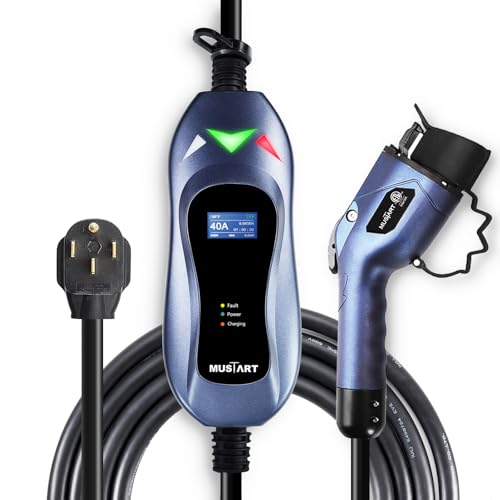
MUSTART
MUSTART 40A Portable, 25 ft Cable
$219.99
If the charger has to stay plug-in, buy the plug-in unit with the long cable rather than a short unit and an extension. Twenty-five feet on the charger itself, 40 amps, and one plug in the supply path instead of three.
- Cable
- 25 ft
- Output
- 9.6 kW
- Plug
- 14-50
- Extensions
- None needed
Trade-off A 25 foot captive cable is heavy and wants a holster and a hook rather than a hook on its own.
Check price
Maizengauto
Maizengauto EV Charger Pedestal
$129.99
When the problem is that no wall is near the car, move the charger instead of lengthening the cable. A pedestal puts the unit where the car parks, and the extra distance is carried by a properly sized buried feeder rather than by a cord lying across a driveway.
- Type
- Pedestal
- Finish
- Galvanised
- Solves
- Reach
- Adds
- No connectors
Trade-off Needs a trench, a base and an electrician, so it is the most expensive answer on the page.
Check pricePaid links. Prices shown when researched and change without notice.
Do the arithmetic that this tier is built on. A 16 foot charger plus a 20 foot extension gives you 36 feet of cable, one extra connector pair, a warranty question and 9.6 kW, for the price of the charger plus about $145.99. A 25 foot hardwired 48 amp charger gives you 25 feet of cable with no extra connector, no warranty question and 11.5 kW. In most garages 25 feet from a well-chosen position reaches everything 36 feet from a bad position does, which is why charger placement in a garage is a more useful page than this one for most readers, and why the long cable charger roundup is where this problem is usually solved.
Who should not buy anything on this page
Anyone with a 48 amp charger. There is no J1772 extension rated for 48 amps continuous, and a 48 amp unit is hardwired so there is no supply-side option either. Anyone whose warranty period still has time left on it and who would want to use it. Anyone whose real problem is distance measured in tens of feet rather than feet, because that is a feeder problem and a pedestal with a buried run is the engineered answer to it. And anyone who would end up running a cord across a driveway where cars drive over it, which destroys conductor insulation invisibly and from the inside.
How we chose these cables
We did not test any of these cables in person and we do not claim to. Nothing here was thermally imaged, nothing was left charging overnight under observation, and no connector was taken apart.
The picks come from published specifications, listed safety certifications and verified owner reviews read in volume. In this category certification carries more weight than anywhere else on the site, because the entire product is a pair of connectors and a length of conductor, and the only external evidence that the three were engineered to work together at rated current is a listing mark. That is why the UL listed 40 foot cable is the recommendation in the long tier despite being the most expensive item here by a wide margin.
The second filter was rating honesty. Several extension listings advertise a length prominently and a current rating nowhere, or quote a peak figure rather than a continuous one, and a cable that cannot state a continuous rating is disqualified. The third filter was length, applied in reverse: shorter products scored better, which is the opposite of how the category markets itself.
The fourth filter was owner reports of heat, specifically discolouration at the connector body, a smell during charging, or a charger derating itself mid-session. Those reports cluster on unlisted products and on the longest cables, and while individual reviews are unreliable the pattern across hundreds of them is not.
Prices were accurate when researched and change without notice. Where a product has no verified Amazon listing it appears as a search link rather than a direct one, which is deliberate: a fabricated product link is worse than no link.
Buying tips: the rules if you go ahead anyway
Buy the shortest length that closes the gap
Every foot adds resistance, adds weight and adds another foot of cable to trip over and drive across. Measure the actual shortfall between the charger connector at full stretch and the car's charge port, add two feet for the arc, and buy that length. Buying forty feet because it was on the same page as twenty is how a small compromise becomes a large one.
Insist on a stated continuous rating at or above your charger
A 40 amp charger needs a cable rated 40 amps continuous, not 40 amps peak and not 50 amps unqualified. If the listing will not tell you the continuous rating and the conductor gauge, the answer is no. A 32 amp charger has more margin, which is one of several reasons a 32 amp unit is an easier product to live with than people expect.
Keep it uncoiled and out of standing water
A coiled cable cannot shed heat, and a cable carrying 40 amps for eight hours is generating heat the whole time. Lay it out flat, never leave it looped in a bundle while charging, and keep both connector bodies off the ground so they are not sitting in whatever ran off the car. Connectors are rated for weather, not for immersion.
Put your hand on both ends after an hour
This is the single most useful habit in this whole category. Warm is a warning and hot is a stop. Do it the first night, do it again a week later, and do it any time you notice the charging session taking longer than usual, because a charger that has quietly derated itself is often responding to a temperature sensor in the connector.
Never stack an extension on an adapter
An extension plus a NACS to J1772 adapter plus a charger is three added contact pairs in series, each one a candidate for the heat runaway described above, and each one adding resistance to the same path. If you need an adapter for connector reasons, that is the compromise you have already spent, and adding a second one is where installations start failing.
Price the alternative before you order
Write down what the extension costs, then look up what a charger with a 25 foot cable costs, then look up what your electrician would charge to move the existing unit eight feet along the wall. The extension wins that comparison much less often than the search volume suggests. The installation cost calculator will price the relocation for you.
Where to go next
If you have not bought the charger yet, buy cable length instead of buying an extension later: start with the long cable charger roundup. If the charger is already on the wall in the wrong place, read charger placement in a garage before you buy anything, because moving a unit is often a one-hour job. If the distance is genuinely large, the answer is a pedestal with a buried feeder, and the electrical consequences of that distance are covered in long runs and voltage drop.
Common questions
Is it safe to use an extension cable with an EV charger?
It is a compromise rather than a category of safe products. Most charger manufacturers do not permit extensions and using one may void the warranty, so start by reading your own manual. If you proceed, a short UL listed J1772 extension on the charger output side, rated at or above the charger current, is the defensible version. A NEMA 14-50 extension cord on the supply side is the version that produces melted plug faces, and the right fix in nearly every case is a longer charger cable instead.
What is the difference between a J1772 extension and a 14-50 extension cord?
Which side of the charger they sit on, and that changes everything. A J1772 extension goes between the charger cable and the car, downstream of the safety electronics, the ground fault protection and the pilot signal that negotiates current. A NEMA 14-50 extension cord goes between the wall receptacle and the charger plug, upstream of all of that, adding two more contact pairs to the high-current supply path with nothing monitoring them.
Will an extension cable slow down my charging?
Slightly, and not usually in a way you would notice. Twenty feet of 8 AWG conductor at 40 amps drops about a volt and a quarter, so the charger sees marginally less voltage and delivers marginally less power. The reason to care is not speed, it is that this drop adds on top of the branch circuit run. A 90 foot circuit plus a 40 foot extension is a 130 foot conductor path, and that total is what matters.
Can I use an extension cable with a 48 amp charger?
No, not with anything sold as an EV extension. The J1772 extension cables on the market are rated at 40 amps maximum, and a 48 amp charger on a 60 amp circuit exceeds that rating continuously for hours. A 48 amp charger is also hardwired rather than plug-in, so the supply-side option does not exist either. If you own a 48 amp unit and it does not reach, the answer is to move the charger.
Does using an extension void my charger warranty?
Frequently yes. Manufacturers commonly state in the installation manual that the unit must be connected directly, without extension cords or adapters, and a warranty claim on a heat-damaged connector is exactly the claim that gets refused. This applies more strongly to supply-side extension cords than to output-side J1772 cables, but both appear in manuals. Read yours before you spend anything, because the manual is the only document that settles it for your unit.
What should I do instead of buying an extension?
In order of preference: buy a charger with a 25 foot cable rather than a 16 foot one, since the difference in price is smaller than a good extension costs. Move the charger to a better wall position so the cable reaches without help. Park the car the other way round. Or if there is genuinely no wall within reach, put the unit on a pedestal and let a properly sized buried feeder carry the distance.
Getting your own panel and load numbers ready for an electrician? The EV Home Charging Install Planner is the paid version of these pages: 8 printable worksheets you fill in with your own numbers, plus the full PDF, $29.
How this page was researched
Specifications come from manufacturer documentation, listed safety certifications and verified owner reviews. We do not perform hands-on product testing and never claim to. Figures are researched planning information, not professional electrical advice. Last reviewed 2026-08-17.