Best Budget EV Chargers
Short answer
The best budget EV charger is the ELEGRP 40A at around $209.99, an ETL certified 40 amp unit with a 25 foot cable that delivers 9.6 kW on a 50 amp circuit. Never buy a charger that does not state a UL or ETL listing mark, and save money by choosing 32 amps over 48 amps instead, because the circuit costs more than the charger.
The best budget EV charger is the ELEGRP 40A NEMA 14-50 portable at around $209.99. It is ETL certified according to its listing, it draws 40 amps continuously on a 50 amp circuit for 9.6 kW, and it ships with a 25 foot cable, which is longer than the cable on chargers costing three times as much. If you would rather spend 40 dollars more and be finished thinking about it, the Grizzl-E Smart 40A at $250 carries a UL certification and an Energy Star listing in a metal case.
Everything else on this page follows from one rule, and it is the only rule on this site with no exceptions in it. Certification is the line you never cross under budget pressure. Cable length, app quality, warranty terms, enclosure material and amperage are all negotiable when money is tight. A listing mark from a Nationally Recognized Testing Laboratory is not, because a home charger is a 240 volt device that runs near its rated current for eight hours a night, every night, for a decade, hanging on the wall of a room attached to where your family sleeps.
Top pick, budget EV charger
Best budget pick
ELEGRP
ELEGRP 40A NEMA 14-50 Portable
$209.99
The cheapest charger on this page that states a listing mark, delivers real 40 amp output and ships with a 25 foot cable. It is ETL certified per the listing, it plugs into a NEMA 14-50 receptacle, and at 240 volts it delivers 9.6 kW, which is more than most cars sold can accept anyway.
- Output
- 9.6 kW
- Continuous
- 40 A
- Circuit
- 50 A
- Cable
- 25 ft
- Plug
- 14-50
- Cert
- ETL
Paid link. Price shown when researched.
Where does the money actually go on a cheap install?
Almost everyone shopping in this category has the proportions backwards. The charger is usually the smallest line on the invoice. On a typical project the wall unit is 15 to 30 percent of the total and the branch circuit is the rest, because what costs money is a licensed electrician, a permit, and the labour of getting a heavy conductor from your panel to your garage wall through finished construction.
That has a direct consequence for how you save money. Shaving 60 dollars off the charger is a rounding error. Choosing an amperage one step down changes the breaker, the conductor size and sometimes whether the panel needs work at all, and that is worth hundreds. The table below is the same 125 percent continuous-load arithmetic used everywhere on this site, with the cost of the circuit set beside the cost of the box.
| Charger output | Breaker | Power | Typical copper | Charger price band | Typical installed circuit |
|---|---|---|---|---|---|
| 24 A | 30 A | 5.8 kW | 10 AWG | $115 to $170 | $350 to $1,200 |
| 32 A | 40 A | 7.7 kW | 8 AWG | $180 to $260 | $400 to $1,400 |
| 40 A | 50 A | 9.6 kW | 6 AWG | $170 to $300 | $450 to $1,600 |
| 48 A | 60 A | 11.5 kW | 6 AWG | $430 to $600 | $1,100 to $2,000 |
Read the last two columns together and the real budget lever is obvious. Going from a 48 amp hardwired station to a 32 amp plug-in unit saves roughly 250 dollars on the charger and frequently 700 dollars or more on the circuit, because 8 AWG copper is far cheaper than 6 AWG, a 40 amp breaker is a commodity, and a receptacle is quicker to fit than a hardwired termination with a whip. Price your own run through the installation cost calculator before you decide what you can afford, because the answer changes what charger you should be shopping for.
The trade is charging speed you may never use. A 32 amp unit delivers 7.7 kW, a 48 amp unit delivers 11.5 kW, and the difference is roughly 12 miles of range per hour on an average crossover. Over a ten hour overnight park that gap only matters if you routinely arrive home needing more than about 75 miles put back. The full argument, with the numbers laid out step by step, is in 32A vs 40A vs 48A.
Which listing marks are real, and which listings just do not say?
A home charger should carry a UL 2594 listing or an ETL listing to that same standard. Both marks mean a Nationally Recognized Testing Laboratory tested a sample against a published standard and continues to inspect the factory. An Energy Star listing is a useful secondary signal because it implies somebody measured the standby draw, but it is not a safety mark and should never be read as one.
The table below records what each product listing on this page actually states. The distinction that matters at this price is not UL against ETL. It is a listing that names a mark against a listing that says nothing at all.
| Charger | Price | Continuous | Cable | Listing mark as stated |
|---|---|---|---|---|
| VEVOR Level 1 and 2 Portable, 16A | $115.97 | 16 A | 28 ft | Not stated in listing |
| EVDANCE Level 1 and 2 Portable, 16A | $119.99 | 16 A | 25 ft | ETL listed |
| ChargeHere 16A Portable, UL Listed | $129.99 | 16 A | Dual plug | UL listed |
| BETUMODA Level 2 EV Charger, 40A with 25 ft Cable | $169.99 | 40 A | 25 ft | Not stated in listing |
| AIMILER 32A, 25 ft Cable | $199.99 | 32 A | 25 ft | ETL certified |
| ELEGRP 40A NEMA 14-50 Portable | $209.99 | 40 A | 25 ft | ETL certified |
| MUSTART 40A Portable, 25 ft Cable | $219.99 | 40 A | 25 ft | Not stated in listing |
| WOLFBOX Portable Level 1 and 2, 40A | $229.99 | 40 A | Portable | Not stated in listing |
| Grizzl-E Smart 40A | $250.00 | 40 A | Metal case | UL certified, Energy Star |
| Lectron 40A NEMA 14-50 Plug-In | $269.99 | 40 A | 16 ft | ETL certified |
Be precise about what the right-hand column means. "Not stated in listing" is not a finding that a unit is uncertified. Plenty of manufacturers hold a listing and write a careless product page. It means we could not verify the claim from published information, and for a permanently installed 240 volt appliance an unverified safety claim has to be treated as absent until you can confirm it. That is why the BETUMODA 40A at $169.99 is the cheapest 40 amp unit here and still is not the pick, and why the VEVOR dual-voltage 16A at $115.97 loses to the ChargeHere 16A at $129.99 over fourteen dollars.
How to check it yourself in two minutes: look for the mark and a control number on the unit's own rating label in the product photographs, search the certifying laboratory's public directory for the brand, and read the one-star reviews specifically for the words overheating, melted and tripping. Owner reviews are unreliable one at a time and quite reliable in volume, and a connector that runs hot shows up as a pattern long before it shows up as a recall.
Starter: the cheapest hardware worth owning
This tier is dual-voltage portables and the very cheapest 40 amp units. Two of the three cost less than a set of tyres, and the reason to consider them is not poverty. A 16 amp dual-voltage unit on a NEMA 6-20 circuit delivers 3.8 kW, which is 11 to 14 miles of range per hour, roughly three times what a household outlet manages, on 12 AWG conductor rather than 6 AWG. For a plug-in hybrid or a short commute that is the whole job done for under 400 dollars all in.
Starter tier: $119 to $170
Dual-voltage portables and the lowest-priced 40 amp unit in the category. Read the trade-off line on each one before you buy.

EVDANCE
EVDANCE Level 1 and 2 Portable, 16A
$119.99
The cheapest thing on this page that is worth owning. A dual-voltage unit that runs 12 amps at 120 volts and 16 amps at 240 volts, with an ETL listing stated on the product page and a 25 foot cable for the price of a tank of fuel.
- Level 1
- 1.4 kW
- Level 2
- 3.8 kW
- Cable
- 25 ft
- Cert
- ETL
Trade-off At 16 amps on 240 volts this is the slowest Level 2 that exists, around 11 to 14 miles of range per hour.
Check price
CHARGEHERE
ChargeHere 16A Portable, UL Listed
$129.99
UL listed rather than ETL, which is the stronger of the two marks to see on a low-cost import, and it ships with both a 5-15 and a 6-20 plug. A NEMA 6-20 circuit is the cheapest genuine 240 volt install available and this unit is built around exactly that.
- Level 1
- 1.4 kW
- Level 2
- 3.8 kW
- Plugs
- 5-15 and 6-20
- Cert
- UL
- Circuit
- 20 A
Trade-off A 6-20 circuit is still a new 240 volt circuit, so it still needs an electrician and normally a permit.
Check price
BETUMODA
BETUMODA Level 2 EV Charger, 40A with 25 ft Cable
$169.99
The lowest price at which anybody sells a 40 amp unit with a 25 foot cable, which on paper is the same 9.6 kW output as chargers costing twice as much. Buy it only for a receptacle you already own and only after you have confirmed the listing mark yourself.
- Output
- 9.6 kW
- Continuous
- 40 A
- Circuit
- 50 A
- Cable
- 25 ft
Trade-off The listing does not state a UL or ETL mark. Unverified is not the same as uncertified, but for a nightly 40 amp load it should be treated as disqualifying until you can confirm it.
Check pricePaid links. Prices shown when researched and change without notice.
The ChargeHere 16A is the quiet recommendation of this whole page. It is UL listed, it comes with a 5-15 plug for a household outlet and a 6-20 plug for a small 240 volt circuit, and a NEMA 6-20 is by a wide margin the cheapest real Level 2 installation available. Almost nobody is sold this path, because there is no margin in it for anybody, and it is the correct answer surprisingly often.
The EVDANCE dual-voltage 16A does the same job with an ETL listing and a 25 foot cable at $119.99. Both units are the hedge for somebody who is not yet sure whether they will ever pay for a 240 volt circuit: run at 120 volts now, move to 240 volts later without buying a second charger.
Buy once: the 200 dollar band where the value actually is
This is the tier to shop in, and it is a narrow one. Between roughly 200 and 220 dollars you can buy a certified unit with real 32 or 40 amp output and a 25 foot cable. Above it you are buying software, enclosure material and warranty terms. Below it you are buying uncertainty. Nothing in this band charges a normal car more slowly than a 650 dollar premium unit on the same circuit.
Buy-once tier: $199 to $220
Certified output, long cables and prices that leave the rest of the budget for the circuit, which is where it is needed.
ELEGRP
ELEGRP 40A NEMA 14-50 Portable
$209.99
The budget pick. ETL certified per the listing, 40 amps on a 50 amp circuit, 25 feet of cable and a NEMA 14-50 plug, for a little over 200 dollars. Nothing above it in this category charges a normal car faster on the same circuit.
- Output
- 9.6 kW
- Circuit
- 50 A
- Cable
- 25 ft
- Cert
- ETL
Trade-off No app and no energy reporting, so a time-of-use rate plan has to be scheduled from the car.
Check price
AIMILER
AIMILER 32A, 25 ft Cable
$199.99
A 32 amp unit on a 40 amp circuit with a 25 foot cable, an app and an ETL listing. This is the right output rather than the cheap one if your car has a 6.6 or 7.2 kW onboard charger, because the extra amps above it would never be drawn.
- Output
- 7.7 kW
- Circuit
- 40 A
- Cable
- 25 ft
- Cert
- ETL
Trade-off Caps at 7.7 kW, so it is the wrong buy if a large-pack truck is coming to the driveway later.
Check price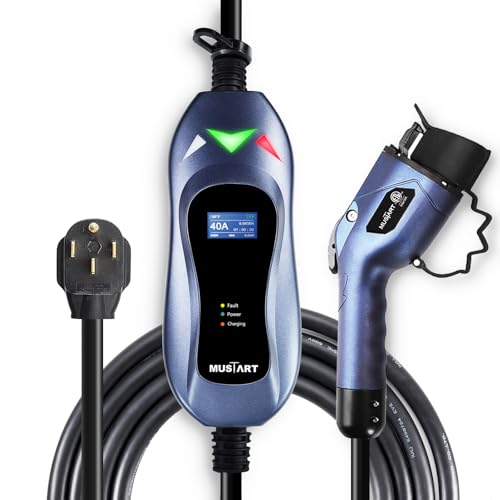
MUSTART
MUSTART 40A Portable, 25 ft Cable
$219.99
A long-serving 40 amp portable with a 25 foot cable and a NEMA 14-50 plug, from a brand that has been in this category long enough to have a warranty history. It is the volume seller in the 220 dollar band.
- Output
- 9.6 kW
- Circuit
- 50 A
- Cable
- 25 ft
- Plug
- 14-50
Trade-off The listing does not state a listing mark, so confirm the certification on the unit itself before you commit to nightly use.
Check pricePaid links. Prices shown when researched and change without notice.
The ELEGRP 40A is the pick because it is the cheapest combination of a stated ETL certification, 40 amp output and 25 feet of cable. The AIMILER 32A at $199.99 is the better buy in one specific and common situation: your car has a 6.6 or 7.2 kW onboard charger, as a Nissan Leaf or an early Toyota bZ4X does, so 32 amps is everything the car can draw and the 40 amp circuit it needs is cheaper to install than a 50 amp one.
The MUSTART 40A portable is on the list because it has been sold long enough to have a genuine owner history, which is worth something in a category full of brands that appeared last year. Its listing does not state a mark, so check the rating label before you buy.
Ceiling: spend a bit more and buy once
The ceiling of a budget page is not a premium tier. It is the argument for spending another 40 to 60 dollars to remove the two things that make cheap chargers annoying: an enclosure that is not rated for where you want to hang it, and a certification you have to go and verify yourself.
Ceiling tier: $229 to $270
Sealed metal cases, stated certifications and brands with a support organisation. All three still deliver the same 9.6 kW.
Grizzl-E
Grizzl-E Smart 40A
$250.00
The cheapest charger in this whole price band that carries a UL certification and an Energy Star listing, in a metal case rated for indoor or outdoor mounting. Forty amps, 9.6 kW, and a company with a support organisation behind it.
- Output
- 9.6 kW
- Circuit
- 50 A
- Case
- Metal
- Cert
- UL and Energy Star
Trade-off At 250 dollars it is 80 dollars more than the cheapest 40 amp unit here, and the charging speed is identical.
Check price
Lectron
Lectron 40A NEMA 14-50 Plug-In
$269.99
ETL certified, 40 amps, a NEMA 14-50 plug and a 16 foot cable, from a brand that also sells the adapters and holsters you will want later. The most complete package just above the budget ceiling.
- Output
- 9.6 kW
- Circuit
- 50 A
- Cable
- 16 ft
- Cert
- ETL
Trade-off A 16 foot cable is the shortest here and cable length is the specification owners regret most often.
Check price
WOLFBOX
WOLFBOX Portable Level 1 and 2, 40A
$229.99
A dual-voltage 40 amp portable, so one unit covers a 120 volt outlet at a relative house and a 240 volt receptacle at home. If you want one charger to travel rather than two chargers to own, this is the shape of the answer.
- Level 1
- 1.4 kW
- Level 2
- 9.6 kW
- Continuous
- 40 A
- Circuit
- 50 A
Trade-off The listing does not state a UL or ETL mark, and a unit you carry between houses gets more mechanical abuse than a wall unit.
Check pricePaid links. Prices shown when researched and change without notice.
The Grizzl-E Smart 40A at $250 is the honest recommendation for most people who arrived here on a budget. It is UL certified with an Energy Star listing, the case is metal rather than moulded plastic, and it is rated for indoor or outdoor mounting, which the plastic-cased units in the tiers above genuinely are not. On a ten year ownership horizon the difference between $209.99 and $250 is four dollars a year.
Who should not buy the ceiling tier
Anybody whose charger will live inside a dry attached garage, plugged into an existing receptacle, and who has already verified the certification on a cheaper unit. In that situation the metal case protects against nothing that is happening and the 40 dollars is better spent on an EV-rated receptacle, which is a component that genuinely fails. Also skip it if your car accepts 6.6 kW, because you are paying for 40 amp hardware to draw 27.
What should you never buy at this price?
Four things, and none of them are brands. First, any unit whose listing and rating label both fail to name a UL or ETL mark. Second, any charger sold with an included extension cord that is not itself rated for continuous 240 volt duty, because that cord becomes the weakest link in the path. Third, a plug-in charger destined for a cheap general-purpose receptacle that is not marketed as EV rated: the receptacle, not the charger, is then the cheapest part of the installation and the most likely thing to fail. Fourth, a 48 amp unit bought because it was on offer, when the circuit it requires is not in your budget. A 48 amp charger on a 50 amp circuit is not a compromise, it is a code violation waiting for an inspector.
There is a fifth, softer one. Do not buy a cheap plug-in unit for a garage where you would rather have a hardwired station, on the theory that you will upgrade later. The conductor and the labour are the expensive part and you will pay for them twice. If hardwired is the eventual plan, read hardwired versus plug-in now and wire it once.
How we chose these chargers
We did not test any of these units in person and we do not claim to. There is no lab here, no instrumented garage and no sample hardware. On a page about cheap electrical equipment that would be the easiest sentence to fake and the least defensible.
The picks come from published manufacturer specifications, the safety certifications each listing actually states, and verified owner reviews read in volume. Certification was the first filter and it eliminated more products than everything else combined, which is why several well-known cheap units are described here with an explicit warning rather than a recommendation. The second filter was continuous output honesty, because some listings quote a peak figure the unit only reaches briefly rather than the continuous current the breaker must be sized against.
The third filter was cable length, since a 16 foot cable and a 25 foot cable are a far larger practical difference than 32 amps against 40. The fourth was failure pattern in owner reviews at volume, specifically connector overheating, enclosures admitting water and units failing inside the warranty period. Prices were accurate when researched and change without notice, which matters more in this category than any other because budget listings reprice constantly.
Buying tips for a tight budget
Buy the circuit once and the charger twice, not the other way round
Conductors in a wall last for the life of the house and wall units last five to fifteen years. If the marginal cost of one size up in conductor is small while the electrician is already on site, take it. Then buy the cheapest certified charger that fits, and replace it in a decade with whatever exists then. That sequence costs less over twenty years than buying a premium charger onto an undersized circuit.
Check what your car can accept before you choose amperage
The wall unit offers current and the car decides how much to take, so the lower number always wins. Most current electric cars cap at 11.5 kW, a Nissan Leaf and an early Toyota bZ4X cap at 6.6 kW, and only the Ford F-150 Lightning can use 19.2 kW. Buying 48 amps for a 6.6 kW car is the single most expensive mistake in this category because it charges no faster and costs a larger breaker, heavier conductor and a hardwired termination.
Ask the electrician to quote two amperages
Get one price for a 40 amp circuit and one for a 50 or 60 amp circuit on the same visit. The spread tells you exactly what the extra output costs in your house rather than in general, and it is frequently much smaller or much larger than people expect depending on the panel and the run. Full detail on how these quotes are built is in Level 2 charger installation cost.
Do not economise on the receptacle
A cheap standard NEMA 14-50 costs under ten dollars and is a general-purpose device that is not marketed for electric vehicle duty. Yours carries 40 amps for eight hours nightly, and the plug face is the most likely component in the whole installation to fail as contact resistance rises with wear. A receptacle sold specifically for EV charging costs four to five times as much and that difference is not optional.
Chase the rebate before you chase the discount
A utility rebate or a tax credit is frequently worth more than the entire price difference between a budget charger and a premium one, and some programs require a listed or a networked unit to qualify. Check the eligibility rules before you buy, because buying first and reading the terms afterwards is how people end up 300 dollars worse off with the cheaper charger.
Where to go next
If your budget turns out to have more room in it than you thought, the main Level 2 roundup covers the same three tiers without a price ceiling. If the install cost is what is squeezing you, work through the installation cost calculator and then read 32A vs 40A vs 48A, because dropping one amperage step is the single largest saving available to you and it usually costs nothing you will notice.
We review them on their own too, in full detail: the Grizzl-E Smart and the Lectron Nexus 48A.
Common questions
What is the cheapest EV charger it is actually safe to buy?
The cheapest unit worth owning is one that states a UL or ETL listing mark, and those start around 120 dollars for a 16 amp dual-voltage portable and around 200 dollars for a certified 40 amp unit with a 25 foot cable. Below that the savings come out of the listing mark, the cable or the connector, and none of those three are places to save 40 dollars on a device that carries 240 volts for eight hours a night.
Does a cheap EV charger charge slower than an expensive one?
No, not on the same circuit. Charging speed is set by the lower of two numbers: the current the wall unit offers and the current the car will accept. A 200 dollar 40 amp unit and a 650 dollar 40 amp unit both deliver 9.6 kW on a 50 amp circuit. What the extra money buys is enclosure quality, app and energy reporting, warranty length and a support organisation, not kilowatts.
Is UL or ETL certification actually different?
Not in what they promise. Both are Nationally Recognized Testing Laboratories and both test against the same standard, UL 2594 for electric vehicle supply equipment. A unit listed by either has been submitted, tested and is subject to follow-up factory inspection. The meaningful distinction is not UL against ETL, it is listed against a product page that simply does not say.
How do I save money on a home charging installation?
Choose a lower amperage, not a cheaper box. A 32 amp charger runs on a 40 amp circuit with 8 AWG copper; a 48 amp charger needs a 60 amp circuit, 6 AWG copper and a hardwired termination. That step can be a difference of several hundred dollars in conductor and labour, and on a car with a 6.6 or 7.2 kW onboard charger it costs you no charging speed at all.
Can I just use the cable that came with the car?
For a plug-in hybrid or a low-mileage driver, frequently yes, and that is the genuinely free option. A 120 volt cable adds three to five miles of range per hour, which is 36 to 60 miles overnight. If your daily driving fits inside that, the correct amount to spend on charging hardware is close to zero. Use a receptacle in good condition on a circuit doing nothing else, and never an extension cord.
Are budget chargers a false economy?
Only when the saving comes out of certification, the connector or the cable. A certified 40 amp unit at 210 dollars and a premium 40 amp unit at 650 dollars charge a car at exactly the same speed on the same circuit, so the budget unit is a genuine saving. A unit with no stated listing mark at 150 dollars is not a saving, because the part you removed is the part that protects the house.
Getting your own panel and load numbers ready for an electrician? The EV Home Charging Install Planner is the paid version of these pages: 8 printable worksheets you fill in with your own numbers, plus the full PDF, $29.
How this page was researched
Specifications come from manufacturer documentation, listed safety certifications and verified owner reviews. We do not perform hands-on product testing and never claim to. Figures are researched planning information, not professional electrical advice. Last reviewed 2026-08-17.