Best Level 1 EV Chargers
Short answer
The best Level 1 charger for most drivers is the Lectron Level 1 15A unit at around $159.99, which draws 12 amps continuously on a standard 120 volt outlet for about 1.4 kW and three to five miles of range per hour. Twelve hours overnight is 36 to 60 miles of range, which genuinely covers a plug-in hybrid or a commute under about 40 miles a day.
The best Level 1 charger for most drivers is the Lectron Level 1 15A unit at around $159.99: a purpose-built 120 volt cordset, ETL certified, drawing 12 amps continuously for about 1.4 kW. If you would rather keep a path to 240 volts open, the EVDANCE dual-voltage 16A unit at around $119.99 does the same job at 120 volts, costs less, and has a 25 foot cable instead of a 16 foot one. The VEVOR dual-voltage 16A unit at around $115.97 is the cheapest defensible option on the page.
Level 1 has a reputation problem. It gets written about as the thing you tolerate until you can afford a real charger, and for a large group of drivers that is simply wrong. Twelve amps at 120 volts for twelve hours is 36 to 60 miles of range added while you sleep, every night, for the cost of the cordset and nothing else. If your daily driving sits under that and your car parks at home overnight, Level 1 is not a compromise, it is the correct answer, and the right amount to spend on charging hardware is roughly one hundred and twenty dollars.
Top pick, Level 1 charging unit
Best for most Level 1 drivers
Lectron
Lectron Level 1 Charger, 15A
$159.99
A dedicated 120 volt charging unit rather than the cordset that came loose in the boot. ETL certified, rated 15 amps, with a 16 foot cable and a plain NEMA 5-15 plug. On an ordinary 15 amp household circuit the continuous-load rule caps it at 12 amps, which is about 1.4 kW and three to five miles of range per hour. Over a twelve hour overnight park that is 36 to 60 miles, which quietly covers a lot of drivers.
- Rated
- 15 A
- On a 15 A circuit
- ~1.4 kW
- Volts
- 120 V
- Plug
- NEMA 5-15
- Cable
- 16 ft
- Cert
- ETL
Paid link. Price shown when researched.
What does 12 amps overnight actually get you?
A standard North American receptacle sits on a 15 amp circuit, and a continuous load is limited to 80 percent of that, which is 12 amps. Twelve amps at 120 volts is 1,440 watts, so about 1.4 kW before losses. Divide that by how far your car goes on a kilowatt hour and you have your rate: an efficient sedan around 4.2 miles per kWh gains close to five miles an hour, an average crossover around 3.5 gains about five, and a large electric truck around 2.2 gains closer to three.
The number that matters is not the hourly rate, it is the overnight total. Cars park for a lot longer than people think. A twelve hour window between arriving home and leaving in the morning is completely ordinary, and twelve hours at 1.4 kW is 17 kWh, or 36 to 60 miles of range depending on the car. A fourteen hour window on a day you work from home is nearer 70. Weekends add another 48 hours of slack that absorbs an unusual week.
| Setup | Amps | Volts | Power | Miles per hour | Added in 12 hours |
|---|---|---|---|---|---|
| Shared household outlet, 15 A circuit | 12 A | 120 V | 1.4 kW | 3 to 5 | 36 to 60 |
| Dedicated 120 V 20 A circuit | 16 A | 120 V | 1.9 kW | 5 to 7 | 60 to 84 |
| NEMA 6-20, 240 V 20 A circuit | 16 A | 240 V | 3.8 kW | 11 to 14 | 132 to 168 |
| NEMA 14-50, 240 V 50 A circuit | 40 A | 240 V | 9.6 kW | 29 to 35 | Full for most |
The second row is the cheapest upgrade in home charging and almost nobody talks about it. A dedicated 120 volt 20 amp circuit lets the unit draw 16 amps instead of 12, which is 1.9 kW and a 35 percent improvement for the price of a short run of 12 AWG. It also takes the freezer, the garage lights and the workbench off the circuit your car is on, which is worth more than the extra kilowatt. The full ladder of outputs is laid out in the charging speed chart, and you can put your own pack size and window into the charge time calculator before you buy anything.
Which cars can genuinely live on Level 1?
Two groups, and neither is small. The first is plug-in hybrids. A plug-in hybrid carries roughly 10 to 18 kWh of usable battery, so 1.4 kW refills it from empty in seven to thirteen hours. That fits inside a normal overnight park with room to spare, and it means the electric portion of the car is fully available every single morning. A 240 volt circuit for a plug-in hybrid is money spent to finish charging in the middle of the night instead of near dawn.
The second is low-mileage drivers of full electric cars, and this is where the interesting arithmetic lives. The question is never whether Level 1 can fill your battery from empty, because it cannot do that conveniently for anything. The question is whether it replaces what you used yesterday. If your commute is a 25 mile round trip, you used about 7 kWh, and five hours on a household outlet puts it back. You are not charging a battery, you are topping up a day.
| Vehicle | Usable pack | Hours from empty at 1.4 kW | Overnight sessions from empty | Miles added in 12 hours |
|---|---|---|---|---|
| Nissan Leaf | 60 kWh | 41.7 h | 3.5 | 60 |
| Chevrolet Bolt EUV | 65 kWh | 45.1 h | 3.8 | 62 |
| Tesla Model 3 | 75 kWh | 52.1 h | 4.3 | 73 |
| Volkswagen ID.4 | 77 kWh | 53.5 h | 4.5 | 55 |
That third column is the one people fixate on and it is the least relevant. Nobody arrives home empty and needs full by morning on a regular basis. The last column is the honest test: compare it against what you actually drove today, and then against your worst week rather than your worst day. If seven overnight sessions cover seven days of driving, Level 1 covers you, and the case for spending more becomes resilience rather than speed. The full argument on both sides is in Level 1 versus Level 2.
The real risk is the receptacle, not the charger
Here is the part of Level 1 that deserves more attention than it gets. A charging unit draws 12 amps continuously for ten or twelve hours. Almost nothing else in a house does that. A kettle draws more but for two minutes. A television draws far less. A vacuum cleaner draws a lot for twenty minutes and then stops. The receptacle in a garage is frequently the oldest and least loved in the building, may be a backstab connection where the conductor is held by a spring rather than a screw, and may be sharing a circuit with a freezer that cycles on all night.
That combination is exactly the duty cycle a tired receptacle fails under, and the failure is not dramatic at first. Contact resistance rises, the joint warms, the warmth accelerates the oxidation, and the cycle repeats over months. Four rules cover it, and none of them cost anything. Plug the unit directly into the wall, never into an extension cord or a power strip. Use a receptacle that is doing nothing else while the car charges. Touch the plug and the wall plate an hour into a session and stop immediately if either is warm. And if the outlet is loose enough that the plug sags out of it, it is finished and needs replacing.
If you are charging in a shared garage, a carport or a building you do not own, that same logic applies with more force because you did not see the wiring go in and you cannot get it inspected on a whim. What is possible in that situation, and how to approach a landlord or an association about it, is covered in apartment and condo charging.
Starter: Level 1 done properly, $116 to $160
Everything in this tier does the same electrical job, because the circuit rather than the unit sets the limit. An ordinary 15 amp household circuit caps a continuous load at 12 amps, so all three deliver about 1.4 kW from a normal outlet and none of them can be made to go faster no matter what the listing says. What separates them is cable length, certification mark and whether the unit has a future at 240 volts. Cable length is the specification people regret, so read that column first.
Starter tier: dedicated 120 volt units, $116 to $160
Identical output, different cables and different futures. Two of the three step up to 240 volts if a circuit ever arrives.

VEVOR
VEVOR Level 1 and 2 Portable, 16A
$115.97
The cheapest defensible unit on this page. Rated 16 amps at either 120 or 240 volts, with a 28 foot cable, a NEMA 6-20 plug and a 5-15 adapter. Note what that rating implies at 120 volts: to draw its full 16 amps it wants a dedicated 20 amp circuit, and on an ordinary 15 amp household circuit it is capped at 12 amps like everything else.
- Rated
- 16 A
- Volts
- 120 or 240
- At 240 V
- 3.8 kW
- Cable
- 28 ft
- Plug
- NEMA 6-20P
- Adapter
- NEMA 5-15
Trade-off The adapter arrangement means one more mechanical joint in the path, so keep it dry and inspect it.
Check price
EVDANCE
EVDANCE Level 1 and 2 Portable, 16A
$119.99
Twelve amps at 120 volts and sixteen at 240, ETL listed, with a 25 foot cable that reaches across a garage from an outlet that was never positioned with a car in mind. The sensible hedge if you are not sure whether a 240 volt circuit is ever happening.
- At 120 V
- 12 A
- At 240 V
- 16 A
- Level 2
- 3.8 kW
- Cable
- 25 ft
- Cert
- ETL Listed
Trade-off At 16 amps on 240 volts it is the slowest Level 2 available, so it is a hedge rather than an upgrade.
Check price Lectron
Lectron Level 1 Charger, 15A
$159.99
A purpose-built 120 volt unit with nothing to configure and nothing to get wrong. ETL certified and rated 15 amps, which on a standard household circuit means 12 amps continuous and about 1.4 kW. If Level 1 is your answer and you expect it to stay your answer, this is the one to buy and stop thinking about.
- Rated
- 15 A
- On a 15 A circuit
- ~1.4 kW
- Plug
- NEMA 5-15
- Cable
- 16 ft
- Cert
- ETL
Trade-off A 16 foot cable and 120 volts only, so it has no path to anything faster.
Check pricePaid links. Prices shown when researched and change without notice.
The Lectron Level 1 is the top pick because it is the least ambiguous purchase here. It is a 120 volt unit and nothing else, which means there is no plug adapter to lose, no voltage mode to be confused about, and nothing that behaves differently depending on what it is plugged into. If you know Level 1 is your answer, simplicity is worth paying a little for.
The EVDANCE unit and the VEVOR unit are both cheaper and both carry considerably more cable, 25 and 28 feet against 16. In a garage where the only available outlet is behind the workbench on the wrong wall, that is the difference between charging and not charging. Both are dual voltage, which means they will run at 16 amps on a 240 volt circuit if one ever appears, and both therefore hedge a decision you have not made yet.
Buy once: dual voltage, so a circuit later does not mean a new unit
This tier is for households where a 240 volt circuit is plausible but not booked. The logic is straightforward: a dual-voltage unit costs a little more than a Level 1 only unit, and considerably less than owning both. The one meaningful distinction inside the tier is how much Level 2 the unit can actually deliver once the circuit exists, and the gap between 16 amps and 40 amps is a factor of two and a half.
Buy-once tier: dual-voltage units, $130 to $300
All three keep a path to 240 volts open. What differs is how much they deliver once the circuit exists, from 3.8 kW to 9.6 kW, and which plugs are in the box.

CHARGEHERE
ChargeHere 16A Portable, UL Listed
$129.99
UL listed rather than ETL, which is the stricter and more widely recognised mark, and it ships with both a 5-15 plug and a 6-20 plug. That second plug is the whole argument: a NEMA 6-20 circuit is the cheapest genuine 240 volt installation there is and this unit is built to use one.
- Rated
- 16 A
- Volts
- 120 or 240
- At 240 V
- 3.8 kW
- Plugs
- 5-15 and 6-20
- Cert
- UL Listed
Trade-off A 6-20 circuit is still a new 240 volt circuit and still needs an electrician and a permit.
Check price
WOLFBOX
WOLFBOX Portable Level 1 and 2, 40A
$229.99
A 40 amp unit sold as Level 1 and Level 2, so it works at 120 volts today and delivers up to 9.6 kW from a 240 volt circuit later without being replaced. The unit for a household that is fairly sure a 240 volt circuit is coming but has not booked the electrician yet. Confirm which plugs are in the box on the listing, because the plug set decides where it is useful.
- Rated
- 40 A
- Levels
- 1 and 2
- At 240 V
- Up to 9.6 kW
- Circuit
- 50 A
Trade-off You pay for 40 amp hardware that sits at 12 amps until the circuit exists.
Check price
Tesla
Tesla Mobile Connector, 32A
$300.00
The factory NACS cordset, sold as a Level 2 unit up to 32 amps with a 20 foot cable. It is the right buy mainly if your car has a NACS inlet and you would rather not own a connector adapter. Check the listing for which plug adapters are included, because that is what decides whether it also covers a household outlet.
- Connector
- NACS
- Rated
- Up to 32 A
- Cable
- 20 ft
- At 240 V
- 7.7 kW
Trade-off The most expensive unit here, and the plug adapters that widen its range are a separate purchase.
Check pricePaid links. Prices shown when researched and change without notice.
The ChargeHere 16A is the most interesting unit on the whole page and it is not because of its output. It is UL listed rather than ETL, and it ships with both a 5-15 plug and a 6-20 plug. That second plug points at a middle path almost nobody is offered: a NEMA 6-20 receptacle on a 20 amp 240 volt circuit, wired in 12 AWG, delivering 3.8 kW. That is nearly three times the best Level 1 can do, for a fraction of the conductor cost of a 50 amp circuit.
The WOLFBOX 40A dual-voltage unit is the opposite bet. You buy 40 amp hardware, run it at 12 amps for now, and when a 50 amp circuit and a NEMA 14-50 arrive it delivers the full 9.6 kW without being replaced. The cost of that option is real: you are paying roughly twice the cheapest unit here for capability that sits idle until the electrician comes. Whether that is sensible depends entirely on how firm the plan is.
The Tesla Mobile Connector at around $300.00 is the priciest option and it earns that only in one situation: your car has a NACS inlet and you would rather own one factory cordset than a third-party unit plus a connector adapter. It is sold as a Level 2 unit rated up to 32 amps, so check which plug adapters come with it before assuming it covers a household outlet as well. Which adapters exist and which direction each one runs in is set out in the portable charger roundup.
Ceiling: stop buying cordsets and buy a circuit
The ceiling of this category is not a better cordset. Every unit above delivers the same 1.4 kW from the same outlet, and there is no premium Level 1 charger that charges faster, because the circuit sets the limit and the circuit is 15 amps. So the ceiling tier here is the three circuits worth having, in ascending order of cost and benefit.
Ceiling tier: the circuits, not the cordsets
Two of these are receptacles rather than chargers, which is the honest answer: at the top of this category the money goes into the wall, not into the box on the cable. Those two buttons run a category search for comparable devices rather than pointing at one specific part, because the correct receptacle grade is your electrician's call.
Various
NEMA 5-20 Receptacle for a Dedicated 120 Volt Circuit
A dedicated 120 volt 20 amp circuit lets a charging unit draw 16 amps instead of 12, which is 1.9 kW and five to seven miles of range per hour instead of three to five. It also removes the freezer, the lights and the workbench from the circuit your car is on, which is the real gain.
Trade-off It is still Level 1. If your driving needs more than about 70 miles overnight this does not solve it.
Check priceVarious
NEMA 6-20 Receptacle for the Cheapest Real 240 Volt Circuit
Sixteen amps at 240 volts is 3.8 kW, which is 11 to 14 miles of range per hour and nearly three times the best Level 1 can manage. The conductor is 12 AWG rather than 6 AWG, so the material cost of the run is a fraction of a 50 amp circuit. Almost nobody is offered this option.
Trade-off Fewer chargers ship with a 6-20 plug, so the unit and the receptacle have to be chosen together.
Check price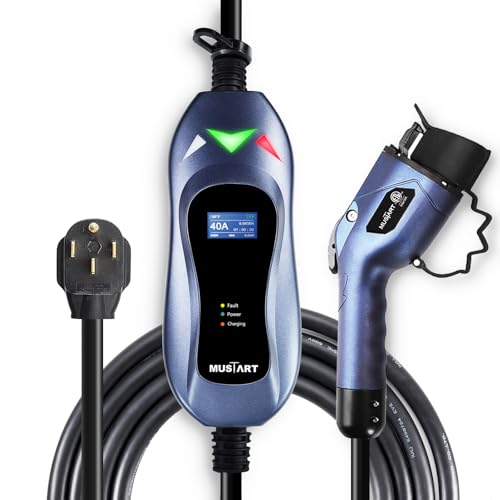
MUSTART
MUSTART 40A Portable, 25 ft Cable
$219.99
If the answer turns out to be a proper 240 volt circuit, this is the endpoint: a 40 amp portable unit on a NEMA 14-50 with a 25 foot cable, delivering 9.6 kW. Roughly seven times a household outlet, and the point at which overnight charging stops being something you think about.
- Output
- 9.6 kW
- Continuous
- 40 A
- Circuit
- 50 A
- Cable
- 25 ft
Trade-off Needs a 50 amp circuit, which is the expensive part of the project rather than the unit.
Check pricePaid links. Prices shown when researched and change without notice.
Who should not spend at this tier
Anyone whose current setup already covers their driving. If you have a plug-in hybrid, or a full electric car and a commute under about 40 miles, and you are waking up to a car that has replaced yesterday's mileage, there is nothing to fix and the correct spend is zero. The most expensive mistake in home charging is not buying too little, it is paying for a 50 amp circuit to solve a problem you did not have.
Renters should also be careful here. Every option in the ceiling tier is licensed electrical work on property you may not own, needs permission you may not get, and stays behind when you leave. In that situation the dual-voltage units in the tier above are the better bet, because they move house with you.
How we chose these chargers
We did not test any of these units in person and we do not claim to. There is no lab here, no instrumented garage and no sample hardware, and for a category where every unit delivers the same 1.4 kW, a claim to have measured a difference would be the least believable thing on the page.
The picks come from published specifications, listed safety certifications and verified owner reviews read in volume. Certification is the first filter and it is not negotiable. A charging cordset is a device that carries a continuous load for twelve hours while lying on a garage floor, and it should carry a UL listing or an ETL listing to the relevant standard. Where a unit is UL listed rather than ETL that is noted, since UL is the stricter and more widely recognised mark and it is a genuine tiebreaker at these prices.
The second filter is honest output. Several listings in this price band advertise amperage figures the unit reaches only at 240 volts while heavily implying it applies at 120, and every figure above is the continuous rating at the stated voltage. The third filter is cable length, because in Level 1 the outlet position was never chosen with a car in mind and a 16 foot cable frequently does not reach. The fourth is the failure pattern in owner reviews, which in this category clusters around plug faces running warm, control boxes failing after a year of outdoor use, and adapters going missing. Prices were accurate when researched and change without notice, and where a product has no verified Amazon listing it appears as a search link rather than an invented one.
Buying tips for 120 volt charging
Measure the cable run before you choose a unit
Stand at the outlet with a tape measure, walk the route the cable will actually take around the car rather than through it, and add three feet. Charge ports sit front left, front right or rear left depending on the model, and a car that parks nose in on Tuesday and backed in on Saturday needs the longer figure. A 25 or 28 foot cable costs nothing extra in this tier and solves the problem permanently.
Replace the receptacle before you blame the charger
A ten dollar commercial-grade receptacle, properly terminated on the screws rather than the backstab holes, is the single best value in Level 1 charging. If the outlet you plan to use is old, loose, painted over or on a circuit shared with something that cycles, having it replaced is cheap and it removes the failure mode that actually happens. That is licensed work, and it takes minutes.
Let the car do the scheduling
None of the units on this page has a meaningful scheduling feature, and none needs one. Every current electric car and plug-in hybrid can be told to start charging inside an off-peak window from its own screen or app. On Level 1 that matters more than it does on Level 2, because a session can run eight or ten hours and may otherwise straddle a peak period at three times the rate.
Do not buy a 40 amp unit for a 15 amp outlet without a plan
A dual-voltage 40 amp unit is a good buy if a 50 amp circuit is genuinely coming. It is a poor buy if it is an intention. Written quotes have a way of turning a plan into a decision, so get one, and if the number surprises you, the 6-20 route in the ceiling tier is often the honest compromise nobody offered.
Keep the original cordset even after you upgrade
The unit that came with the car, or the cheap dual-voltage unit you started with, is worth keeping in the boot once a wall unit is installed. It costs nothing to retain and it covers the case where you are parked at a relative's house for a weekend with a household outlet and no other options.
Where to go next
If you are still deciding whether Level 1 covers your driving, the head-to-head arithmetic is in Level 1 versus Level 2 and the speeds are tabulated in the charging speed chart. If your unit needs to travel as well as sit at home, the adapter and duty-rating questions are covered in the portable charger roundup. And if you want your own numbers rather than a range, put your pack size and your overnight window into the charge time calculator.
Common questions
How many miles per hour does a Level 1 charger add?
Three to five miles of range per hour on a standard household outlet, where the unit draws 12 amps continuously at 120 volts for about 1.4 kW. An efficient sedan sits at the top of that range and a large electric truck at the bottom. On a dedicated 120 volt 20 amp circuit the unit can draw 16 amps instead, which is 1.9 kW and five to seven miles per hour, a genuine 35 percent improvement for the cost of one circuit.
Is Level 1 charging enough for a plug-in hybrid?
Almost always, yes. A plug-in hybrid carries roughly 10 to 18 kWh of usable battery, and 1.4 kW refills that from empty in seven to thirteen hours, comfortably inside an overnight park. Installing a 240 volt circuit for a plug-in hybrid usually buys you a finish time of 1am instead of 5am, which changes nothing you will ever notice. Spend the money on a decent cordset and a good receptacle instead.
Can I use an extension cord with a Level 1 charger?
No. A charging unit draws 12 amps continuously for ten or twelve hours, and that duty cycle is exactly what an extension cord and a power strip are not built for. Undersized cord, a loose plug face or a coiled cord under a rug all turn into heat at the weakest joint. Plug the unit directly into a receptacle in good condition, and if the plug or the wall plate is warm during charging, stop and have the circuit inspected.
Does Level 1 charging damage the battery?
No. Slow AC charging is gentler on a lithium pack than repeated DC fast charging, not harsher, and many manufacturers explicitly prefer it for daily use. The risks with Level 1 are electrical rather than chemical, and they live in the receptacle: a tired outlet on a shared circuit carrying 12 amps for twelve hours a night is the failure mode people actually meet, not battery degradation.
Should I buy a dual-voltage unit or a Level 1 only unit?
Buy dual voltage if there is any realistic chance of a 240 volt circuit within the life of the unit, because the price difference is small and the alternative is buying twice. Buy Level 1 only if you are confident the answer is not changing, for example a plug-in hybrid in a rented garage. A dual-voltage unit with a 6-20 plug is the most flexible position, because a 20 amp 240 volt circuit is a cheap thing to add later.
Do I need an electrician for Level 1 charging?
Not to plug a unit in, but you do to change anything about the circuit. Adding a dedicated 120 volt circuit for the car, replacing a worn receptacle, or installing a NEMA 6-20 for 240 volt charging are all licensed work, a permit and inspection are normally required, and code requirements vary by jurisdiction. It is also worth an electrician looking at the existing outlet if the house is older than the wiring standards you would like it to meet.
Getting your own panel and load numbers ready for an electrician? The EV Home Charging Install Planner is the paid version of these pages: 8 printable worksheets you fill in with your own numbers, plus the full PDF, $29.
How this page was researched
Specifications come from manufacturer documentation, listed safety certifications and verified owner reviews. We do not perform hands-on product testing and never claim to. Figures are researched planning information, not professional electrical advice. Last reviewed 2026-08-17.